Abdominal pain
<languages/> <translate> For pediatric patients see Abdominal pain (peds). See also abdominal pain (geriatrics) and Abdominal pain in pregnancy.
Background
- Patients with immunosuppression often have delayed or atypical presentations
- Fever is not a reliable marker for surgical disease
- Abdominal pain may be particularly misleading in elderly or diabetics
- Consider pain in any abdominal or pelvic region in a female of child-bearing age, including pre-teens, is an ectopic pregnancy until proven otherwise
</translate>
<translate>
Classification by Abdominal pain location
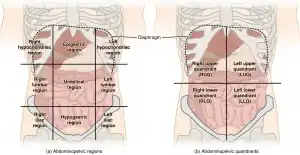
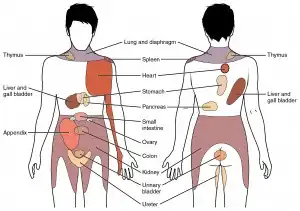
| RUQ pain | Epigastric pain | LUQ pain |
| Flank pain | Diffuse abdominal pain | Flank pain |
| RLQ pain | Pelvic pain | LLQ pain |
</translate> <translate>
Clinical Features
- Abdominal pain (see workup by location)
- May be associated with nausea, vomiting or diarrhea
- Fever may be present in pain from infectious etiology
Differential Diagnosis
</translate>
<translate>
Diffuse Abdominal pain
- Abdominal aortic aneurysm
- Acute gastroenteritis
- Aortoenteric fisulta
- Appendicitis (early)
- Bowel obstruction
- Large bowel obstruction
- Ogilvie's syndrome
- Small bowel obstruction
- Malignant bowel obstruction
- Large bowel obstruction
- Bowel perforation
- Diabetic ketoacidosis
- Gastroparesis
- Hernia
- Hypercalcemia
- Inflammatory bowel disease
- Mesenteric ischemia
- Mesenteric vein thrombosis
- Pancreatitis
- Peritonitis
- Sickle cell crisis
- Spontaneous bacterial peritonitis
- Volvulus
</translate> <translate> </translate>
<translate>
Epigastric Pain
- Gastroesophageal reflux disease (GERD)
- Peptic ulcer disease with or without perforation
- Zollinger-Ellison syndrome
- Gastritis
- Pancreatitis
- Gallbladder disease
- Acute cholecystitis
- Cholangitis
- Symptomatic cholelithiasis
- Acalculous cholecystitis
- Myocardial Ischemia
- Splenic Infarctionenlargement/rupture/aneurysm
- Pericarditis/Myocarditis
- Aortic dissection
- Hepatitis
- Pyelonephritis
- Pneumonia
- Pyogenic liver abscess
- Fitz-Hugh-Curtis Syndrome
- Hepatomegaly due to CHF
- Bowel obstruction
- SMA syndrome
- Pulmonary embolism
- Bezoar
- Ingested foreign body
</translate> <translate> </translate>
RUQ Pain
- Gallbladder disease
- Pancreatitis
- Acute hepatitis
- Pancreatitis
- GERD
- Appendicitis (retrocecal)
- Pyogenic liver abscess
- Bowel obstruction
- Cirrhosis
- Budd-Chiari syndrome
- GU
- Other
- Hepatomegaly due to CHF
- Peptic ulcer disease with or without perforation
- Pneumonia
- Herpes zoster
- Myocardial ischemia
- Pulmonary embolism
- Abdominal aortic aneurysm
<translate> </translate>
Left upper quadrant abdominal pain
- GERD
- Peptic ulcer disease with or without perforation
- Pancreatitis
- Splenic infarction/Splenic artery aneurysm rupture
- Pyelonephritis
- Bowel obstruction
- Myocardial Ischemia
- Pneumonia
- Pulmonary embolism
- Herpes zoster
- Pericarditis/Myocarditis
- Aortic Dissection
<translate> </translate>
<translate>
RLQ Pain
- GI
- Appendicitis
- Perforated appendicitis
- Peritonitis
- Crohn's disease (terminal ileitis)
- Diverticulitis (cecal, Asian patients)
- Inguinal hernia
- Mesenteric ischemia
- Ischemic colitis
- Meckel's diverticulum
- Neutropenic enterocolitis (typhlitis)
- Appendicitis
- GU
- Ectopic
- Endometriosis
- Kidney stone
- Mittelschmerz
- Ovarian cyst
- Ovarian torsion
- PID
- Pyelonephritis
- Other
- Abdominal aortic aneurysm
- Epiploic appendagitis
- Mesenteric lymphadenitis
- Herpes zoster
- Psoas abscess
- Testicular torsion
</translate> <translate> </translate>
LLQ Pain
- Diverticulitis
- Kidney stone
- UTI
- Pyelonephritis
- Ectopic pregnancy
- Infectious colitis
- Inflammatory bowel disease (Crohn's Disease, Ulcerative Colitis)
- Inguinal hernia
- Mesenteric ischemia
- Epiploic appendagitis
- Mittelschmerz
- Ovarian cyst
- Ovarian torsion
- PID
- Psoas abscess
- Testicular torsion
- Appendicitis
- Abdominal aortic aneurysm
- Herpes zoster
- Endometriosis
- Colon cancer
- Irritable bowel syndrome
- Small bowel obstruction
<translate> </translate>
Acute Pelvic Pain
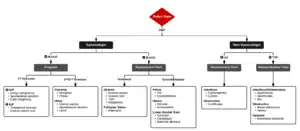
Gynecologic/Obstetric
- Normal variants may be noted on exam but generally do not cause pain or other symptoms
- Nabothian cysts: Epithelial cells within mucous glans that appear as yellow inclusions on the cervix
- Cervical Ectropion: Edothelial cells on the exterior of the cervix
- Parous cervix: The is no longer round but may have multiple shapes after birth
- Pregnancy-related
- Ectopic pregnancy
- Spontaneous abortion, threatened or incomplete
- Septic abortion
- Pelvic organ prolapse
- Acute Infections
- Vulvovaginitis
- Adnexal Disorders
- Hemorrhage/rupture of ovarian cyst
- Ovarian torsion
- Twisted paraovarian cyst
- Other
- Myoma (degenerating)
- Genitourinary trauma
- Ovarian hyperstimulation syndrome
- Sexual assault
- Recurrent
- Mittelschmerz
- Primary/Secondary Dysmenorrhea
- Pelvic Congestion Syndrome
- Endometriosis
Genitourinary
Gastrointestinal
- Gastroenteritis
- Appendicitis
- Bowel obstruction
- Perirectal abscess
- Diverticulitis
- Inflammatory bowel disease
- Irritable bowel syndrome
- Mesenteric adenitis
Musculoskeletal
- Abdominal wall hematoma
- Psoas hematoma, psoas abscess
- Hernia
Vascular
- Pelvic thrombophlebitis
- Abdominal aortic aneurysm
- Ischemic bowel (Mesenteric Ischemia)
<translate> </translate>
Extra-abdominal Sources of Abdominal pain
- MI
- Aortic Dissection
- PNA
- PE
- Testicular Torsion
- Herpes Zoster
- Muscle spasm
- Spinal pathology
- Strep Pharyngitis (peds)
- Mononucleosis
- DKA
- ETOH Ketoacidosis
- Uremia
- Sickle Cell Crisis
- SLE
- Vasculitis
- Glaucoma
- Hyperthyroidism
- Methanol Poisoning
- Heavy Metal toxicity
- Addison's disease
- Porphyria
- Paroxysmal nocturnal hemoglobinuria
- Black widow spider bite
<translate>
Evaluation
- Pregnancy test in all females of childbearing age — this is mandatory
- Vitals: Tachycardia and hypotension suggest serious pathology (hemorrhage, sepsis, perforation)
- Point-of-care ultrasound: FAST exam (free fluid), RUQ (gallbladder), aorta (AAA), renal (hydronephrosis)
- Workup is by location:
- RUQ pain
- RLQ pain
- Epigastric pain
- LUQ pain
- LLQ pain
- Diffuse abdominal pain
- Flank pain
Management
- Pain control: Do not withhold analgesia — multiple studies confirm it does not mask surgical findings[2]
- Ketorolac 15-30 mg IV, acetaminophen 1g IV, or opioids for severe pain
- Antiemetics: Ondansetron 4 mg IV for nausea/vomiting
- IVF: Fluid resuscitation for dehydrated or hemodynamically unstable patients
- NPO: If surgical abdomen suspected
- Antibiotics: Early if infection suspected (sepsis, perforated viscus, appendicitis)
- Surgical consultation: Emergent for peritonitis, perforation, ischemic bowel, ruptured AAA, ruptured ectopic
- Treat underlying cause
Disposition
- Admit: Surgical abdomen, hemodynamic instability, intractable pain/vomiting, inability to tolerate PO, suspected serious pathology requiring observation or further workup
- Discharge: Benign exam with improvement after treatment, reliable follow-up, clear return precautions (worsening pain, fever, vomiting, inability to tolerate PO)
- The two most notoriously missed conditions are appendicitis and small bowel obstruction.[3]. When discharging patients with abdominal pain, clear instructions should be given for return if there are red flags.
See Also
- Abdominal Pain (Geriatrics)
- Abdominal Pain (Peds)
- Abdominal Trauma
- Abdominal pain in pregnancy
- Pelvic Pain
References
- ↑ Norris DL, Young JD. UTI. EM Clin N Am. 2008; 26:413-30.
- ↑ Ranji SR, et al. Do opiates affect the clinical evaluation of patients with acute abdominal pain? JAMA. 2006;296(14):1764-74.
- ↑ Macaluso CR and McNamara RM. Evaluation and management of acute abdominal pain in the emergency department. Int J Gen Med. 2012; 5: 789–797. https://www.ncbi.nlm.nih.gov/pmc/articles/PMC3468117/
</translate>