Armed spider bite
Background[1]
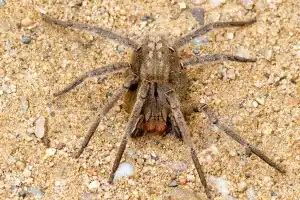
- Identification: Brown gray with white spots forming a longitudinal band on the dorsal abdomen and a red-brown brush of hair on the chelicerae. Large in size (4.5-6cm) with 4-5mm fangs.
- They do not form webs, but rather are mobile nocturnal hunters
- among the largest and most aggressive spiders in South AmericaHabitat restricted to South America, largely Brazil, Argentina, and Uruguay.
- Genus: Phoneutria
- The best-known representative is P. nigriventer, the Brazilian Wandering Spider
Venom
- A complex mixture of polypeptide components. Neurotoxicity is the most clinically relevant.
- Histamine and other components potentiate localized swelling and vascular permeability
- Several neurotoxic components that activate sodium channels, potentiating action potentials and causing uncontrolled muscle contractions.
Clinical Features
- Initial intense pain that radiates to the trunk
- Within 10-20 minutes, onset of systemic toxicity
- Tachycardia
- Hypertension
- Profuse diaphoresis,
- Salivation
- Vertigo
- Visual disturbances
- Nausea and vomiting
- Priapism
- Death has been reported, particularly in children and frail adults, from respiratory paralysis
- Most recover in 24-48hours
Differential Diagnosis
<translate>
Envenomations, bites and stings
- Hymenoptera stings (bees, wasps, ants)
- Mammalian bites
- Closed fist infection (Fight bite)
- Dog bite
- Marine toxins and envenomations
- Toxins (ciguatera, neurotoxic shellfish poisoning, paralytic shellfish poisoning, scombroid, tetrodotoxin
- Stingers (stingray injury)
- Venomous fish (catfish, zebrafish, scorpion fish, stonefish, cone shells, lionfish, sea urchins)
- Nematocysts (coral reef, fire coral, box jellyfish, sea wasp, portuguese man-of-war, sea anemones)
- Phylum porifera (sponges)
- Bites (alligator/crocodile, octopus, shark)
- Scorpion envenomation
- Reptile envenomation
- Snake bites
- Crotaline (Pit Vipers)
- Elapidae (Coral Snakes)
- Lizard bites
- Snake bites
- Spider bites
- Black widow
- Brown recluse
- Tarantula
- Funnel-web spider bite
- Armed spider bite
</translate>
Evaluation
- Generally a clinical diagnosis
Management
- Largely Supportive Care
- Pain Control
- Local anesthetic infiltration at site of the bite is effective in 95% of cases
- Opioids are discouraged as they may potentiate respiratory depression in severe envenomation
- Pain Control
- Antivenom
- Polyvalent and Monovalent formulations available
- Skin testing and antihistamine prophylaxis recommended prior to use
- 1-5 vials given IV or IM
- Clinical response judged by relief of pain or resolution of priapism
- Polyvalent and Monovalent formulations available
Disposition
- May discharge those with no systemic symptoms after period of ED observation
- Admit patients with signs or symptoms of systemic toxicity
See Also
References
- ↑ Leslie V. Boyer, Greta J. Binford, Janice A. Degan. Spider Bites. Paul S. Auerbach. In: Auerbach’s Wilderness Medicine. 7th Ed. 2017: 1010-1011.