Blunt neck trauma
Background
- Suspect vascular damage to cord, if discrepancy between neuro deficit and level of spinal column injury
- Spinal cord injury is more likely if anterior (vertebral bodies) AND posterior (spinal canal) columns are disrupted
Clinical Features
- Signs of life-threatening neck or upper thoracic injury (look for TWELVE):
- Tracheal deviation
- Wounds
- External markings
- Laryngeal disruption
- Venous distention
- Emphysema (surgical)
- Features may include signs and symptoms of:
Pediatrics
- In a small study of 42 patients with a cervical seatbelt sign there were no isolated cerebrovascular injuries. For pediatric patients in a motor vehicle collision, the presence of an isolated seatbelt sign was not associated with any cases of cerebrovascular injury. [1]
Differential Diagnosis
<translate>
Neck Trauma
- Penetrating neck trauma
- Blunt neck trauma
- Blunt cerebrovascular injury (BCVI)
- Vertebral artery dissection
- Carotid artery dissection
- Blunt laryngeal trauma
- Whiplash injury
- Blunt cerebrovascular injury (BCVI)
- Strangulation
- Hanging and near-hanging
- Cervical spine injury
- Cervical fractures and dislocations
- Atlanto-occipital dissociation
- Cervical injury (peds)
- Cervical spine clearance
- Spinal cord injury
- Spinal cord injury
- Incomplete spinal cord syndromes
- Central cord syndrome
- Anterior cord syndrome
- Brown-Séquard syndrome
- SCIWORA
- Neurogenic shock
</translate>
Other
Evaluation
General Approach
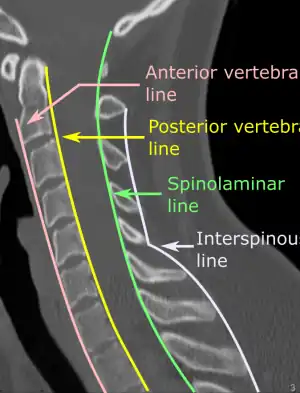
- If concern for cervical spine injury, use a cervical spine clearance decision rule to determine need for imaging
- Perform a neuro exam, to determine concern for spinal cord injury
- If concern for vascular injury, use the Denver screening criteria
Workup
- Use cervical spine clearance to evaluate for bone/cord injury with consideration of x-ray or non-contrast cervical CT (see below)
- May later consider cervical MRI to further evaluate for cord injury
- Use Denver Screening Criteria if concerned for anterior neck trauma and consider CTA neck with contrast to evaluate for vascular injury (see below)
Denver screening criteria for blunt cerebrovascular injury
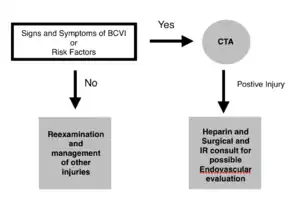
The Denver Screening Criteria are divided into risk factors and signs and symptoms
Signs and Symptoms
- Arterial hemorrhage
- Cervical bruit
- Expanding neck hematoma
- Focal neurologic deficit
- Neuro exam inconsistent with head CT
- Stroke on head CT
<translate>
NEXUS Cervical Spine Rule
Radiography is not necessary if the patient satisfies ALL of the following low risk criteria:
- No midline cervical tenderness
- No focal neuro deficits
- Normal alertness
- No intoxication
- No painful distracting injury
C-spine imaging should be considered unless the patient meets all of the above low risk criteria[2] [3] </translate>
Management
- Prehospital
- Hospital
- Secure ABCs
- See cervical spine clearance
- See specific diagnosis
Disposition
- Based on specific diagnosis
See Also
- Penetrating neck trauma
- Cervical spine clearance
- Canadian cervical spine rule
- NEXUS cervical spine rule
- Strangulation
- Vertebral and carotid artery dissection
External Links
References
- ↑ Desai NK, et al. Screening CT angiography for pediatric blunt cerebrovascular injury with emphasis on the cervical “seat- belt sign.” AJNR Am J Neuroradiol. 2014 Sep;35(9):1836-40. PMID: 24722311.
- ↑ 27. Hoffman JR, et al. Low-risk criteria for cervical-spine radiography in blunt trauma: a prospective study. Ann Emerg Med 1992;21:1454-60.
- ↑ Mahadevan, et al. Interrater reliability of cervical spine injury criteria inpatients with blunt trauma. Ann Emerg Med1998;31:197-201