Bulging fontanelle
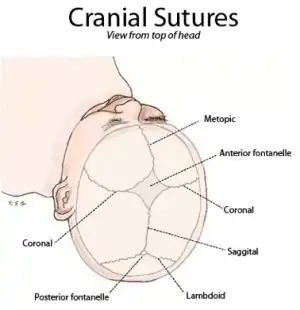
Background Neonatal suture anatomy. Fontanelles are fibrous, membrane-covered gaps between cranial bones[ 1]
A newborn has six fontanelles: anterior, posterior, two mastoid, and two sphenoid
Anterior and posterior are the most prominent
The posterior fontanelle usually closes by 1-2 months of age
The anterior fontanelle usually closes between 7-19 months of age
A bulging fontanelle represents increased intracranial pressure , which may be transient and either benign or malignant
Key EM concern: meningitis is the most critical diagnosis to rule out in a febrile infant with a bulging fontanelle[ 2]
Meticulous history and physical is essential to guide management Clinical Features Normal Fontanelle Soft, flat, or slightly concave when infant is upright and calm
May briefly bulge with crying, coughing, or Valsalva maneuver — this is normal and transient
Sunken fontanelle suggests dehydration Abnormal (Bulging) Fontanelle Tense, convex, non-pulsatile fontanelle when infant is calm and upright
May feel firm or "full" to palpation
Assess with infant calm and in upright position (crying and supine position can cause false bulging) Associated Findings Fever + bulging fontanelle → meningitis until proven otherwise
Irritability, high-pitched cry, poor feeding, vomiting
Lethargy, altered mental status, seizures (late signs)
"Sunset" eyes (downward gaze deviation — hydrocephalus)
Split sutures, rapidly increasing head circumference (increased ICP, hydrocephalus)
Bruising, retinal hemorrhages → consider NAT
Papilledema (though difficult to assess in infants) Red Flags Fever + bulging fontanelle (meningitis — requires LP)
Altered mental status or seizures
Rapidly enlarging head circumference
Signs of non-accidental trauma (bruises, retinal hemorrhages)
Focal neurologic deficits
Apnea or bradycardia Differential Diagnosis Infectious (Most Urgent) Increased ICP Metabolic/Endocrine Other Benign/Transient Crying, Valsalva, supine positioning (normal variant — resolves when calm and upright) Evaluation Assessment Examine fontanelle with infant calm and upright
Head circumference and comparison to prior measurements
Full neurologic exam (tone, reflexes, mental status)
Fundoscopic exam if possible (retinal hemorrhages → NAT)
Assess vital signs including temperature Standard Approach Head CT (non-contrast): evaluate for hemorrhage, hydrocephalus, mass, edema
Obtain before LP if concern for mass lesion or elevated ICP LP Opening pressure, CSF cell count, glucose, protein, Gram stain, culture
Send viral studies if encephalitis suspected
Consider HSV PCR in neonates CBC , BMP , blood culturesBlood glucose
Consider metabolic workup if no infectious or structural cause identified When to Obtain Imaging Before LP Focal neurologic deficits
Papilledema
Signs of severely elevated ICP (altered mental status, bradycardia, hypertension)
History of shunt (shunt malfunction)
History of CNS disease or mass Management Treat underlying pathology
Suspected meningitis: empiric antibiotics should NOT be delayed for imaging or LP
Elevated ICP: see Management of Elevated Intracranial Pressure
Head of bed elevation 30 degrees
Neurosurgical consultation for hydrocephalus or mass
Herpes encephalitis: IV acyclovir — start empirically in neonates with any suspicion
Intracranial hemorrhage: neurosurgical consultation, correct coagulopathy Disposition Admit All infants with bulging fontanelle + fever (pending LP results and cultures)
Suspected meningitis or encephalitis
Intracranial hemorrhage or mass
New hydrocephalus
Non-accidental trauma (also alert child protective services)
Altered mental status or seizures Discharge Discharge is rare — only if clearly benign and transient cause identified (e.g., post-vaccination in well-appearing infant with normal exam)
Must have reliable caregivers and immediate return access
Return precautions: fever, poor feeding, irritability, vomiting, seizure, lethargy See Also References
↑ Kiesler J, Ricer R. The abnormal fontanel. Am Fam Physician. 2003 Jun 15;67(12):2547-52. PMID 12825844
↑ Freedman SB, et al. Transient bulging fontanelle after vaccination: case report and review of the vaccine adverse event reporting system. J Pediatr. 2005 Nov;147(5):640-4. PMID 16291356