Chalazion
Background
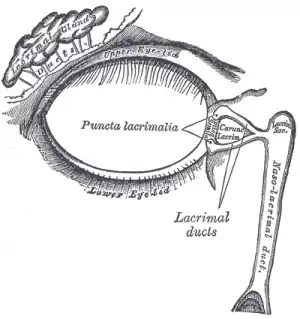 Anterior view of the right eye, with lacrimal duct shown medial.
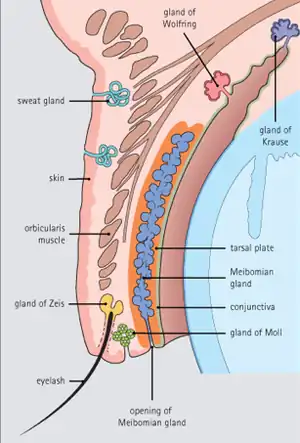
- Chronic, sterile, granulomatous inflammatory lesion from blockage of a meibomian (or Zeis) gland
- Also known as meibomian gland lipogranuloma
- Often develops from a healing hordeolum (stye)
- More common on upper eyelid (higher density of meibomian glands)
- Risk factors: blepharitis, rosacea, seborrheic dermatitis
Clinical Features
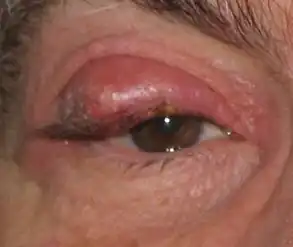 Chalazion of right eye
- Eyelid swelling initially may be tender, evolving into a painless, rubbery, well-circumscribed nodule
- Not erythematous or warm (unlike acute hordeolum)
- Points toward conjunctival surface (can see on lid eversion)
- May cause astigmatism or visual disturbance if large enough to compress the cornea
- Key distinction from hordeolum: Chalazion is painless and chronic; hordeolum is acute, tender, and often has a pointing pustule
Differential Diagnosis
Proptosis
No proptosis
Lid Complications
Other
Evaluation
- Clinical diagnosis — no imaging or labs needed
- Evert eyelid to visualize the granuloma from the conjunctival side
Management
- Discontinue eye makeup and contact lenses until resolved
- Warm compresses × 15 minutes QID with gentle eyelid massage
- Antibiotics are NOT indicated (this is a granulomatous condition, not an infection)
- Eyelid hygiene with dilute baby shampoo scrubs
- Most resolve spontaneously over weeks to months
- Persistent cases: ophthalmology referral for intralesional steroid injection or incision and curettage
Disposition
- Discharge with warm compress instructions
- Ophthalmology referral if persistent >6 weeks, recurrent, or concern for malignancy
See Also
References