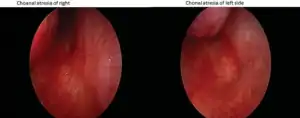
Nasal endoscopic view of posterior choanae, depicting complete atresia bilaterally.
Obliteration or blockage of the posterior nasal aperture
Incidence is between 1:5000 and 1:8000 live births
Approximately 60% of cases are unilateral
More common in girls than in boys
Clinical Features
Clinical presentation will depend on if unilateral or bilateral
Unilateral
Typically present later in life
Commonly with purulent nasal discharge and obstruction on the affected side and/or a history of chronic sinusitis
Rarely will present with respiratory distress
Bilateral
Typically will present in early life with episodes of acute respiratory distress with cyanosis that is relieved with crying and with the return of cyanosis with rest (paradoxical cyanosis)
May present with feeding difficulty, as they are unable to breathe and feed simultaneously
May be an isolated anomaly or associated with a congenital anomaly syndrome (e.g. Treacher-Collins, CHARGE, VACTERL/VATER, Pfeiffer)
Other congenital anomalies are in present in 50% of individuals with unilateral choanal atresia and 60% of individuals with bilateral choanal atresia
Examiner can attempt to pass a 5 or 6 fr catheter from the nose to the oropharynx, alternatively the examiner can use a qualitative measure of nasal airflow (i.e. the movement of a wisp of cotton under the nostrils, fogging of a mirror)
Diagnosis is confirmed with CT imaging with intranasal contrast
Ideally diagnosis of this condition should be done immediately after birth
A thorough physical exam should also be performed to detect associated anomalies
Management
Unilateral
Generally does not require emergent surgical repair, but respiratory status should be carefully considered.
Nasal saline can be helpful for keeping the nasal route clear
Bilateral
If presenting with respiratory distress, individuals require immediate airway management, either with an oral airway or endotracheal intubation [1]