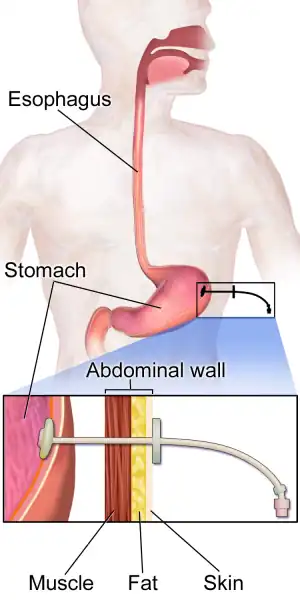
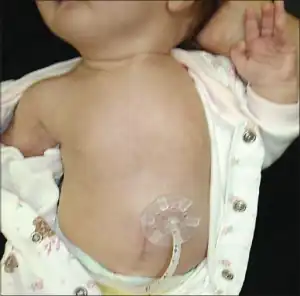
Attempts should not be made to clear tube if uncertain position/integrity of tube
Management
Mechanical Interventions
Attempt to milk back cheesy precipitants, if the tube is pliant
Gentle back-and-forth flushing with saline: be patient, continue pumping back and forth (even if you feel no forward flow or change) for a few minutes
This will often dislodge just enough residue to allow for a proper flush
Use guidewire or small stylet in proximal tube
Do not attempt to clear subcutaneous portion of tube with guidewire or stylet secondary to to risk of puncture of tube, injure the pt, or create a tube leak.
Use fogarty catheter to clear obstruction
Use a No 4 embolectemy cath for a 10-12F tube or a No 5 embolectemy cath for a 14F tube
Insert until obstruction met, then inflate and deflate and then continue insertion. Stop insertion just proximal to internal opening of feeding tube. Inflate and deflate while withdrawing catheter. Repeat as necessary.
Do not withdraw with balloon inflated because the tube and catheter will move together as a unit
Confirm position/integrity of tube with contrast radiography after procedure
Attempt to flush with warm water
The smaller the syringe used, the greater the force that can be applied (pascal's principle)
Catheters are prone to aneurysm and rupture (especially Broviaks) therefore, always confirm tube integrity with contrast radiography if this method is used
Pharmacologic Interventions
Coca-cola has not been shown to be superior to water and may result in precipitants and further blockage
Meat tenderizer and cranberry juice no better than warm water
Use commercially available declogger (Bionix), Clog Zapper
Use catheter to instill pancreatic enzymes and allow 30-60 minutes to dissolve obstruction, then flush with water[1]
Crush 1 pancrelipase tab (lipase, amylase, protease) to fine powder
Crush 1 non-enteric sodium bicarbonate 324mg tab to fine powder
Dissolve powder mix in 5 cc warm water to achieve activated pancrelipase ~pH 8 sln
Complications
Catheter perforation, aneurysm, or displacement
Internal catheter leak
Stomach perforation
Imaging
Ensure patency and placement with KUB with 20-30ml of water soluble contrast (ie gastrografin) post flushing
External Links
Disposition
Discharge if:
G-tube successfully unclogged and functioning
Patient tolerating feeds
Caregiver able to manage at home
Admit for:
Unable to unclog tube and requires replacement
Signs of peritonitis or tube dislodgement with peritoneal contamination
Dehydration or electrolyte abnormalities from prolonged inability to feed
See Also
G-tube complications
References
↑Williams NT. Medication Administration Through Enteral Feeding Tubes. Am J Health Syst Pharm. 2008;65(24):2347-2357.