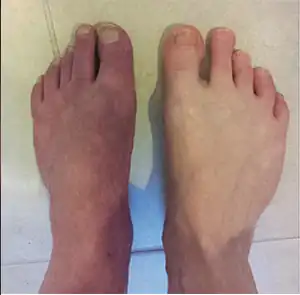
Disorder of the extremities characterized by regional pain that is disproportionate in time or degree to the usual course of any known trauma or other lesion
Pain is not in a specific nerve territory or dermatome
Pain usually has a distal predominance of abnormal sensory, motor, sudomotor, vasomotor, and/or trophic findings
CRPS often worsens over time
35% of patients report symptoms throughout their whole body.[1]
Sub-Types
Type I
NO evidence of peripheral nerve injury (edema, erythema, numbness), 90% of clinical presentations
Type II
YES evidence of peripheral nerve injury, considered more serve type
Causes
Generally unknown
Inciting event
Found in about 90% of cases - usually begin 4-6wks after fractures, crush injuries, sprains, and surgery.[2]
Proposed mechanisms
Classic inflammation, neurogenic inflammation, and maladaptive changes in pain perception at the level of the central nervous system
↑Schwartzman RJ, Erwin KL, Alexander GM (May 2009). "The natural history of complex regional pain syndrome". The Clinical Journal of Pain. 25 (4): 273–80. doi:10.1097/AJP.0b013e31818ecea5. PMID 19590474.
↑Sandroni P, Benrud-Larson LM, McClelland RL, Low PA. Complex regional pain syndrome type I: incidence and prevalence in Olmsted county, a population-based study. Pain 2003; 103:199.