Background Cyanotic
Acyanotic
Differentiation by pulmonary vascularity on CXR[ 1] Increased pulmonary vascularity
Decreased pulmonary vascularity
Clinical Features
Clinical Presentation
Causative Conditions in Neonates
Causative Conditions in Infants and Children
Cyanosis
Transposition of the great arteries, TOF , tricuspid atresia, truncus arteriosus , total anomalous pulmonary venous returnTOF, Eisenmenger complex
Cardiovascular shock Critical aortic stenosis , coarctation of the aorta , HLHS
Coarctation of the aorta (infants)
Congestive heart failure Rare: PDA, HLHS
PDA , VSD , ASD , atrioventricular canal
Murmur PDA , valvular defects (AS, PS)VSD , ASD , PDA , outflow obstructions, valvular defects (AS, PS)
Syncope —
AS, PS, Eisenmenger complex
Hypertension —
Coarctation of the aorta
Arrhythmias —
ASD , Ebstein anomaly, postsurgical complication after repair of congenital heart defect
Differential Diagnosis THE MISFITS [ 2]
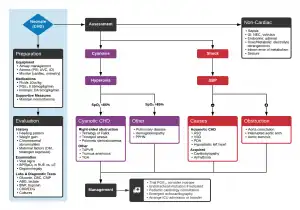
Evaluation Algorithm for the Evaluation and Management of Suspected Congenital Heart Disease in Neonates Cyanotic
Cardiac Lesion
Chest Radiograph
ECG
Tetralogy of Fallot Boot-shaped heart, normal-sized heart, decreased pulmonary vascular markings
Right axis deviation, right ventricular hypertrophy
Transposition of the great arteries Egg-shaped heart, narrow mediastinum, increased pulmonary vascular marking
Right axis deviation, right ventricular hypertrophy
Total anomalous pulmonary venous return Snowman sign, significant cardiomegaly, increased pulmonary vascular markings
Right axis deviation, right ventricular hypertrophy, right atrial enlargement
Tricuspid atresia Heart of normal to slightly increased size, decreased pulmonary vascular markings
Superior QRS axis with right atrial hypertrophy, left atrial hypertrophy, left ventricular hypertrophy
Truncus arteriosus Cardiomegaly, increased pulmonary vascular markings
Biventricular hypertrophy
Can use the "5 T's' mnemonic:[ 3] 1 vessel: Truncus arteriosus
2 vessels switched: Transposition of the great vessels
3=TRIcuspid: Tricuspid atresia
4 defects: Tetralogy of Fallot
5 letters: Total anomalous pulmonary vascular return (TAPVR) Acyanotic (duct-dependent)
Coarctation of the aorta
Cardiomegaly with pulmonary edema (neonate)
RVH, right bundle-branch block (neonate)
Rib notching and collateral vascularity (child)
LVH (child)
Hypoplastic left heart syndrome Cardiomegaly
Right atrial enlargement, RVH, peaked P waves
Aortic stenosis
Cardiomegaly
LVH in severe cases
Acyanotic non-duct dependent (i.e. CHF)
Atrial septal defect Cardiomegaly with increased vascular markings
Right axis deviation, RVH , RBBB
VSD Cardiomegaly with increased vascular markings
LAH , LVH , (RVH with larger VSDs)
PDA Cardiomegaly with increased vascular markings
LVH , RVH with larger PDAs
Endocardial cushion defect
Cardiomegaly with increased vascular markings
Superior QRS axis with RVH , RBBB , LVH , prolonged PR interval
Anomalous origin of the left coronary artery
Cardiomegaly
Abnormally deep and wide Q waves with precordial ST segment changes
Management Shock (duct-dependent lesion)Knee chest position
Increased venous return to heart, increased SVR (decreased R>L shunting)
O2
Morphine or NS to increase preloadSodium bicarbonate 2mEq/kg IV bolus (promotes vasodilation)Propranolol 0.2mg/kg IV (relieves infundibular spasm)Phenylephrine 2-10mcg/kg/min to increased SVRThrombolysis for Surgical Shunt Obstruction Blalock-Taussig shunt should maintain flow murmur
Loss of flow murmur alongside profound hypoxia relative to baseline saturations should prompt consideration for shunt obstruction
Definitive treatment is surgical, but systemic recombinant tPA may be considered as salvage intervention when other options are not readily available[ 4] Heparin bolus 50-100 u/kg
Notify cardiology, CT surgeon, ECMO
0.01 mg/kg bolus r-tPA, then 0.03 - 0.06 mg/kg/hr Disposition Medication Dosing Prostaglandin E1 0.1mcg/kg/min IV/IO IV/IO
Propranolol 0.2mg/kg IV IV
Phenylephrine 2-10mcg/kg/min IV infusion IV
See Also References
↑ Knipe K et al. Cyanotic congenital heart diseases. Radiopaedia. http://radiopaedia.org/articles/cyanotic-congenital-heart-disease
↑ Brousseau T, Sharieff GQ. Newborn emergencies: the first 30 days of life. Pediatr Clin North Am. 2006 Feb;53(1):69-84, vi.
↑ Waldman JD, Wernly JA. Cyanotic congenital heart disease with decreased pulmonary blood flow in children. Pediatr Clin North Am. 1999;46(2):385-404. doi:10.1016/s0031-3955(05)70125-5
↑ Diaz F et al. Systemic thrombolysis with recombinant tissue plasminogen activator for acute life-threatening Blalock-Taussig shunt obstruction. Indian J Crit Care Med. 2016 Jul; 20(7): 425–427.