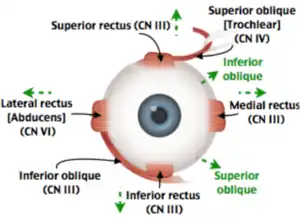
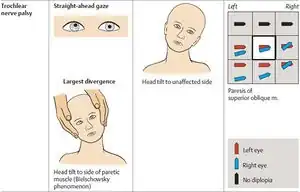
Worse on downward gaze and gaze away from affected muscle [2]
Head-tilt
Tilt typically away from affected side (~70%) to overcome inward rotation of affected eye to create wider separation of images. Can be paradoxical, where patient tilts head toward affected side (~3%) [1][4]
Bielschowsky phenomenon - head tilt to affected side reveals inability to intort, diplopia
Trauma: Its long course makes it susceptible to traumatic injury. Head trauma (adult) is the second most common cause. Is generally severe with loss of consciousness. Consider underlying structural abnormalities if results after minor trauma.
Head CT if traumatic, suspect stroke, or subarachnoid hemorrhage (rare).
MRI is study of choice, although there no increased yield from MRI vs CT scan. [2][4]
Management
Address underlying acute pathology
May require surgical correction
+/- Neurology consult
Disposition/Follow-up
Vasculopathic: Observation for improvement over 6-8 weeks. Often resolve spontaneously in 4-6 months.
Traumatic: Observation for improvement over 6-8 weeks. Often resolves spontaneously. If progressing or lack of improvement – neuroimaging with MRI
Isolated, idiopathic cases very rarely have an underlying etiology after prolonged follow-up, and most resolve spontaneously in weeks to months. If no improvement in 2 months, consider neuroimaging. [4]
Disposition
Admit for:
Traumatic fourth nerve palsy with other injuries
Associated neurologic deficits suggesting central pathology
Discharge with outpatient ophthalmology/neurology follow-up for:
Isolated fourth nerve palsy with normal imaging
Microvascular fourth nerve palsy in patients with vascular risk factors
Provide prism glasses referral if symptomatic diplopia
↑ 2.02.12.22.3Sheik Z. Trochlear Nerve Palsy Treatment and Management on emedicine.medscape.com/article/1200187 Accessed on 8/29/2015
↑Disorders of Ocular Movement and Pupillary Function In: Adams and Victor's Principles of Neurology. 10th ed. Accessed on AccessMedicine.com on 8/29/2015. Chapter 14
↑ 4.04.14.24.34.4Brazis, PW. Isolated palsies of cranial nerves III, IV, and VI. Seminars in neurology. 2009 Feb. 29(1):14