Funnel-web spider bite
Background
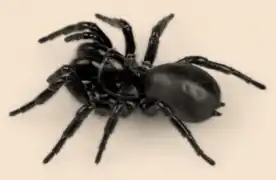
- Identification: Glossy black cephalothorax and velvety black abdomen, often with reddish hairs.[1]
- Females grow up to 4cm in length, whereas males are smaller and more delicate.
- Females dig a funnel shaped burrow under rocks, logs or building foundation and rarely stray, whereas males wander after reaching maturity and may enter buildings
- Aggressive behavior, 4-5mm fangs which can penetrate a chicken skull, and potent venom make these among the deadliest spiders in the world.
- Genus: Atrax and Hadronyche[2]
- The most clinically relevant species are restricted to Eastern Australia near Sydney and the central coast region of New South Wales and adjacent Blue Mountains.[3]
Venom
- Components of the venom include Atraxotoxin and Robustoxin which appear to induce widespread neurotransmitter release, resulting in neuromuscular and autonomic stimulation.
Clinical Features
- 90% of bites will not involve significant envenomation.
- Local Symptoms:
- Intense pain, wheal with erythema at injection site, localized sweating with piloerection,
- Lasts for 30min
- Is not thought to produce skin necrosis
- Systemic Symptoms
- Earliest: Perioral tingling, diaphoresis, nausea/vomiting, salivation, and lacrimation.
- Severe:
- Pulmonary edema with dyspnea
- Peripheral neuromuscular syndrome including fasciculations, tremors, and spasms
- Impaired consciousness
- Death due to pulmonary edema, hypotension, or cardiac arrest
Differential Diagnosis
<translate>
Envenomations, bites and stings
- Hymenoptera stings (bees, wasps, ants)
- Mammalian bites
- Closed fist infection (Fight bite)
- Dog bite
- Marine toxins and envenomations
- Toxins (ciguatera, neurotoxic shellfish poisoning, paralytic shellfish poisoning, scombroid, tetrodotoxin
- Stingers (stingray injury)
- Venomous fish (catfish, zebrafish, scorpion fish, stonefish, cone shells, lionfish, sea urchins)
- Nematocysts (coral reef, fire coral, box jellyfish, sea wasp, portuguese man-of-war, sea anemones)
- Phylum porifera (sponges)
- Bites (alligator/crocodile, octopus, shark)
- Scorpion envenomation
- Reptile envenomation
- Snake bites
- Crotaline (Pit Vipers)
- Elapidae (Coral Snakes)
- Lizard bites
- Snake bites
- Spider bites
- Black widow
- Brown recluse
- Tarantula
- Funnel-web spider bite
- Armed spider bite
</translate>
Evaluation
- Generally a clinical diagnosis
Management
- Pressure Immobilization Dressing
- Wrap the length of the bitten extremity with an elastic bandage
- Splint the extremity in neutral position to immobilize
- Immobilize victim and transport to medical care
- If a patient presents with a tourniquet or pressure immobilization dressing, obtain IV access for potential resuscitation before removing.
- Supportive Care
- O2, mechanical ventilation if needed
- Gentle IV fluids
- Atropine for sialorrhea bronchorrhea
- Antivenom
- Specific IgG antivenom has been developed by Commonwealth Serum Laboratories
- Empiric treatment with 2 amps (100mg/amp) of IgG in the setting of systemic signs/symptoms
- 2amps repeated Q15 min until symptom resolution occurs
- 2-8amps total dose reported
- No difference in dosing between adults and peds.
- No adverse effects reported in 40 patients over 10 years
Disposition
- May discharge those without systemic signs after period of ED observation
- Admit those with systemic signs or requiring antivenom
See Also
External Links
References
- ↑ Leslie V. Boyer, Greta J. Binford, Janice A. Degan. Spider Bites. Paul S. Auerbach. In: Auerbach’s Wilderness Medicine. 7th Ed. 2017: 1002-1003.
- ↑ Leslie V. Boyer, Greta J. Binford, Janice A. Degan. Spider Bites. Paul S. Auerbach. In: Auerbach’s Wilderness Medicine. 7th Ed. 2017: 1002-1003.
- ↑ Leslie V. Boyer, Greta J. Binford, Janice A. Degan. Spider Bites. Paul S. Auerbach. In: Auerbach’s Wilderness Medicine. 7th Ed. 2017: 1002-1003.