Hepatitis A
<languages/> <translate>
Background
- Transmission by
- Fecal-oral route
- Most commonly transmitted from asymptomatic children to adults
- Can also occur with improper food handling, oyster consumption
Clinical Features

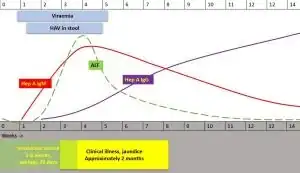
- Incubation period 15-50 days
- Prodrome of nausea/vomiting, malaise
- ~1 week into illness, may have dark urine (bilirubinuria), clay-colored stools, jaundice
- No chronic component
- Can cause aversion to tobacco among smokers
- ~1-2% of HAV infections in adults lead to fulminant hepatic failure
- Death from hepatic failure is rare
Differential Diagnosis
</translate>
<translate>
Causes of acute hepatitis
- Acetaminophen toxicity (most common cause of acute liver failure in the US[1])
- Viral hepatitis
- Hepatitis A
- Hepatitis B
- Hepatitis C
- Hepatitis D
- Hepatitis E
- HSV
- Epstein-Barr virus
- Varicella zoster virus
- Toxoplasmosis
- Acute alcoholic hepatitis
- Toxins
- Mushroom toxicity
- Crotinarius mushrooms
- Gyromitra mushrooms
- Amanita mushrooms
- Ischemic hepatitis
- Autoimmune hepatitis
- Wilson's disease
</translate> <translate>
Evaluation
</translate>
<translate>
Interpreting Acute Hepatitis Panel Results
| Anti-hepatitis A, IgM | Hepatitis B surface antigen | Anti-hepatitis B core, IgM | Anti-hepatitis C | Interpretation |
|---|---|---|---|---|
| Positive | Negative | Negative | Negative | Acute hepatitis A |
| Negative | Positive | Positive | Negative | Acute hepatitis B |
| Negative | Positive | Negative | Negative | Chronic hepatitis B infection |
| Negative | Negative | Positive | Negative | Acute hepatitis B; quantity of hepatitis B surface antigen is too low to detect |
| Negative | Negative | Negative | Positive | Acute or chronic hepatitis C; additional tests are required to make the determination |
</translate> <translate>
Management
- Supportive care
- Antiemetics
- Oral or IV hydration
- Avoid hepatotoxic medications
- Patients with fulminant hepatic failure (1-2% of HAV infections) may be considered for liver transplant
- Postexposure prophylaxis recommend for non-immunized close contacts of patient
Disposition
- Typically discharge, admit if:
- INR >2
- Unable to tolerate PO
- Intractable pain
- Bilirubin >30
- Hypoglycemia
- Significant comorbidity/immunocompromised
See Also
- Acute hepatitis
External Links
References
- ↑ Ostapowicz G, Fontana RJ, Schiodt FV, et al. Results of a prospective study of acute liver failure at 17 tertiary care centers in the United States. Ann Intern Med. 2002 Dec 17; 137(12): 947-54.
</translate>