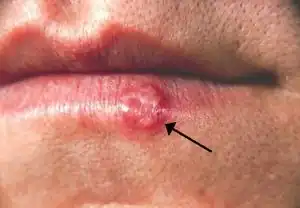
Sores typically heal within 2–3 weeks, but the herpes virus (typically HSV-1) remains dormant in the facial nerve branches, following orofacial infection, periodically reactivating (in symptomatic people) to create sores in the same area of the mouth or face at the site of the original infection.
Frequency varies from rare episodes to 12 or more recurrences per year (typically 1-3 attacks per year)
The frequency and severity of outbreaks generally decreases over time.
Treatment does not affect dormant virus in nerve ganglions → recurrent disease remains possible
Clinical Features
Herpes labialis
typically umbilicated vesicles, painful, that unroof and crust over
typically localized to the vermillion border
Classic Phases
Prodromal (day 0–1): Tingling, itching, and reddening of the skin around the infected site
Inflammation (day 1): Swelling and redness
Pre-sore (day 2–3): Tiny, hard, inflamed papules and vesicles that may itch and are painfully sensitive to touch.
Open lesion (day 4): Vesicles break open and merge to create one big, open, weeping ulcer. May develop a fever and lymphadenopathy
Crusting (day 5–8): A honey/golden crust starts to form from the syrupy exudate.
Healing (day 9–14): New skin begins to form underneath the scab. A series of scabs will form over the sore (called Meier Complex), each one smaller than the last. Irritation, itching, and some pain are common.
Post-scab (12–14 days): A reddish area may linger at the site of infection.