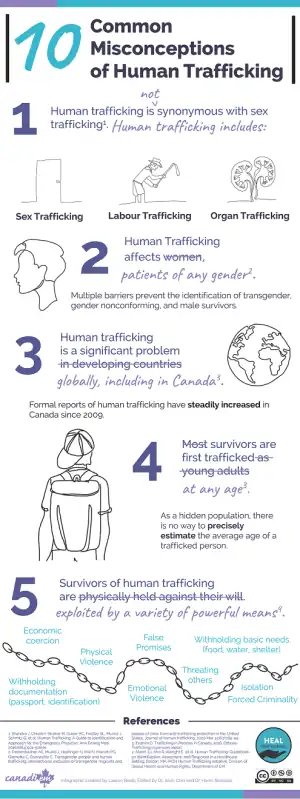
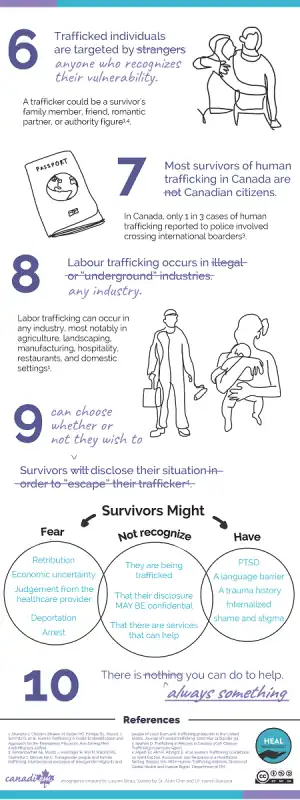
Over 60% of trafficked persons will present to the ED during their time of exploitation [1]
International Labor Organization has recorded that globally 49.6 million people were living in modern day slavery in 2021
International definition:
UN Protocol to Prevent, Suppress, and Punish Trafficking in Persons (Palermo Protocol) defines “trafficking in persons” as recruitment, transportation, harboring of persons by means of the threat or use of force...or of a position of vulnerability...to achieve the consent of a person having control over another person for the purpose of exploitation
Action-Means-Purpose (A-M-P) Model
Action: thing trafficker does to trafficked persons
Goal is not to necessarily elicit disclosure, but to create a safe environment for the patient, address immediate health needs, and empower patient to seek help/resources on their terms
Use the PEARR Tool
Provide privacy: discuss sensitive topics along and in a safe, private setting. Make sure to use professional interpreter if needed.
Educate: be sure to normalize the sharing of information when educating patients.
Ask: allow time for open discussion with the patient.
Respect & Respond: If patient requests assistance, arrange communication with victim advocate/social work and/or provide patient with resources (see below). If the patient declines assistance, please respect the patient’s wishes.
Try to have patient alone (if accompanied) to ask safety questions
Questions to ask
Do you feel safe at home/work/school?
Has anyone forced you to do something you don’t want to do?
Similar to assault cases, only document facts/objective findings
Careful documentation of exam findings that might be concerning for abuse
Document concerns for trafficking for future providers
Hotlines and other resources
888-373-7888 U.S. National trafficking hotline
800-799-7233 U.S. domestic violence hotline
800-656-4673 U.S. sexual assault hotline
Social Work
Case Management
References
Alpert EJ, Ahn R, Albright E et al. Human Trafficking: Guidebook on Identification, Assessment, and Response in a Healthcare Setting. Boston, MA: MGH Human Trafficking Initiative, Division of Global Health and Human Rights, Department of Emergency Medicine.
Canada’s Human Trafficking Laws. British Columbia Public Health Agency. 2014.
Human Trafficking. Public Safety Canada, Government of Canada. 2019.
Identifying Victims of Human Trafficking: What to look for in a healthcare setting. National Human Trafficking Resource Center. The Polaris Project.
Lederer L, Wetzel C. The Health Consequences of Sex Trafficking and Their Implications for Identifying Victims in Healthcare Facilities. Ann Heal Law. 2013;23(1):61–91.
Macias Konstantopoulos W, Ahn R, Alpert EJ, Cafferty E, McGahan A, Williams TP, et al. An international comparative public health analysis of sex trafficking of women and girls in eight cities: Achieving a more effective health sector response. J Urban Health. 2013. PMID: 24151086
Meshkovska B, Siegel M, Stutterheim SE, Bos AER. Female sex trafficking: Conceptual issues, current debates, and future directions. J Sex Res. 2015. PMID: 25897567
PEARR Tool Trauma-Informed Approach to Victim Assistance in Health Care Settings. Dignity Health, in partnership with HEAL Trafficking and Pacific Survivor Center. 2019.
Shandro J, Chisolm-Straker M, Duber HC, Findlay SL, Munoz J, Schmitz G, et al. Human Trafficking: A Guide to Identification and Approach for the Emergency Physician. Ann Emerg Med. 2016;68(4):501-508.e1. PMID: 27130802
Walls NE, Bell S. Correlates of engaging in survival sex among homeless youth and young adults. J Sex Res. 2011. PMID: 20799134
Zimmerman C BR. Caring for Trafficked Persons: Guidance for Health Providers. Health Providers. Geneva, Switzerland: International Organization for Migration. 2009.
↑Lederer LJ, Wetzel CA. The health consequences of sex trafficking and their implications for identifying victims in healthcare facilities. Ann Health Law. 2014;23(1):61-91.