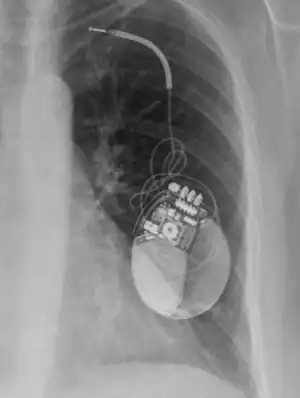
All ICDs are also pacemakers (i.e. have pacing functionality) but pacemakers are not ICDs (i.e. do not have shocking functionality)
Parts
Pulse Generator
Typically implanted in L upper chest wall
Contains device hardware and battery
Acts as a shocking electrode in defibrillation
Leads
Insulated and antimicrobial-coated
Atrial lead
Pacing and sensing functionality
Typical bipolar (pacing and sensing are performed by two electrodes, located several millimeters apart at the tip of the lead)
Right ventricular lead
Pacing, sensing, and defibrillation functionality
Has one or two coils to facilitate defibrillation
Easily identified on Chest X-Ray and can hep differentiate an ICD from a pacemaker
Typical bipolar (pacing and sensing are performed by two electrodes, located several millimeters apart at the tip of the lead)
Left Ventricular Lead
Pacing and sensing functionality
Bipolar or unipolar (pacing and sensing are performed by one electrode at the tip of the LV lead and a second remote electrode, typically either one of the RV electrodes or the pulse generator)
In response to a ventricular rate within a pre-set range (typically ~150-220 bpm), the device will compare the ongoing QRS morphology to a saved image of a QRS complex that is known to be a sinus beat; if the ICD algorithm determines that the ongoing morphology is significantly different (i.e. is unlikely to be a sinus tachycardia), it will deliver a series of paced beats at a rate slightly faster than the ongoing rate in an attempt to break the re-entrant cycle
A device will typically be programmed to attempt anti-tachycardia pacing several times; if unsuccessful, it will move on to defibrillation
Defibrillation
Delivery of a large electrical shock (up to 42 joules) from one electrode to the other in response to VT or VF
Magnet Mode
Placement of a magnet over the generator will deactivate anti-tachycardia pacing and defibrillation modes as long as the magnet is in place.
Diagnostics
Records rhythm strips of AF, VT, and VF episodes for later review
If anti-tachycardia pacing or defibrillation has occurred, there will be a large alert on the device's interrogation home screen
Keeps track of % of paced vs intrinsic beats
Keeps a rate histogram, as well as % of time spent in AF
Methods to Identify Manufacturer
Patient should carry a pocket card indicating manufacturer
Manufacturer Hotline has patient database
Medtronic Inc. (1-800-328-2518)
St. Jude Medical Inc. (recently acquired by Abbott, Inc.) (1-800-722-3774)
Boston Scientific Inc. (1-800-227-3422)
Magnet mode
Does not help differentiate ICDs (different than pacemakers)
Electromagnetic Interference
Nonmedical
Cell phones: do not interact with device
Airport security: may trigger alarm, no alteration of activity
Medical Sources
MRI: mostly safe, consult cards on device specific recs
Cardioversion: Use AP pads >8cm from device to minimize adverse effects
Unipolar Cautery - can cause sensing and pacing malfunction as well as reprogramming
Complications
Defibrillator Shocks
Approximately 1/3 - 1/2 of ICD patients receive a shock within one year of placement[3]
Generally described by patients as a powerful "kick to the chest"
Can be very distressing and a source of anxiety for patients
Inappropriate Shocks
Causes
Misclassification by device of SVT or AF as VT or VF
Electrical Noise
Fractured Lead
Can be diagnosed by interrogation of device after a reported shock
Phantom Shocks
The perception of a shock without a delivered shock
Generally described by patients as a mild electrical pain or pain around the defibrillator site
More common in patients who have never had an actual shock
Signals generated by interaction of different portions of the pacing system
Potentially life-threatening as it can cause V-Fib or (paradoxically) bradycardia due to failure to capture
Pacemaker Mediated Tachycardia
Also known as Endless Loop Tachycardia
Formation of a re-entrant circuit causing inappropriate tachycardia
Most commonly: paced ventricular beat -> retrograde AV node conduction -> intrinsic P wave -> device reacts to intrinsic P wave by looking for intrinsic QRS, but since AV node is now refractory it delivers a paced beat at the programmed P-R interval (typically ~200-250ms), starting the process anew
Tachycardia does not exceed programmed upper limit rate on pacemaker
Each company has on-call representatives who will come interrogate a device 24/7 (phone numbers above)
Most cath labs will have machines capable of interrogating each brand
Expected ECG Patterns
Absence of pacer artifact indicates intrinsic depolarization
With newer pacemakers, pacer spikes may not appear on some or all paced beats, depending on EKG machine
Pacing artifacts preceding depolarizations indicate successful pacing and capture
Leads in RV apex produce LBBB pattern with appropriate discordance
New RBBB pattern may indicate lead in LV
Bi-ventricular devices can produce paced QRS complexes that are either narrow or wide and bizarre, depending on device programming
Simultaneous depolarization of ventricles produces dominant R wave in V1
Plain Film Findings
Obtain PA/Lateral Films to confirm pulse generator, manufacturer, lead placement/number/integrity
R atrial lead J shaped(tip medially on AP) entering right atrial appendage
RV leads point downward with tip between left spine and cardiac apex--lateral XR shows inferior and anterior
Coronary sinus lead- courses posteriorly on lateral XR
Extra leads may be appropriately abandoned and capped
ICD component appears as thickened shock coil
Management
Reported Shock
If unable to prove a phantom shock, electrophysiology or cardiology consult is often needed
Interrogation is mandatory, either by an experienced clinician or by device representative
Some devices can be remotely interrogated; contact the respective company representative at the above phone numbers to discuss this possibility
Repeated Shocks
Before placement of a magnet or changing the device parameters, you must determine if the shocks are appropriate (i.e. the patient is in VT storm or having recurrent episodes of VF) or inappropriate
If it is determined that the shocks are inappropriate, a magnet will deactivate the shocking function while placed over the device
Electrophysiology consult
Pacemaker Mediated Tachycardia
Break with adenosine - magnet will not fix PMT in a patient with a defibrillator
Disposition
Consider discharge if:
Proven Phantom Shock
Resolved Pacemaker Mediated Tachycardia
Single shock only AND Currently asymptomatic AND No concerning associated symptoms (e.g. chest pain, dyspnea, syncope)
Ensure patient has Electrophysiology/Cardiology follow-up
↑Al-Khatib SM et al. 2017 AHA/ACC/HRS Guideline for Management of Patients With Ventricular Arrhythmias and the Prevention of Sudden Cardiac Death: A Report of the American College of Cardiology/American Heart Association Task Force on Clinical Practice Guidelines and the Heart Rhythm Society. J Am Coll Cardiol. 2018;72(14):e91. Epub 2018 Aug 16.
↑Al-Khatib SM et al. 2017 AHA/ACC/HRS Guideline for Management of Patients With Ventricular Arrhythmias and the Prevention of Sudden Cardiac Death: A Report of the American College of Cardiology/American Heart Association Task Force on Clinical Practice Guidelines and the Heart Rhythm Society. J Am Coll Cardiol. 2018;72(14):e91. Epub 2018 Aug 16.
↑Sears SF Jr., Shea JB, Conti JB. Cardiology patient page. How to respond to an implantable cardioverter-defibrillator shock. Circulation. 2005;111:e380–e382
↑Berg SK et al. Phantom shocks in patients with implantable cardioverter defibrillator: results from a randomized rehabilitation trial (COPE-ICD). Europace. 2013 Oct;15(10):1463-7. Epub 2013 Apr 18.