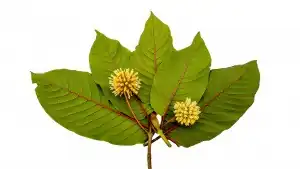
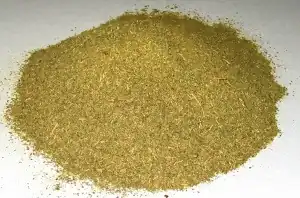
Kratom flowers and foliage.Typical powdered Kratom for commercial use.
Derived from Mitragyna speciosa, a tropical evergreen tree in the coffee family native to Southeast Asia
Leaves contain over 40 alkaloids; the two most clinically relevant are:
Mitragynine (most abundant, up to 66% of total alkaloid content) — partial mu-opioid receptor agonist[1]
7-Hydroxymitragynine (7-OH) (minor constituent, <2% of alkaloid content) — approximately 5-fold greater mu-opioid affinity than mitragynine[1]
Both alkaloids exhibit G-protein biased agonism at mu-opioid receptors with limited beta-arrestin recruitment (theoretically less respiratory depression than classical opioids, though still reported)[1]
Additional receptor activity at alpha-1A, alpha-2A, 5-HT1A, 5-HT2A, D1, and D2 receptors contributes to mixed stimulant-opioid clinical picture[2]
Mitragynine is metabolized by CYP3A4 to 7-hydroxymitragynine (a more potent metabolite) and inhibits CYP2D6 and CYP3A4, creating significant potential for drug-drug interactions[3]
Available in the US as powder, capsules, tablets, extracts, and liquid "shots" sold at gas stations, smoke shops, and online
Products are unregulated, with highly variable alkaloid content and potential for contamination (Salmonella, heavy metals including lead)[4]
Estimated 1.7 million Americans aged ≥12 used kratom in 2021[4]
Not FDA-approved for any indication; not a legal dietary supplement or food additive[4]
Federally unscheduled but banned in several states (Alabama, Arkansas, Indiana, Vermont, Wisconsin, Louisiana); regulated in many others[5]
Hepatotoxicity — typically cholestatic pattern, onset 1-8 weeks of regular use; can be severe (bilirubin >20 mg/dL); usually reversible with cessation[9]
Cardiac arrest (rare, primarily in polydrug exposure)[10]
For all patients: provide counseling on risks of kratom, advise cessation, and consider referral to addiction medicine if regular use or dependence is identified
Provide naloxone prescription at discharge if ongoing use is anticipated
↑ 1.01.11.2Kruegel AC, Grundmann O. The medicinal chemistry and neuropharmacology of kratom: A preliminary discussion of a promising medicinal plant and analysis of its potential for abuse. Neuropharmacology. 2018;134(Pt A):108-120.
↑Yusof SR, Zakaria Z, Amir Rawa MS, et al. Kratom Alkaloids: Interactions With Enzymes, Receptors, and Cellular Barriers. Front Pharmacol. 2021;12:751656.
↑ 3.03.1Tanna RS, Tian DD, Cech NB, et al. Refined Prediction of Pharmacokinetic Kratom-Drug Interactions: Time-Dependent Inhibition Considerations. J Pharmacol Exp Ther. 2021;376(1):64-73.
↑ 7.07.1Eastlack SC, Cornett EM, Kaye AD. Kratom—Pharmacology, Clinical Implications, and Outlook: A Comprehensive Review. Pain Ther. 2020;9(1):55-69.
↑ 8.08.1Narrative Review of Kratom in the Emergency Department. Auctores. 2025.
↑ 9.09.19.2LiverTox: Clinical and Research Information on Drug-Induced Liver Injury. Kratom. National Institute of Diabetes and Digestive and Kidney Diseases; 2020.