Benign bone deposition within soft tissues, most often skeletal muscle.
Usually arises secondary to trauma (either one larger traumatic event or repeated small traumas) and will generally be localized to a single muscle or group of muscles involved in the trauma.[1][2]
Alternatively, can be generalized, widespread, progressive and unrelated to trauma - this is thought to be a hereditary form with a separate pathogenesis and treatment
Pathophysiology not completely understood - may be related to inappropriate differentiation of mesenchymal cells into chondrocytes and osteoblasts in the setting of trauma/inflammation[3]
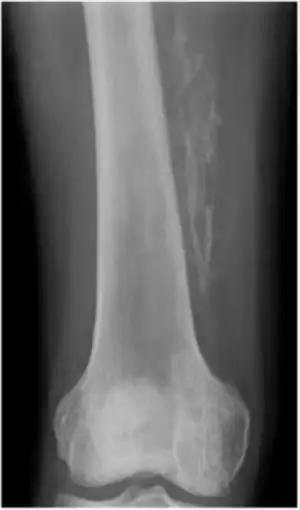
Plain radiograph taken two months after injury demonstrates irregular calcification located along muscle on medial aspect of right thigh. Diagnosis was myositis ossificans
Clinical Features
Length of pain out of proportion to trauma
Decreased range of motion
Palpable, painful mass (generally forms within 2 weeks of initial trauma)
↑ 1.01.11.2 Walczak BE, et al. Myositis Ossificans. J Am Acad Orthop Surg. 2015;23(10):612-22.
↑ Ropper AH, et al. Chapter 48. Diseases of Muscle. In: Ropper AH, Samuels MA, Klein JP. eds. Adams & Victor's Principles of Neurology, 10e. New York, NY: McGraw-Hill; 2014.
↑ Kan L, et al. Dysregulation of local stem/progenitor cells as a common cellular mechanism for heterotopic ossification. Stem Calls. 2009;27(1):150-156.