Vomiting or inability to protect the airway (aspiration risk)
Facial trauma or burns
Facial, esophageal, or gastric surgery
Poor mask fit
Procedure
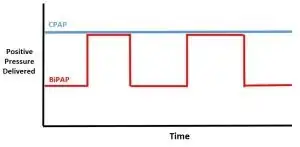
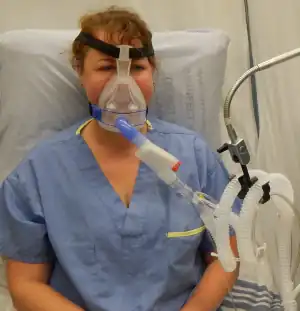
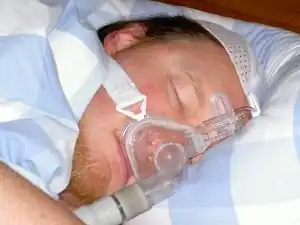
Patient on BPAP.CPAP mask on EMS manikin.Home CPAP device.
Prepare intubation equipment in case of BPAP/CPAP failure.
Position the patient in a 30-90° upright position.
Apply the mask.
Select the appropriately-sized mask.
Secure it in place by fastening the Velcro straps.
Note: Some experts recommend allowing the patient to get used to the mask first, PRIOR TO starting the positive airway pressures.
Prepare the patient.
Patients will often require frequent coaching throughout this process.
In moderately anxious patients, consider low-dose fentanyl, a benzodiazepine or ketamine to assist with patient-ventilator synchrony.
Adjust the settings.
For BPAP, begin with an IPAP of 8-10 cm H2O and an EPAP of 2-4 cm H2O.
Gradually titrate upward IPAP and EPAP 1-2 cm every 5-15 minutes with a goal IPAP 10-16 cm H2O and EPAP of 8-10 cm H2O depending upon patient response.
Continue close monitoring.
A doctor, nurse, or respiratory therapist should be with the patient at all times during BPAP/CPAP use.