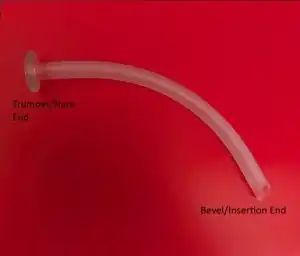
Nasopharyngeal airways are tubular, soft, flexible airway devices
NPA's provide an open airway through the nasopharynx rather than the oropharynx
The widened opening which remains outside the nose gives the device its common moniker "Nasal trumpet"
NPA's are supraglottic by definition and generally do not stimulate the gag reflex when placed
NPA are not contraindicated in the conscious or semi-conscious patient whose gag reflex is intact
Oxygen therapy and/or pressurized respiratory therapies by nasal cannula, simple masks, non-rebreather masks, CPAP, and BiPAP may be used with an NPA in place
Presence of an NPA in the posterior pharynx may interfere with intubation; they generally should be removed prior to laryngoscopy
NPA Device example
Indications
Need to ensure an open airway
Contraindications
Suspected or known maxillofacial fractures
Suspected or known septal hematoma on the same side
Equipment Needed
1x NPA device, appropriately sized
Lubricant
Procedure
Gently insert the well-lubricated tip end of the NPA device with the bevel oriented toward the septum, pushing the tip directly backward (not upward) into the nasopharynx
Depending on the orientation of the bevel, you may need to progressively rotate the device so that the natural curvature aligns with the caudal curvature of the device while in place
Insert the device fully, until the "trumpet" end is in contact with, or very near, the nare
Complications
Epistaxis
Device intrusion through fracture lines if placed in patient with facial trauma