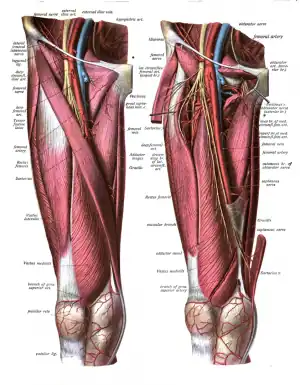
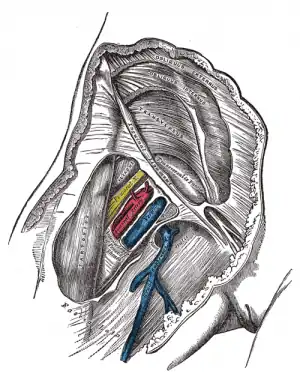
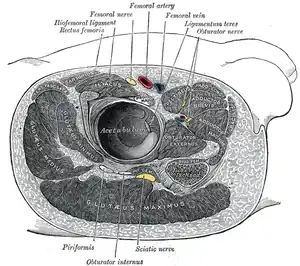
Anterior thigh anatomy (right) showing vein medial to artery and nerve.Right anterior femoral sheath laid open to show its three structures. (Femoral nerve visible in yellow.)Cross section of the right hip at the level of the acetabulum.
Found to be effective method of regional pain control in ED[1]
Does not alter clinical presentation of developing compartment syndrome (compartments innervated by sciatic nerve)[2]
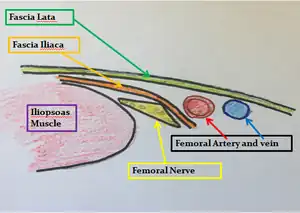
Cartoon of pertinent anatomy in femoral nerve block
Femoral Nerve Block
Place patient supine
Cleanse skin with chlorhexidine or betadine and drape
Apply sterile ultrasound probe 1cm distal to inguinal ligament
Find the large nonpulsatile femoral vein as the initial landmark under ultrasound
Identify femoral nerve (hyperechoic structure lateral to the femoral artery)
Must also identify Fascia Lata and deeper Fascia Iliaca, as these two fascial planes overlie the femoral nerve. If anesthetic is not placed below these two fascial planes, the anesthetic will not reach femoral nerve and the block will fail.
Inject a small amount of local anesthetic into skin and subcutaneous tissue at the needle entry site
Under ultrasound guidance, advance noncutting spinal needle to the femoral nerve sheath
Aspirate to ensure not in blood vessel
Inject 20cc of 0.5% bupivicaine or another local anesthetic along nerve sheath.
technique is similar to the femoral nerve block, except the needle enters through the fascia iliaca at a more lateral site relative to the femoral nerve block to avoid hitting the femoral nerve, artery, or vein
this extends the block to include the lateral femoral cutaneous nerve, providing anesthesia to the lateral proximal thigh.
Infiltrate a larger volume of anesthetic (30-40cc), allowing anesthetic to travel along the fascial planes to the lateral femoral cutaneous nerve. The volume of anesthetic may be mixed with saline to create an adequate volume to ensure success of the block.
3-in-1-Block
This block incorporates:
Femoral nerve
Lateral femoral cutaneous nerve
Obturator nerve
Allows for greater anestehsia of the hip and knee.
Technique is identical to Fascia iliaca block, but includes application of pressure 4cm distal to injection site.
↑Beaudoin FL, Nagdev A, Merchant RC, Becker BM. Ultrasound-guided femoral nerve blocks in elderly patients with hip fractures. Am. J. Emerg. Med. 2010;28(1):76-81.
↑Karagiannis G, Hardern R. Best evidence topic report: No evidence found that a femoral nerve block in cases of femoral shaft fractures can delay the diagnosis of compartment syndrome of the thigh. EMJ 2005;22(11):814.
↑Beaudoin FL, Haran JP, Liebmann O. A comparison of ultrasound-guided three-in-one femoral nerve block versus parenteral opioids alone for analgesia in emergency department patients with hip fractures: a randomized controlled trial. Acad Emerg Med. 2013 Jun;20(6):584-91.