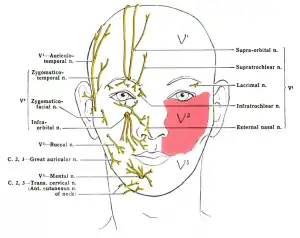
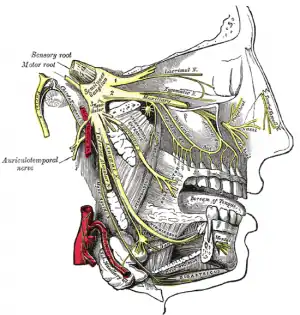
Infraorbital nerve (shown in middle right) with V2 facial sensory distribution.Trigeminal nerve anatomy, with maxillary (V2) branch leading to trigeminal nerve.
Infraorbital nerve is a branch of the maxillary nerve, which is a branch off the trigeminal nerve (CN V2).
Travels through the orbit and enters the infraorbital canal to exit onto the face through the infraorbital foramen.
Infraorbital nerve innervates the ipsilateral lower eyelid, side of the nose, and upper lip
Regional blocks provide anesthesia without distorting soft tissues as in local infiltration
Indications
Trauma or need to perform painful procedure on areas innervated by infraorbital nerve
Contraindications
Infection overlying injection site
Previous allergic reaction local anesthetic
Distortion of anatomical landmarks
Equipment Needed
Local anesthesic
5-10 mL syringe
Blunt fill needle
25-27ga needle
Chlorhexidine or betadine
Gauze
Sterile gloves
Sterile drape
Procedure
Intraoral approach
Place patient in supine position or seated
Apply anesthetic soaked q-tip to the mucosa opposite the upper second premolar (bicuspid) for 1 minute allowing for topical anesthesia
Draw up 2-5cc of anesthetic into syringe
Palpate the infraorbital foramen by having the patient look straight ahead and draw an imaginary line vertically from the pupil toward the inferior border of the infraorbital ridge, keep your finger on the foramen
Retract the cheek and introduce the needle into the mucosa ~ 0.5cm from the buccal surface
Advance the needle, keeping it parallel to the long axis of the bicuspid) until it is near the foramen (~1.5-2.5 cm)... do not advance too far as you may enter the orbit
Aspirate, and if no blood, inject 4-5 cc of anesthetic slowly
Extraoral Approach
Place patient in supine position or seated
Draw up 2-5cc of anesthetic into syringe (avoid epinephrine as you are very close to the facial artery while doing the block via this approach)
Palpate the infraorbital foramen (step 5 above)
Prep the overlying skin with betadine
Insert the needle through the skin, subcutaneous tissue, and muscle
Aspirate, if no blood, inject anesthetic slowly (the tissue will swell)
Remove the needle and massage the area for 10-15 seconds
Field Block
If the nerve block does not work you can do a field block which will generally achieve the same effect
Inject 5 cc of local anesthetic into the upper buccal fold in an arc like distribution and then massage into the area for a few seconds
Amsterdam J and Kilgore K. Regional Anesthesia of the Head and Neck. In: Roberts and Hedges' Clinical Procedures in Emergency Medicine. 6th ed. Philadelphia, PA: Elsevier; 2014.