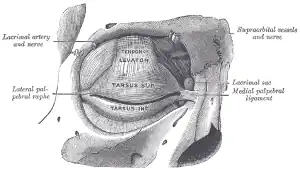
Anterior view of the right orbit. The supraorbital nerve can be seen exiting the orbit through the supraorbital notch with the supraorbital artery.
Supraorbital nerve innervates the ipsilateral upper eyelid, forehead, and anterior 1/3 of scalp
Nerve block provides regional anesthesia without distortion of soft tissue seen in local infiltration
Indications
Trauma or need to perform painful procedure on area innervated by supraorbital nerve
Contraindications
Infection overlying injection site
Previous allergic reaction to local anesthetic
Uncooperative patient
Distortion of anatomical landmarks
Equipment Needed
local anesthesia
lidocaine 2% (lasts 30-60 minutes or longer if given with epinephrine, rapid onset of 4-6 minutes)
Bupivacaine 0.5% (lasts 2-4 hours, slowest in onset)
18 gauge needle to draw up anesthetic
1.5 inch 25 or 27 gauge needle
3-5cc syringe
gauze pads
gloves
betadine/chlorhexidine
Procedure
Obtain informed consent
Place patient in supine position or seated
Draw up 2-5cc of anesthetic into syringe
Palpate the supraorbital foramen over the medial aspect of the supraorbital ridge
Prep area
Advance the needle towards foramen (5-10mm)
Aspirate, and if no blood, inject 1-3 cc of anesthetic slowly
Massage area for 10-15 seconds
If block is unsuccessful, inject a line of anesthetic solution along the orbital rim laterally to medially to block all branches of the ophthalmic nerve
Amsterdam J and Kilgore K. Regional Anesthesia of the Head and Neck. In: Roberts and Hedges' Clinical Procedures in Emergency Medicine. 6th ed. Philadelphia, PA: Elsevier; 2014