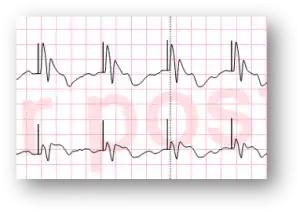
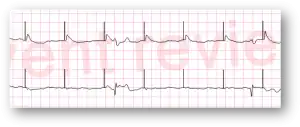
True electrical captureFalse capture with visible phantom beats[2]
Pad placement:
Anterior-posterior (preferred): Pad anteriorly on lead V3 position (left of sternum/cardiac apex area) and posteriorly between left scapula and T-spine [3]
This position requires ~33 mA less current to achieve capture compared to anterolateral placement
Anterior-lateral: Pad on right upper chest below clavicle and on apex of heart
Set: HR 80, pacing threshold usually between 40-80 mA
If hemodynamically unstable or with evidence of end organ poor perfusion start at 80 mA and titrate down as tolerated.
Look for clear QRS complex and T-wave following pacer spike
Check pulse to confirm mechanical capture
Final current set 5-10 mA above threshold level for patient
↑ 1.01.1Epstein AE, DiMarco JP, Ellenbogen KA, et al. ACC/AHA/HRS 2008 Guidelines for Device-Based Therapy of Cardiac Rhythm Abnormalities: a report of the American College of Cardiology/American Heart Association Task Force on Practice Guidelines (Writing Committee to Revise the ACC/AHA/NASPE 2002 Guideline Update for Implantation of Cardiac Pacemakers and Antiarrhythmia Devices): developed in collaboration with the American Association for Thoracic Surgery and Society of Thoracic Surgeons. Circulation. May 27 2008;117(21):e350-408
↑"Transcutaneous Pacing (TCP): The Problem of False Capture". EMS 12 Lead. Retrieved 2019-01-31.
↑Moayedi S, Patel P, Brady N, Witting M, Dickfeld TL. Anteroposterior pacer pad position is better than anterolateral for transcutaneous cardiac pacing. Resuscitation. 2022 Dec;181:140-146. doi: 10.1016/j.resuscitation.2022.11.009. Epub 2022 Nov 18. PMID: 36410605.