Penile fracture
Background
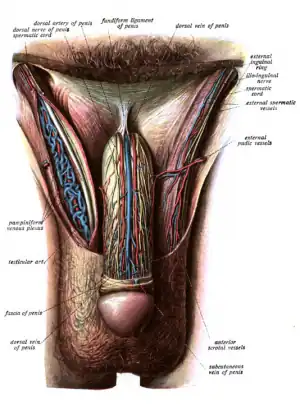 Penis anatomy
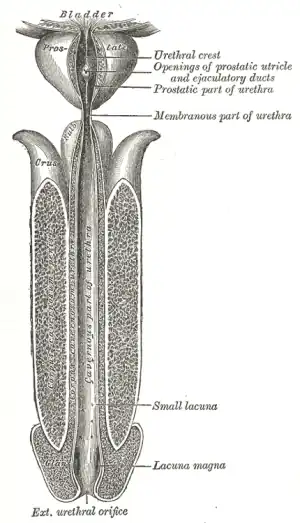 The human male urethra laid open on its anterior (upper) surface.
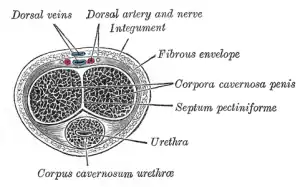 Transverse section of the penis.
- Tunica albuginea of one or both corpora cavernosa ruptures due to trauma to erect penis
- Can be associated with urethral rupture and deep dorsal vein injury
- Unlikely to occur in blunt pelvic trauma with a flaccid penis
- Associated with a urethral injury in up to 38% of penile fractures[1]
Clinical Features
- Penis is circumstantially swollen, discolored, tender, and flaccid
- Typically occurs during intercourse with receptive partner on top
- Cracking sound followed by pain, usually immediate detumescence, swelling, discoloration, deformity

Differential Diagnosis
Evaluation
- Clinical diagnosis
- Rule out other trauma
- Do NOT pass foley until confirming patient can pass urine OR
- Retrograde urethrogram may be necessary to assure urethral integrity (especially important if pt unable to urinate)
- Urology may request corpus cavernosography, MRI, or ultrasound if the penile fracture is atypical[2]
Management
- Surgical exploration/repair required for most injuries if there is obvious or suspected fracture
- Penile hematoma with no fracture can be treated as an outpatient with NSAIDs
- Penile laceration with no fracture can be closed with 4-0 or 5-0 absorbable sutures
Disposition
- Admit, usually to OR for operative repair
See Also
References
- ↑ Wessells H et al. Penile and genital injuries. Urol Clin North Am. 2006 Feb;33(1):117-26
- ↑ Lee S. et al. Trauma to male genital organs: a 10-year review of 156 patients, including 118 treated by surgery. BJU Int. 2008 Jan;101(2):211-5