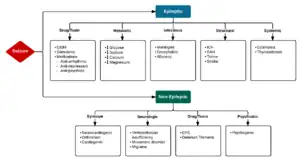
Psychogenic nonepileptic seizure (PNES) characterized disturbances of motor, sensory, autonomic, cognitive, and/or emotional functions that can mimic epileptic seizures.
In contrast to epileptic seizures, PNES are not associated with abnormally excessive neuronal activity but are instead derived from psychologic causes.
The term pseudoseizures and hysterical seizures are historical terms that are now discouraged.
Accurate diagnosis is best achieved via a detailed history, physical examination, selected testing, and neurology and/or psychiatry evaluation.
Epidemiology
Estimated incidence rate ranges from 1.5 to 5 per 100,000 persons per year.
Estimate prevalence 2 to 33 per 100,000 persons.
More common in women
Etiology
There may be a history of sexual abuse, eating disorders, depression, substance abuse, anxiety disorders or personality disorders, and the episode may be preceded by a stressful event
Dissociative disorders and conversion disorders are felt to be the underlying cause to most episodes of PNES.
Some patients may have both psychogenic nonepileptic seizures and true epileptiform seizures
Clinical Features
Symptoms specific to PNES:
Duration > 2 minutes
Pelvic thrusting
Side to side head rocking
Crying/shrieking
Voluntary eye movements away from the examiner/forceful closing of the eyes
Lactic acid may be able to differentiate from true generalized tonic-clonic seizure[1]
Consider obtaining a drug screen (and a pregnancy test in women)
If unsure, an urgent neuro consult with EEG can determine the diagnosis
Management
Avoid invasive medical procedures
Some patients will improve after they are told the diagnosis in a compassionate, non-judgmental fashion.
If new diagnosis or diagnostic uncertainty consider admission for neurology consult and video EEG.
Psychiatric intervention is the main treatment modality (e.g. outpatient cognitive behavioral therapy).
The purpose of psychiatric consultation is to identify underlying psychiatric conditions that can help direct treatment.
In case of significant emotional stress, administer a mild tranquilizing agent (e.g. lorazepam 1-2mg IM/IV; hydroxyzine 50-100mg IM)
Disposition
If symptoms improve consider discharge with close neurology and psychiatry follow-up to rule out epilepsy and identify and treat the underlying psychiatric origin of symptoms.
If symptoms cannot be controlled or patient/family are not accepting of diagnosis. Consider admission for observation and further evaluation.
Prognosis
25-38 percent of patients achieve "seizure" freedom
Children have a better prognosis than adults, with 70-80% achieving remission