Scurvy
Background
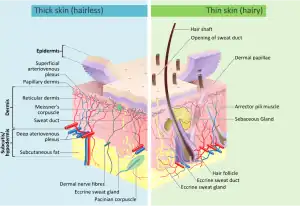
- Nutritional deficiency of Vitamin C (Ascorbic acid)
- Vitamin C is typically found in fruits and vegetables.
- Vitamin C is a cofactor for hydroxylation of proline and lysine amino acids in procollagen molecules, which is required for cross-linking collagen's triple helix.
- Scurvy therefore leads to unstable collagen and collagen fragility.
- Leaking of vascular structures
- Gingival bleeding
- Petechiae
- Easy bruising
- Leaking of vascular structures
- Vitamin C is also required for the disulfide bonding in hair leading to corkscrew appearance of hair.
- 16th-19th century sailors with scurvy found to have developed tooth decay, bruising, lassitude, and often died from massive hemorrhage[1]
Risk Factors
- Eating disorders or select eating habits
- Infants who only consume pasteurized milk
- Autism
- Alcohol disorder
- Isolated elderly persons with poor nutrition
Clinical Features
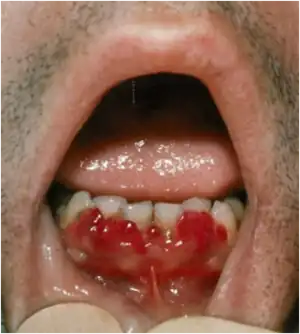
- Gingival bleeding
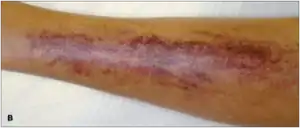
- Easy bruising
- Petechiae
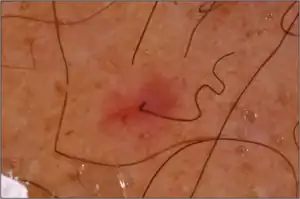
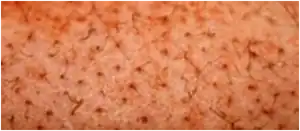
- Corkscrew hair
- Perifollicular hemmorrhage
- Weakness, fatigue, and muscle cramping
- Vitamin C is cofactor for enzymes involved in biosynthesis of carnitine, which is essential for release of energy via transport of fatty acids into mitochondria[2]
- Mood disturbance, cognitive impairment, delusions and depression[3]
- Vitamin C is a modulator of neurotransmitter synthesis and release (e.g. Dopamine)[4]
- Anemia
- Vit C promotes intestinal absorption of Iron and prevents oxidative damage to the red-cell cytoskeleton[5]
Differential Diagnosis
Petechiae/Purpura (by cause)
- Abnormal platelet count and/or coagulation
- Septicemia
- Idiopathic thrombocytopenic purpura (ITP)
- Hemolytic uremic syndrome
- Leukemia
- Coagulopathies (e.g. hemophilia)
- Henoch-Schonlein Purpura (HSP)
- Acute hemorrhagic edema of infancy (AHEI)
- Hypersensitivity vasculitis
- Primary vasculitides
- Wegener's
- Microscopic polyangiitis
- Eosinophilic granulomatosis with polyangiitis (Churg-Strauss syndrome)
- Secondary vasculitides
- Trauma
Dentoalveolar Injuries
Odontogenic Infections
- Acute alveolar osteitis (dry socket)
- Acute necrotizing ulcerative gingivitis (trench mouth)
- Dental abscess
- Periapical abscess
- Periodontal abscess
- Ludwig's angina
- Pulpitis (dental caries)
- Pericoronitis
- Peritonsillar abscess (PTA)
- Retropharyngeal abscess
- Vincent's angina - tonsillitis and pharyngitis
Other
Vitamin deficiencies
- Vitamin A deficiency
- Vitamin B deficiencies
- Vitamin B1 deficiency (Thiamine)
- Vitamin B3 deficiency (Pellagra)
- Vitamin B9 deficiency (Folate)
- Vitamin B7 deficiency (Biotin)
- Vitamin B12 deficiency
- Vitamin C deficiency (Scurvy)
- Vitamin D deficiency (Rickets)
- Vitamin E deficiency
- Vitamin K deficiency
- Zinc deficiency
Evaluation
- Guided by clinical suspicion but confirmed with laboratory analysis of vitamin C levels.
Management
- Vitamin C supplementation.
- 1 gram of oral vitamin C daily
Disposition
- Depends on the manifestations of vitamin C and their severity
External Links
References
- Kluesner, Nicholas and Miller, daniel. “Scurvy: Malnourishment in the land of the plenty.” The journal of emergency medicine. Vol 46. no 4. pages 530-532. 2014.
- Maltos, andre, et al. “Scurvy in a patient with AIDS: case report.” Revista de sociedade brasileira de medicina tropical 44(1): 122-123. 2011.
- ↑ Pichan, Cayla, B. S., et al. “Inadequate Support.” New England Journal of Medicine, vol. 385, no. 10, 2021, pp. 938–44.
- ↑ Pichan, Cayla, B. S., et al. “Inadequate Support.” New England Journal of Medicine, vol. 385, no. 10, 2021, pp. 938–44.
- ↑ Pichan, Cayla, B. S., et al. “Inadequate Support.” New England Journal of Medicine, vol. 385, no. 10, 2021, pp. 938–44.
- ↑ Pichan, Cayla, B. S., et al. “Inadequate Support.” New England Journal of Medicine, vol. 385, no. 10, 2021, pp. 938–44.
- ↑ Pichan, Cayla, B. S., et al. “Inadequate Support.” New England Journal of Medicine, vol. 385, no. 10, 2021, pp. 938–44.