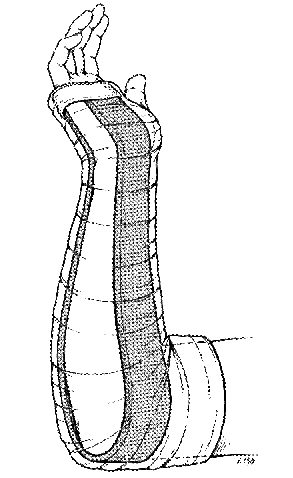
Sugar tong splint
Background Prevents pronation/supination, flexion/extension at the wrist, and immobilizes elbow Indications Procedure Sugar tong splint. Splint Application General ProcedureAssess pre-procedure neurovascular status (i.e., distal pulse, motor, and sensation) [ 2]
Measure and prepare the splinting material
May use contralateral extremity if easier
Most splints use a width slightly greater than the diameter of the limb
Apply stockinette (if applicable)
Extend 2" beyond estimated the splinting material length
Apply padding (if applicable)
Use 2–3 layers over the area to be splinted / between digits (when applicable)
Add an extra 2–3 layers over bony prominences
Apply splinting material
Lightly moisten the splinting material.
Place as appropriate to specific splint type
Once finished, if applicable fold the ends of stockinette back over the splinting material if there is excess
Apply elastic bandaging (e.g., ace wrap)
While still wet
May further mold the splint to the desired shape
Maintain position until splint material has hardened
Re-check and document repeat neurovascular status Splint-Specific Details Apply padding and splint material as shown in figure
Splint course:[ 2] From proximal palmar crease
Around elbow
To dorsum of MCP joints
Watch for bunching of material around elbow, protect bony prominence such as elbow, ulnar styloid [ 3]
Reassess distal pulse, motor, and sensation
Key anatomic positions
Elbow at 90°
Neutral forearm with thumb pointed superiorly
Wrist in slight extension (approximately 10-20°) and slight ulnar deviation See Also References