Urethral stricture
Background
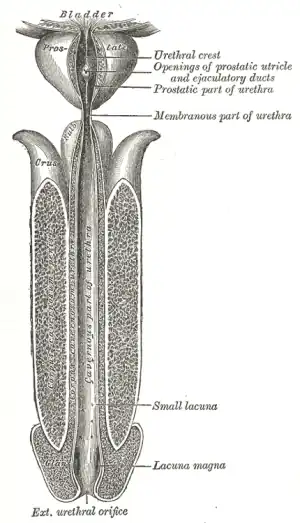 Urethral anatomy.
- Occurs relatively commonly in men
- Most common etiology is idiopathic in well-resourced countries, traumatic in resource-poor regions[1]
- Other common etiologies include instrumentation, infection, and inflammatory skin conditions
Clinical Features
- Chronic obstructive voiding symptoms
- Sexual dysfunction
Complications
Differential Diagnosis
Evaluation
Workup
Diagnosis
- Should undergo cystourethroscopy, retrograde urethrogram, voiding cystourethrogram, and/or ultrasound urethrography[2]
- Noninvasive studies cannot definitively diagnose
Management
- Treat resulting complications
- No absolute contraindication for treatment of urethral strictures
- Options for treatment include minimally invasive therapies, urinary diversion procedures, and surgical reconstruction (eg, urethroplasty)
- Consult urology
Disposition
See Also
External Links
References
- ↑ Wessells H, Angermeier KW, Elliott S, Gonzalez CM, Kodama R, Peterson AC, Reston J, Rourke K, Stoffel JT, Vanni AJ, Voelzke BB, Zhao L, Santucci RA. Male Urethral Stricture: American Urological Association Guideline. J Urol. 2017 Jan;197(1):182-190. doi: 10.1016/j.juro.2016.07.087. Epub 2016 Aug 3. PMID: 27497791.
- ↑ Wessells H, Angermeier KW, Elliott S, Gonzalez CM, Kodama R, Peterson AC, Reston J, Rourke K, Stoffel JT, Vanni AJ, Voelzke BB, Zhao L, Santucci RA. Male Urethral Stricture: American Urological Association Guideline. J Urol. 2017 Jan;197(1):182-190. doi: 10.1016/j.juro.2016.07.087. Epub 2016 Aug 3. PMID: 27497791.