Vital signs (peds)
This page is for pediatric patients. For adult patients, see: vital signs and see critical care quick reference for vital signs by age group.
Chart
Pediatric vital signs chart[1]
| Age | Pulse^ | Respiratory Rate | Systolic BP |
| Preterm < 1 kg | 120-160 | 30-60 | 36-58 |
| Preterm 1 kg | 120-160 | 30-60 | 42-66 |
| Preterm 2 kg | 120-160 | 30-60 | 50-72 |
| Newborn | 126-160 | 30-60 | 60-70 |
| Up to 1 year | 100-140 | 30-60 | 70-80 |
| 1-3 years | 100-140 | 20-40 | 76-90 |
| 4-6 years | 80-120 | 20-30 | 80-100 |
| 7-9 years | 80-120 | 16-24 | 84-110 |
| 10-12 years | 60-100 | 16-20 | 90-120 |
| 13-14 years | 60-90 | 16-20 | 90-120 |
| 15 years and older | 60-90 | 14-20 | 90-130 |
^Fever directly causes an increase in heart rate of 10 beats per minute per degree centigrade[2]
Newborn Vital Signs[3]
| Age | Pulse^ | Respiratory Rate | Systolic BP |
| Preterm < 1 kg | 120-160 | 30-60 | 36-58 |
| Preterm 1 kg | 120-160 | 30-60 | 42-66 |
| Preterm 2 kg | 120-160 | 30-60 | 50-72 |
| Newborn | 126-160 | 30-60 | 60-70 |
| Min of life | Target sat^^ |
|---|---|
| 1 min | 60-65% |
| 2 min | 65-70% |
| 3 min | 70-75% |
| 4 min | 75-80% |
| 5 min | 80-85% |
| 10 min | 85-95% |
^Fever directly causes an increase in heart rate of 10 beats per minute per degree centigrade[4] ^^Hyperoxia can be harmful
Systolic Blood Pressure
SBP Rule of Thumb
- 0-28dy >60
- 1-12mo >70
- 1-10yrs = 70 + (Age x 2)
- >10yrs = >90
Note: Lower limit of DBP = 2/3 SBP
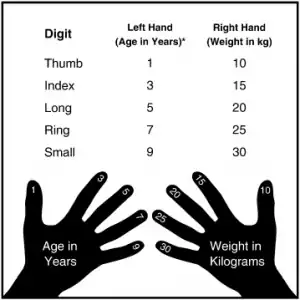
Estimation of Weight
See Also
Pediatric Critical Care
- Critical care quick reference
- Neonatal resuscitation
- Newborn resuscitation
- PALS (Main)
- Intubation (peds)
- Initial mechanical ventilation settings (peds)
- Vital signs (peds)
See Also
References
- ↑ National Model EMS Clinical Guidelines. 2015. 12. Full text
- ↑ Davies P, Maconochie I. The relationship between body temperature, heart rate and respiratory rate in children. Emerg Med J. 2009 Sep;26(9):641-3. doi: 10.1136/emj.2008.061598.
- ↑ National-Model-EMS-Clinical-Guidelines-23Oct2014
- ↑ Davies P, Maconochie I. The relationship between body temperature, heart rate and respiratory rate in children. Emerg Med J. 2009 Sep;26(9):641-3. doi: 10.1136/emj.2008.061598.