Ugaritic alphabet
| Ugaritic | |
|---|---|
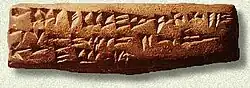 The Ugaritic writing system | |
| Script type | |
Period | c. 1400 – c. 1190 BCE |
| Direction | Left-to-right  |
| Languages | Ugaritic, Hurrian, Akkadian |
| Related scripts | |
Parent systems | Egyptian hieroglyphs?
|
| ISO 15924 | |
| ISO 15924 | Ugar (040), Ugaritic |
| Unicode | |
Unicode alias | Ugaritic |
Unicode range | U+10380–U+1039F |
The Ugaritic alphabet is an abjad (consonantal alphabet) with syllabic elements written using the same tools as cuneiform (i.e. pressing a wedge-shaped stylus into a clay tablet), which emerged c. 1400[1] or 1300 BCE[2] to write Ugaritic, an extinct Northwest Semitic language; it fell out of use amid the Late Bronze Age collapse c. 1190 BCE. It was discovered in Ugarit (modern Ras Shamra, Syria) in 1928. It has 30 letters. Other languages, particularly Hurrian, were occasionally written in the Ugaritic script in the area around Ugarit, but not elsewhere. The script was written from left to right.
Clay tablets written in Ugaritic provide the earliest evidence of both the North Semitic and South Semitic orders of the alphabet, which gave rise to the alphabetic orders of the reduced Phoenician writing system and its descendants, including the Paleo-Hebrew alphabet, Hebrew, Syriac, Greek and Latin, and of the Geʽez script, which was also influenced by the ancient Egyptian hieroglyphic writing system,[3] and adapted for Amharic. The Arabic, Ancient North Arabian and Ancient South Arabian scripts are the only other Semitic alphabets which have letters for all or almost all of the 29 commonly reconstructed Proto-Semitic consonant phonemes. These finds are significant as they represent the earliest dated example of not one but two different alphabetical orders still used today.
Function
The Ugaritic writing system was an augmented abjad. In most syllables only consonants were written, including the /w/ and /j/ of diphthongs. Ugaritic was unusual among early abjads because it also indicated vowels occurring after the glottal stop. It is thought that the letter for the syllable /ʔa/ originally represented the consonant /ʔ/, as aleph does in other Semitic abjads, and that it was later restricted to /ʔa/ with the addition, at the end of the alphabet, of /ʔi/ and /ʔu/.[4][5]
The final consonantal letter of the alphabet, s2, has a disputed origin along with both "appended" glottals, but "The patent similarity of form between the Ugaritic symbol transliterated [s2], and the s-character of the later Northwest Semitic script makes a common origin likely, but the reason for the addition of this sign to the Ugaritic alphabet is unclear (compare Segert 1983: 201–218, Dietrich and Loretz 1988). In function, [s2] is like Ugaritic s, but only in certain words – other s-words are never written with [s2]."[6]
The words that show s2 are predominantly borrowings, and thus it is often thought to be a late addition to the alphabet representing a foreign sound that could be approximated by native /s/; Huehnergard and Pardee make it the affricate /ts/.[7] Segert instead theorizes that it may have been syllabic /su/, and for this reason grouped with the other syllabic signs /ʔi/ and /ʔu/.[8]
Probably the last three letters of the alphabet were originally developed for transcribing non-Ugaritic languages (texts in the Akkadian language and Hurrian language have been found written in the Ugaritic alphabet) and were then applied to write the Ugaritic language.[9] The three letters denoting glottal stop plus vowel combinations were used as simple vowel letters when writing other languages.
The only punctuation is a word divider which is often not used.
Letters
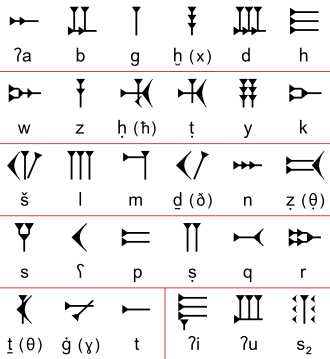
Below is an introductory table to Ugaritic alphabetical letters when compared to similar and better-known scripts. This method of comparison is not exact but can be helpful for first-time readers. Note that the letters are not ordered in any of the alphabetical orders found at Ugarit. Those are discussed later in this article as they play a major role in our understanding of the history of most alphabetical orders today.
| Letter[10] | Phoneme | IPA | Corresponding letter in[11] | ||||||||
|---|---|---|---|---|---|---|---|---|---|---|---|
| Phoenician | OSA script | Aramaic | Arabic | ||||||||
| 𐎀 | ả (ʾa) | [ʔa] | 𐤀 | 𐩱 | 𐡀 | ا | |||||
| 𐎁 | b | [b] | 𐤁 | 𐩨 | 𐡁 | ب | |||||
| 𐎂 | g | [ɡ] | 𐤂 | 𐩴 | 𐡂 | ج | |||||
| 𐎃 | ḫ | [x] | 𐤇 | 𐩭 | 𐡇 | خ | |||||
| 𐎈 | ḥ | [ħ] | 𐩢 | ح | |||||||
| 𐎄 | d | [d] | 𐤃 | 𐩵 | 𐡃 | د | |||||
| 𐎏 | ḏ | [ð] | 𐤆 | 𐩹 | ذ | ||||||
| 𐎇 | z | [z] | 𐩸 | 𐡆 | ز | ||||||
| 𐎅 | h | [h] | 𐤄 | 𐩠 | 𐡄 | ه | |||||
| 𐎆 | w | [w] | 𐤅 | 𐩥 | 𐡅 | و | |||||
| 𐎉 | ṭ | [tˤ] | 𐤈 | 𐩷 | 𐡈 | ط | |||||
| 𐎑 | ẓ | [θˤ] | 𐤑 | 𐩼 | ظ | ||||||
| 𐎕 | ṣ | [sˤ] | 𐩮 | 𐡑 | ص | ||||||
| 𐎊 | y | [j] | 𐤉 | 𐩺 | 𐡉 | ي | |||||
| 𐎋 | k | [k] | 𐤊 | 𐩫 | 𐡊 | ك | |||||
| 𐎒 | s | [s] | 𐤎 | 𐩯 | 𐡎 | س | |||||
| 𐎌 | š | [ʃ] | 𐤔 | 𐩪 | 𐡔 | ||||||
| 𐎘 | ṯ | [θ] | 𐩻 | 𐡕 | ث | ||||||
| 𐎚 | t | [t] | 𐤕 | 𐩩 | ت | ||||||
| 𐎍 | l | [l] | 𐤋 | 𐩡 | 𐡋 | ل | |||||
| 𐎎 | m | [m] | 𐤌 | 𐩣 | 𐡌 | م | |||||
| 𐎐 | n | [n] | 𐤍 | 𐩬 | 𐡍 | ن | |||||
| 𐎓 | ʿ | [ʕ] | 𐤏 | 𐩲 | 𐡏 | ع | |||||
| 𐎙 | ġ | [ɣ] | 𐩶 | غ | |||||||
| 𐎔 | p | [p] | 𐤐 | 𐩰 | 𐡐 | ف | |||||
| 𐎖 | q | [q] | 𐤒 | 𐩤 | 𐡒 | ق | |||||
| 𐎗 | r | [r] | 𐤓 | 𐩧 | 𐡓 | ر | |||||
| 𐎛 | ỉ (ʾi) | [ʔi] | |||||||||
| 𐎜 | ủ (ʾu) | [ʔu] | |||||||||
| 𐎝 | s₂ | [su] | |||||||||
| 𐎟 | word divider | 𐤟 | |||||||||
Origin
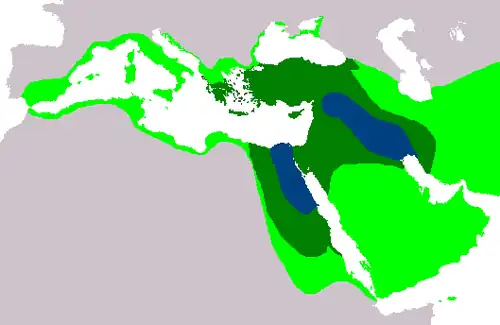
The Ugaritic alphabet is a combination of the system of the Semitic abjad with cuneiform writing methods (pressing a stylus into clay). At the time the Ugaritic script was in use (c. 1300 – c. 1190 BCE),[12] Ugarit, although not a great cultural or imperial centre, was located at the geographic centre of the literate world, among Egypt, Anatolia, Cyprus, Crete, and Mesopotamia.
Deducing the visual origin of any writing system can be notoriously difficult. This can be explained by a multiple-origin hypothesis as writing systems may not always have one single source for graphical inspiration. Due to the high abstractedness of Ugaritic characters, it is easy to find graphical similarities and phonological matches with many other scripts. One such example is "y" in hieratic 𓇌 matching Ugaritic 𐎊. Others have compared it's appearance to that of the Cypro-Minoan script. One can also argue that Ugaritic glyphs can be easily compared to common Akkadian cuneiform "equivalents" as exemplified in the table below.
| Akkadian | Ugaritic | ||
|---|---|---|---|
| la | 𒆷 | 𐎅 | l |
| ḫu | 𒄷 | 𐎈 | ḥ |
| ma | 𒈠 | 𐎎 | m |
| qu | 𒄣 | 𐎖 | q |
| pa | 𒉺 | 𐎔 | p |
| -a | 𒀀 | 𐎀 | a |
| -u | 𒌋 | 𐎓 | ʿ |
| za | 𒍝 | 𐎇 | z |
| za | 𒍝 | 𐎕 | ṣ |
No direct evidence for letter names has been found at Ugarit other than partial abecedaries showing their Akkadian cuneiform syllabic counterpart[13].
Some have suggested that Ugaritic represents some form of the Proto-Sinaitic script,[14] the letter forms distorted as an adaptation to writing on clay with a stylus. It has been proposed in this regard that the two basic shapes in cuneiform, a linear wedge, as in 𐎂, and a corner wedge, as in 𐎓, may correspond to lines and circles in the linear Semitic alphabets: the three Semitic letters with circles, preserved in the Greek Θ, O and Latin Q, are all made with corner wedges in Ugaritic: 𐎉 ṭ, 𐎓 ʕ, and 𐎖 q. Other letters look similar as well: 𐎅 h resembles its assumed Greek cognate E, while 𐎆 w, 𐎔 p, and 𐎘 θ are similar to Greek Y, Π, and Σ turned on their sides.[14] Due to what is arguably the current loss of interest in the field of Semitic epigraphy by the general public, the field today attracts fewer scholars motivated primarily by scientific advancement alone, with many also motivated by the interpretation of religious texts. Therefore one is invited to caution in concluding to a "Phoenician/Hebrew/Sinaitic" single-source origin of the Ugaritic alphabet as a more nuanced perspective may be necessary.
Jared Diamond[15] believes the alphabet was consciously designed, citing as evidence the possibility that the letters with the fewest strokes may have been the most frequent. The characters with the most strokes are s2, y, d and r. In a similar way Hugo Cartwright, a Franco-British software engineer, considers the possibility that syllabic compression of the Ugaritic language was a rule of thumb in the design choice of Ugaritic letters.
There may also have been a degree of influence from the poorly understood Byblos syllabary.[16]
Abecedaries
Lists of Ugaritic letters, abecedaria, have been found in two alphabetic orders. The "Northern Semitic order" is more similar to the one found in Phoenician, Hebrew and Arabic, the earlier, so-called ʾabjadī order, and more distantly, the Greek and Latin alphabets. The "Southern Semitic order" is more similar to the one found in the South Arabian, and the Geʽez scripts. The Ugaritic (U) letters are given in cuneiform and transliteration below. They are laid out in two dimensions as they were often written this way.
North Semitic
Read from left-to-right first and from top-to-bottom second.
| Letter: | 𐎀 | 𐎁 | 𐎂 | 𐎃 | 𐎄 | 𐎅 | 𐎆 | 𐎇 | 𐎈 | 𐎉 |
| Transliteration: | ʾa | b | g | ḫ | d | h | w | z | ḥ | ṭ |
| Letter: | 𐎊 | 𐎋 | 𐎌 | 𐎍 | 𐎎 | 𐎏 | 𐎐 | 𐎑 | 𐎒 | |
| Transliteration: | y | k | š | l | m | ḏ | n | ẓ | s | |
| Letter: | 𐎓 | 𐎔 | 𐎕 | 𐎖 | 𐎗 | 𐎘 | 𐎙 | 𐎚 | ||
| Transliteration: | ʿ | p | ṣ | q | r | ṯ | ġ | t | ||
| Letter: | 𐎛 | |||||||||
| Transliteration: | ʾi | |||||||||
| Letter: | 𐎜 | |||||||||
| Transliteration: | ʾu | |||||||||
| Letter: | 𐎝 | |||||||||
| Transliteration: | s2 |
South Semitic
Read from left-to-right first and from top-to-bottom second.
| Letter: | 𐎅 | 𐎍 | 𐎈 | 𐎎 | 𐎖 | 𐎆 | 𐎌 | 𐎗 | ||||
| Transliteration: | h | l | ḥ | m | q | w | š | r | ||||
| Letter: | [𐎁] | 𐎚 | 𐎒 | 𐎋 | 𐎐 | 𐎃 | 𐎁 | 𐎔 | 𐎀 | 𐎓 | 𐎑 | |
| Transliteration: | [b] | t | s | k | n | ḫ | b | p | ʾa | ʿ | ẓ | |
| Letter: | 𐎂 | 𐎄 | 𐎙 | 𐎉 | 𐎇 | 𐎏 | 𐎊 | 𐎘 | 𐎕 | [𐎛] | [𐎜] | [𐎝] |
| Transliteration: | g | d | ġ | ṭ | z | ḏ | y | ṯ | ṣ | [ʾi] | [ʾu] | [s2] |
Alphabetical order
North and South Semitic
Cartwright, describes the closeness in permutation space of two non-Ugaritic abecedaries' orders, one being considered an "abg" order and the other a "hlḥm" order. He achieves this by measuring rank closeness and by considering orders as gap buffered 2D objects.[17]
| A | B | G |
| W | H | D |
| H. | Z | T. |
| L | K | Y |
| M | N | S. |
| D. | P | O |
| Q | R | S |
| SH | TH | T |
| KH | Z. | DH |
| GH |
When read from top-to-bottom and left-to-right, this Maghrebian abjadi order can be compared to the abecedary Tay 19 found at Tayma[18][19].
| mod. Magh. abjadi | A | W | H. | L | M | D. | Q | SH | GH | B | H | Z | K | N | P | R | TH | Z. | G | D | T. | Y | S. | O | S | T | DH | KH | |||||
| Tay 19 | A | L | H. | M | Q | W | SH | R | B | T1 | S | K | N | GH | [S.] | S3 | [P] | [H] | [O] | D. | G | D | T2 | KH |
This is further reinforced by how letters S., P, H and O are scratched out in the Tay19 inscription.
Order proximity with Safaitic orders
RWQ 67
In his preprint on ordered set comparisons, Cartwright points out how Safaitic abecedary RWQ 67's order also closely resembles that found at Ugarit.
RWQ 67 reads: l m g ʿ n t b ḫ ḏ q d h ḍ y ẓ ġ f s² r w ṯ ṣ ṭ ḥ s¹ z ʾ k[20]
The following gap buffered table of a "vowel-less" RWQ 67-like can be read from top-to-bottom first. Reading the same table from left-to-right produces an equally vowel-less Ugaritic-like abecedary. This is most visible when swapping the "GH" with the "S Z P H. S. T." sections.
| G | B | KH | D | Z | H. | T. | SH | K | ||||
| L | M | |||||||||||
| N | DH | Z. | S | P | S. | Q | R | TH | GH | S2 | ||
| T |
MISSA2 and Amorite
Cartwright also considers the closeness of Safaitic abecedary MISSA2's alphabetical order with various orders including RWQ 67 itself. It can be noted that Nehmé and MacDonald and Al Muʾazzin describe MISSA2 as also grouping Safaitic letters visually which they show with the use of slashes:
MISSA2 reads: t ṯ y ʾ ṣ b r m l n ḫ h z k ḥ s¹ s² ġ f ḍ ṭ ʿ w g ḏ d ẓ q[21]
Cartwright underlines high permutation closeness of MISSA2 with the frequency of consonants used in the "Amorite Bilinguals" published by Krebernik and George.
He also found high permutation closeness between MISSA2 and compressed syllabic reconstructions of Ugaritic and Phoenician.
He suggests that the first characters of MISSA2 (t ṯ y ʾ ṣ b r) may play a special role and compares them to y ṣ ʿ s t underlined in the boustrophedon Maghrebian abjadi comparison with Tay 19.
Ugaritic short alphabet
Two shorter variants of the Ugaritic alphabet existed with findspots primarily not in the area of Ugarit. Findspots have included Tel Beit Shemesh, Sarepta, and Tiryns. It is generally found on inscribed objects vs the tablets of the standard Ugaritic alphabet and unlike the standard version it is usually written right to left.[22] One variant contained 27 letters and the other 22 letters. It is not known what the relative chronology of the different Ugaritic alphabets was.[23][24][25]
Unicode
Ugaritic script was added to the Unicode Standard in April, 2003 with the release of version 4.0.
The Unicode block for Ugaritic is U+10380–U+1039F:
| Ugaritic[1][2] Official Unicode Consortium code chart (PDF) | ||||||||||||||||
| 0 | 1 | 2 | 3 | 4 | 5 | 6 | 7 | 8 | 9 | A | B | C | D | E | F | |
| U+1038x | 𐎀 | 𐎁 | 𐎂 | 𐎃 | 𐎄 | 𐎅 | 𐎆 | 𐎇 | 𐎈 | 𐎉 | 𐎊 | 𐎋 | 𐎌 | 𐎍 | 𐎎 | 𐎏 |
| U+1039x | 𐎐 | 𐎑 | 𐎒 | 𐎓 | 𐎔 | 𐎕 | 𐎖 | 𐎗 | 𐎘 | 𐎙 | 𐎚 | 𐎛 | 𐎜 | 𐎝 | 𐎟 | |
| Notes | ||||||||||||||||
Six letters for transliteration were added to the Latin Extended-D block in March 2019 with the release of Unicode 12.0:[26]
- U+A7BA Ꞻ LATIN CAPITAL LETTER GLOTTAL A
- U+A7BB ꞻ LATIN SMALL LETTER GLOTTAL A
- U+A7BC Ꞽ LATIN CAPITAL LETTER GLOTTAL I
- U+A7BD ꞽ LATIN SMALL LETTER GLOTTAL I
- U+A7BE Ꞿ LATIN CAPITAL LETTER GLOTTAL U
- U+A7BF ꞿ LATIN SMALL LETTER GLOTTAL U
See also
- Old Persian cuneiform – a much later, unrelated attempt at a cuneiform semi-alphabet.
References
- ^ William M. Schniedewind, A Primer on Ugaritic, p. 32
- ^ Ugaritic, in The Ancient Languages of Syria-Palestine and Arabia
- ^ Ullendorf, Edward (July 1951). "Studies in the Ethiopic Syllabary". Africa: Journal of the International African Institute. 21 (3). Cambridge University Press: 207–217. doi:10.2307/1156593. JSTOR 1156593.
- ^ Coulmas, Florian (1991). The writing systems of the world. Wiley. ISBN 978-0-631-18028-9.
- ^ Schniedewind, William; Hunt, Joel (2007). A primer on Ugaritic. Cambridge University Press. ISBN 978-1-139-46698-1.
- ^ Ugaritic, in The Ancient Languages of Syria-Palestine and Arabia
- ^ Huehnergard, An Introduction to Ugaritic (2012), p. 21; Pardee, Ugaritic alphabetic cuneiform in the context of other alphabetic systems in Studies in ancient Oriental civilization (2007), p. 183.
- ^ Stanislave Segert, "The Last Sign of the Ugaritic Alphabet" in Ugaritic-Forschugen 15 (1983): 201–218
- ^ Healey, John F. (1990). "The Early Alphabet". Reading the Past: Ancient Writing from Cuneiform to the Alphabet. University of California Press. p. 216. ISBN 0-520-07431-9.
- ^ Daniels, Peter T.; Bright, William, eds. (1996). "Epigraphic Semitic Scripts". The World's Writing Systems. Oxford University Press, Inc. p. 92. ISBN 978-0-19-507993-7.
- ^ Kogan, Leonid (2011). "Tab. 6.2: Regular correspondences of the Proto-Semitic consonants". In Weninger, Stefan (ed.). The Semitic Languages: An International Handbook. Walter de Gruyter. p. 55. ISBN 978-3-11-025158-6.
- ^ Ugaritic, in The Ancient-Languages of Syria-Palestine and Arabia
- ^ "See Damascus Museum, RS 19.159". Charles Virolleaud, Royal Palace of Ugarit II, Textes en cunéiforme alphabétique des archives est, ouest et centrales, N. 189 (Damascus Museum, RS 19.159).
- ^ a b Brian Colless, Cuneiform alphabet and picto-proto-alphabet
- ^ Writing Right | Senses | DISCOVER Magazine
- ^ A Basic Grammar of the Ugaritic Language: With Selected Texts and Glossary, p. 19 by Stanislav Segert, 1985.
- ^ Cartwright, Hugo. "Permutation Space Closeness of Ordered Sets".
- ^ Macdonald, 1986
- ^ "OCIANA Tay 19".
- ^ A. Al-Jallad; M.C.A. Macdonald. "OCIANA RWQ 67".
- ^ Macdonald; Al Muʾazzin; Nehmé (1996). "Les inscriptions safaïtiques de Syrie, cent quarante ans après leur découverte". Comptes rendus des séances de l'AIBL: p 435-494.
{{cite journal}}:|pages=has extra text (help) - ^ [1]Fossé, Cécile, et al., "Archaeo-Material Study of the Cuneiform Tablet from Tel Beth-Shemesh", Tel Aviv 51.1, pp. 3-17, 2024
- ^ [2]Ferrara, Silvia, "A ‘top-down’ re-invention of an old form: Cuneiform alphabets in context", Understanding Relations Between Scripts II, pp. 15-51, 2020
- ^ Bordreuil, P., "Cunéiformes alphabétiques non canoniques", I. La tablette alphabétique sénestroverse RS 22.03’, Syria 58 (3–4), pp. 301–311, 1981
- ^ Dietrich, M. and Loretz, O., "Die Keilalphabete. Die phönizisch kanaanäischen und altarabischen Alphabete in Ugarit", Münster, 1988
- ^ Suignard, Michel (2017-05-09). "L2/17-076R2: Revised proposal for the encoding of an Egyptological YOD and Ugaritic characters" (PDF).
External links
- Download a Ugaritic font (includes Unicode font)
- Ugaritic cuneiform characters from the Unicode Ugaritic cuneiform script
- Ugaritic cuneiform Omniglot entry on the subject
- Ugaritic script (ancientscripts.com)
- Ugaritic writing Archived 2020-07-13 at the Wayback Machine
- GNU FreeFont Unicode font family with Ugaritic range in its sans-serif face.