English Renaissance theatre

The English Renaissance theatre or Elizabethan theatre was the theatre of England from 16th century until the middle or late 17th century. The English theatre scene, which performed both for the court and nobility in private performances and a very wide public in the theatres, was the most crowded in Europe, with a host of other playwrights as well as the giant figures of Christopher Marlowe, William Shakespeare and Ben Jonson. Elizabeth I herself was a product of Renaissance humanism trained by Roger Ascham, and wrote occasional poems such as "On Monsieur's Departure" at critical moments of her life.[1]
William Shakespeare, whose works include Hamlet, Romeo and Juliet, Macbeth, and A Midsummer Night's Dream, remains one of the most championed authors in English literature. The playwright and poet is widely regarded as the greatest dramatist of all time.[2][3][4]
Background
The term English Renaissance theatre encompasses the period between 1562—following a performance of Gorboduc, the first English play using blank verse, at the Inner Temple during the Christmas season of 1561—and the ban on theatrical plays enacted by the English Parliament in 1642. In a strict sense "Elizabethan" only refers to the period of Queen Elizabeth's reign (1558–1603). English Renaissance theatre may be said to encompass Elizabethan theatre from 1562 to 1603, Jacobean theatre from 1603 to 1625, and Caroline theatre from 1625 to 1642.
Theatre was an accessible art form for all participants in Renaissance England, being both highly sponsored by the aristocratic class and highly attended by the lower classes. Along with the economics of the profession, the character of the drama changed towards the end of the period. Under Elizabeth, the drama was a unified expression as far as social class was concerned: the Court watched the same plays the commoners saw in the public playhouses. With the development of the private theatres, drama became more oriented towards the tastes and values of an upper-class audience. By the later part of the reign of Charles I, few new plays were being written for the public theatres, which sustained themselves on the accumulated works of the previous decades.[5]
England had a strong tradition of literature in the English vernacular, which gradually increased as English use of the printing press became common by the mid-16th century.[6] This tradition of literature written in English vernacular largely began with the Protestant Reformation's call to let people interpret the Bible for themselves instead of accepting the interpretation of the Catholic Church. Discussions of how to translate the Bible so that it could be understood by laymen but remain faithful to God's word became contentious, with people arguing how much license could be taken to impart the correct meaning without sacrificing its eloquence. The desire to let people read the Bible for themselves led William Tyndale to publish his own translation in 1526, giving way to Sir Rowland Hill's publication of the Geneva Bible in 1560, marking the re-establishment of the Church of England at the accession of Elizabeth I. These would be predecessors to the King James Version of the Bible. By the time of Elizabethan literature, a vigorous literary culture in both drama and poetry included poets such as Edmund Spenser, whose verse epic The Faerie Queene had a strong influence on English literature but was eventually overshadowed by the lyrics of William Shakespeare, Thomas Wyatt and others. Typically, the works of these playwrights and poets circulated in manuscript form for some time before they were published, and above all the plays of English Renaissance theatre were the outstanding legacy of the period. The works of this period are also affected by Henry VIII's declaration of independence from the Catholic Church and technological advances in sailing and cartography, which are reflected in the generally nonreligious themes and various shipwreck adventures of Shakespeare.[7]
Sites of dramatic performance
Grammar schools
| Reformation-era literature |
|---|
The English grammar schools, like those on the continent, placed special emphasis on the trivium: grammar, logic, and rhetoric. Though rhetorical instruction was intended as preparation for careers in civil service such as law, the rhetorical canons of memory (memoria) and delivery (pronuntiatio), gesture and voice, as well as exercises from the progymnasmata, such as the prosopopoeia, taught theatrical skills.[8][9] Students would typically analyse Latin and Greek texts, write their own compositions, memorise them, and then perform them in front of their instructor and their peers.[10] Records show that in addition to this weekly performance, students would perform plays on holidays,[11] and in both Latin and English.[12]
Choir schools
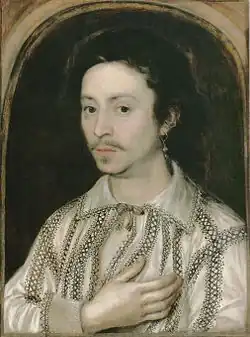
Choir schools connected with the Elizabethan court included St. George’s Chapel, the Chapel Royal, and St. Paul’s.[13] These schools performed plays and other court entertainments for the Queen.[14] Between the 1560s and 1570s these schools had begun to perform for general audiences as well.[15] Playing companies of boy actors were derived from choir schools.[16] John Lyly is an earlier example of a playwright contracted to write for the children's companies; Lyly wrote Gallathea, Endymion, and Midas for Paul’s Boys.[17] Another example is Ben Jonson, who wrote Cynthia’s Revels.[18]
Universities
Academic drama stems from late medieval and early modern practices of miracles and morality plays as well as the Feast of Fools and the election of a Lord of Misrule.[19] The Feast of Fools includes mummer plays.[20] The universities, particularly Oxford and Cambridge, were attended by students studying for bachelor's degrees and master's degrees, followed by doctorates in Law, Medicine, and Theology.[21] In the 1400s, dramas were often restricted to mummer plays with someone who read out all the parts in Latin.[22] With the rediscovery and redistribution of classical materials during the English Renaissance, Latin and Greek plays began to be restaged.[23] These plays were often accompanied by feasts.[24] Queen Elizabeth I viewed dramas during her visits to Oxford and Cambridge.[25] A well-known play cycle which was written and performed in the universities was the Parnassus Plays.[19]
Inns of Court
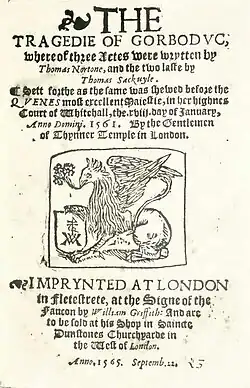
Upon graduation, many university students, especially those going into law, would reside and participate in the Inns of Court. The Inns of Court were communities of working lawyers and university alumni.[26] Notable literary figures and playwrights who resided in the Inns of Court include John Donne, Francis Beaumont, John Marston, Thomas Lodge, Thomas Campion, Abraham Fraunce, Sir Philip Sidney, Sir Thomas More, Sir Francis Bacon, and George Gascoigne.[27][28] Like the university, the Inns of Court elected their own Lord of Misrule.[29] Other activities included participation in moot court, disputation, and masques.[29][28] Plays written and performed in the Inns of Court include Gorboduc, Gismund of Salerne, and The Misfortunes of Arthur.[28] An example of a famous masque put on by the Inns was James Shirley's The Triumph of Peace. Shakespeare's The Comedy of Errors and Twelfth Night were also performed here, although written for commercial theater.[30]
Masque
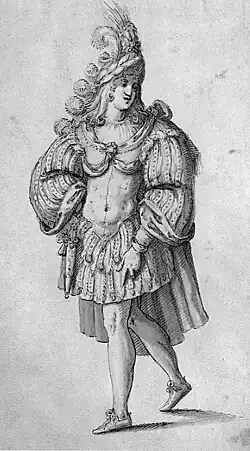
Tudor court masques developed from earlier guisings, where a masked allegorical figure would appear and address the assembled company—providing a theme for the occasion—with musical accompaniment.[31] Costumes were designed by professionals, including Niccolo da Modena.[32] Elizabeth of York paid for costumes for "disguysings" in June and December 1502. Minstrels were dressed in white and green Tudor livery.[33] Henry VIII came to Catherine of Aragon's chamber disguised as Robin Hood in January 1510, perhaps causing initial uneasiness, and there was dancing.[34][35][36]
Hall's Chronicle explained the new fashion of masque at the English court in 1512.[37] The essential feature was the entry of disguised dancers and musicians to a banquet. They would appear in character and perform, and then dance with the guests, and then leave the venue.[38] At the meeting at Lille in October 1513, when the ladies were dancing after a banquet, Henry VIII and eleven other dancers entered "richely appareled with bonettes of gold". At the conclusion of their performance they gave their masque costumes to the audience.[39]
On 1 May 1515, Henry VIII and Catherine of Aragon rode from Greenwich Palace to have breakfast in an arbour constructed in a wood at Shooter's Hill. Catherine and her ladies were dressed in Spanish-style riding gear, Henry was in green velvet. The royal guard appeared in disguise as Robin Hood and his men. There was a pageant chariot or car with Lady May and Lady Flora, followed by a masque and dancing.[40]
According to George Cavendish, in January 1527 Henry VIII came to Cardinal Wolsey's Hampton Court or York Place, by boat "in a masque with a dozen of other maskers all in garments like shepherds made of fine cloth of gold and fine crimson satin paned, and caps of the same with visors", wearing false beards, accompanied with torch bearers and drummers. Their arrival at the palace water gate was announced by cannon fire. The King's part of the entertainment was organised by William Sandys and Henry Guildford. The masquers played a dice game called mumchance before dancing.[41][42] Edward Hall described similar masques involving the king's disguised appearance.[43]
In the play Henry VIII, by Fletcher and Shakespeare, Wolsey's masques were recalled when Henry in shepherd's disguise meets Anne Boleyn.[44][45][46] Anne Boleyn and seven ladies in "maskyng apparel of straunge fashion" performed for Henry VIII and Francis I of France at Calais on 27 October 1532.[47] Some of the costume, supplied by the yeoman of the revels Richard Gibson, was described as "masking gere".[48]
Inventories of masque costume at the court of Henry VIII made when Catherine Howard was queen include lists of "maskyng garmentes" for men and for women. The women's costumes included coifs, partlets, upper garments, kirtles, and a set of "high heads after Dutch fashion of striped lawn".[49] Masques at Elizabeth I's court emphasized the concord and unity between Queen and Kingdom. A descriptive narrative of a processional masque is the masque of the Seven Deadly Sins in Edmund Spenser's The Faerie Queene (Book i, Canto IV). A particularly elaborate masque, performed over the course of two weeks for Queen Elizabeth, is described in the 1821 novel Kenilworth, by Sir Walter Scott. Queen Elizabeth was entertained at country houses during her progresses with performances like the Harefield Entertainment.[50]
William Shakespeare included a masque-like interlude in The Tempest, understood by modern scholars to have been heavily influenced by the masques of Ben Jonson and the stagecraft of Inigo Jones. There is also a masque sequence in his Romeo and Juliet and Henry VIII. John Milton's Comus (with music by Henry Lawes) is described as a masque, though it is generally reckoned a pastoral play.
There is a detailed, humorous, and malicious (and possibly completely fictitious) account by Sir John Harington in 1606 of a masque of Solomon and Sheba at Theobalds.[51] Harington was not so much concerned with the masque itself as with the notoriously heavy drinking at the Court of King James I; "the entertainment went forward, and most of the presenters went backward, or fell down, wine did so occupy their upper chambers". As far as we can ascertain the details of the masque, the Queen of Sheba was to bring gifts to the King, representing Solomon, and was to be followed by the spirits of Faith, Hope, Charity, Victory and Peace. Unfortunately, as Harington reported, the actress playing the Queen tripped over the steps of the throne, sending her gifts flying; Hope and Faith were too drunk to speak a word, while Peace, annoyed at finding her way to the throne blocked, made good use of her symbolic olive branches to slap anyone who was in her way.[52]
Francis Bacon paid for The Masque of Flowers to celebrate the marriage of Robert Carr, 1st Earl of Somerset and Frances Howard, Countess of Somerset.[53] James Hay, 1st Earl of Carlisle, was a performer and sponsor of court masques. He wrote about the tight-fitting costumes, that it was the fashion "to appear very small in the waist, I remember was drawn up from the ground by both hands whilst the tailor with all his strength buttoned on my doublet".[54] Masques were also performed as private entertainments in country houses. In February 1618, The Coleorton Masque was staged at Coleorton Hall in Leicestershire by Thomas Beaumont.[55] The 14 year old Rachel Fane wrote The May Masque for performance at her parents' mansion Apethorpe in Northamptonshire.[56]
Establishment of playhouses
The first permanent English theatre, the Red Lion, opened in 1567[57] but it was a short-lived failure. The first successful theatres, such as The Theatre, opened in 1576. The establishment of large and profitable public theatres was an essential enabling factor in the success of English Renaissance drama. Once they were in operation, drama could become a fixed and permanent, rather than transitory, phenomenon. Their construction was prompted when the Mayor and Corporation of London first banned plays in 1572 as a measure against the plague, and then formally expelled all players from the city in 1575.[58] This prompted the construction of permanent playhouses outside the jurisdiction of London, in the liberties of Halliwell/Holywell in Shoreditch and later the Clink, and at Newington Butts near the established entertainment district of St. George's Fields in rural Surrey.[58] The Theatre was constructed in Shoreditch in 1576 by James Burbage with his brother-in-law John Brayne (the owner of the unsuccessful Red Lion playhouse of 1567)[59] and the Newington Butts playhouse was set up, probably by Jerome Savage, some time between 1575[60] and 1577.[61] The Theatre was rapidly followed by the nearby Curtain Theatre (1577), the Rose (1587), the Swan (1595), the Globe (1599), the Fortune (1600), and the Red Bull (1604).[a]
Elsewhere, the Vagabonds Act 1572 left itinerant actors liable to prosecution as vagrants and caused them to seek wealthy sponsors who could provide a permanent play house for them. At the same time, members of the aristocracy found it useful to have a playing company available to entertain royal or noble guests and thus advance their social status.[62]
Playhouse architecture
.jpg)
Archaeological excavations on the foundations of the Rose and the Globe in the late 20th century showed that all the London theatres had individual differences, but their common function necessitated a similar general plan.[63] The public theatres were three stories high and built around an open space at the centre. Usually polygonal in plan to give an overall rounded effect, although the Red Bull and the first Fortune were square. The three levels of inward-facing galleries overlooked the open centre, into which jutted the stage: essentially a platform surrounded on three sides by the audience. The rear side was restricted for the entrances and exits of the actors and seating for the musicians. The upper level behind the stage could be used as a balcony, as in Romeo and Juliet and Antony and Cleopatra, or as a position from which an actor could harangue a crowd, as in Julius Caesar.[64] The pit was the place where the poorest audience members could view the show. Around the 1600s a new area was introduced into the theaters, a 'gullet'. A gullet was an invisible corridor that the actors used to go to the wings of the stage where people usually changed clothes quickly.
The playhouses were generally built with timber and plaster. Individual theatre descriptions give additional information about their construction, such as flint stones being used to build the Swan. Theatres were also constructed to be able to hold a large number of people.[65] A different model was developed with the Blackfriars Theatre, which came into regular use on a long-term basis in 1599.[b] The Blackfriars was small in comparison to the earlier theatres and roofed rather than open to the sky. It resembled a modern theatre in ways that its predecessors did not. Other small enclosed theatres followed, notably the Whitefriars (1608) and the Cockpit (1617). With the building of the Salisbury Court Theatre in 1629 near the site of the defunct Whitefriars, the London audience had six theatres to choose from: three surviving large open-air public theatres—the Globe, the Fortune, and the Red Bull—and three smaller enclosed private theatres: the Blackfriars, the Cockpit, and the Salisbury Court.[c] Audiences of the 1630s benefited from a half-century of vigorous dramaturgical development; the plays of Marlowe and Shakespeare and their contemporaries were still being performed on a regular basis, mostly at the public theatres, while the newest works of the newest playwrights were abundant as well, mainly at the private theatres.
Audiences
Around 1580, when both the Theater and the Curtain were full on summer days, the total theater capacity of London was about 5000 spectators. With the building of new theater facilities and the formation of new companies, London's total theater capacity exceeded 10,000 after 1610.[66] Ticket prices in general varied during this time period. The cost of admission was based on where in the theatre a person wished to be situated, or based on what a person could afford. If people wanted a better view of the stage or to be more separate from the crowd, they would pay more for their entrance. Due to inflation that occurred during this time period, admission increased in some theaters from a penny to a sixpence or even higher.[67]
Commercial theaters were largely located just outside the boundaries of the City of London, since City authorities tended to be wary of the adult playing companies, but plays were performed by touring companies all over England.[68] English companies even toured and performed English plays abroad, especially in Germany and in Denmark.[69][d] Upper class spectators would pay for seats in the galleries, using cushions for comfort. In the Globe Theatre, nobles could sit directly by the side on the stage.[71]
Performances
The acting companies functioned on a repertory system: unlike modern productions that can run for months or years on end, the troupes of this era rarely acted the same play two days in a row.[72] Thomas Middleton's A Game at Chess ran for nine straight performances in August 1624 before it was closed by the authorities; but this was due to the political content of the play and was a unique, unprecedented and unrepeatable phenomenon. The 1592 season of Lord Strange's Men at the Rose Theatre was far more representative: between 19 February and 23 June the company played six days a week, minus Good Friday and two other days. They performed 23 different plays, some only once, and their most popular play of the season, The First Part of Hieronimo, based on Kyd's The Spanish Tragedy, 15 times. They never played the same play two days in a row, and rarely the same play twice in a week.[73][e] The workload on the actors, especially the leading performers like Richard Burbage or Edward Alleyn, must have been tremendous.
One distinctive feature of the companies was that only men or boys performed. Female parts were played by adolescent boy players in women's costume. Some companies were composed entirely of boy players.[f] Performances in the public theatres (like the Globe) took place in the afternoon with no artificial lighting, but when, in the course of a play, the light began to fade, candles were lit.[76] In the enclosed private theatres (like the Blackfriars) artificial lighting was used throughout. Plays contained little to no scenery as the scenery was described by the actors or indicated by costume through the course of the play.[77]
In the Elizabethan era, research has been conclusive about how many actors and troupes there were in the 16th century, but little research delves into the roles of the actors on the English renaissance stage. The first point is that during the Elizabethan era, women were not allowed to act on stage. The actors were all male; in fact, most were boys. For plays written that had male and female parts, the female parts were played by the youngest boy players.[78] Stronger female roles in tragedies were acted by older boy players because they had more experience.[78] As a boy player, many skills had to be implemented such as voice and athleticism (fencing was one).[78]
In Elizabethan entertainment, troupes were created and they were considered the actor companies. They travelled around England as drama was the most entertaining art at the time. Elizabethan actors never played the same show on successive days and added a new play to their repertoire every other week. These actors were getting paid within these troupes so for their job, they would constantly learn new plays as they toured different cities in England. In these plays, there were bookkeepers that acted as the narrators of these plays and they would introduce the actors and the different roles they played. At some points, the bookkeeper would not state the narrative of the scene, so the audience could find out for themselves. In Elizabethan and Jacobean plays, the plays often exceeded the number of characters/roles and did not have enough actors to fulfil them, thus the idea of doubling roles came to be.[79] Doubling roles is used to reinforce a plays theme by having the actor act out the different roles simultaneously.[80] The reason for this was for the acting companies to control salary costs, or to be able to perform under conditions where resources such as other actor companies lending actors were not present.[80]
There were two acting styles implemented: formal and natural. Formal acting is objective and traditional, while natural acting attempts to create an illusion for the audience by remaining in character and imitating the fictional circumstances. The formal actor symbolises while the natural actor interprets. The natural actor impersonates while the formal actor represents the role. Natural and formal are opposites of each other, where natural acting is subjective. Overall, the use of these acting styles and the doubled roles dramatic device made Elizabethan plays very popular.[81]
Costumes
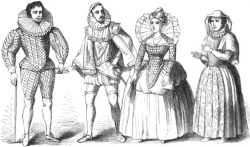
One of the main uses of costume was to create visual effects for the audience, and it was an integral part of the overall performance.[82] Since the main visual appeal on stage were the costumes, they were often bright in colour and visually entrancing. Colours symbolized social hierarchy, and costumes were made to reflect that. For example, if a character was royalty, their costume would include purple. The colours, as well as the different fabrics of the costumes, allowed the audience to know the status of each character when they first appeared on stage.[83]
Costumes were collected in inventory. More often than not, costumes wouldn't be made individually to fit the actor. Instead, they would be selected out of the stock that theatre companies would keep. A theatre company reused costumes when possible and would rarely get new costumes made. The most expensive pieces were given to higher class characters because costuming was used to identify social status on stage. The fabrics within a playhouse would indicate the wealth of the company itself. The fabrics used the most were: velvet, satin, silk, cloth-of-gold, lace and ermine.[84]
Actors also left clothes in their will for following actors to use. Masters would also leave clothes for servants in their will, but servants weren't allowed to wear fancy clothing, instead, they sold the clothes back to theatre companies.[83] n the Tudor and Elizabethan eras, there were laws stating that certain classes could only wear clothing fitting of their status in society. There was a discrimination of status within the classes. Higher classes flaunted their wealth and power through the appearance of clothing, however, courtesans and actors were the only exceptions – as clothing represented their 'working capital', as it were, but they were only permitted to dress so while working. If actors belonged to a licensed acting company, they were allowed to dress above their standing in society for specific roles in a production.[85]
Playwrights
The growing population of London, the growing wealth of its people, and their fondness for spectacle produced a dramatic literature of remarkable variety, quality and extent. About 3,000 plays were written for the Elizabethan stage, and although most of them have been lost, at least 543 remain.[86][87] The people who wrote these plays were primarily self-made men from modest backgrounds.[g] Some of them were educated at either Oxford or Cambridge, but many were not. Although William Shakespeare and Ben Jonson were actors, the majority do not seem to have been performers, and no major author who came on to the scene after 1600 is known to have supplemented his income by acting. Their lives were subject to the same levels of danger and earlier mortality as all who lived during the early modern period: Christopher Marlowe was killed in an apparent tavern brawl, while Ben Jonson killed an actor in a duel. Several were probably soldiers.
Playwrights were normally paid in increments during the writing process, and if their play was accepted, they would also receive the proceeds from one day's performance. However, they had no ownership of the plays they wrote. Once a play was sold to a company, the company owned it, and the playwright had no control over casting, performance, revision or publication. The profession of dramatist was challenging and far from lucrative.[89] Entries in Philip Henslowe's Diary show that in the years around 1600 Henslowe paid as little as £6 or £7 per play. This was probably at the low end of the range, though even the best writers could not demand too much more. A playwright, working alone, could generally produce two plays a year at most. In the 1630s Richard Brome signed a contract with the Salisbury Court Theatre to supply three plays a year, but found himself unable to meet the workload. Shakespeare produced fewer than 40 solo plays in a career that spanned more than two decades: he was financially successful because he was an actor and, most importantly, a shareholder in the company for which he acted and in the theatres they used. Ben Jonson achieved success as a purveyor of Court masques, and was talented at playing the patronage game that was an important part of the social and economic life of the era. Those who were purely playwrights fared far less well: the biographies of early figures like George Peele and Robert Greene, and later ones like Brome and Philip Massinger, are marked by financial uncertainty, struggle and poverty.
Playwrights dealt with the natural limitation on their productivity by combining into teams of two, three, four, and even five to generate play texts. The majority of plays written in this era were collaborations, and the solo artists who generally eschewed collaborative efforts, like Jonson and Shakespeare, were the exceptions to the rule. Dividing the work, of course, meant dividing the income; but the arrangement seems to have functioned well enough to have made it worthwhile. Of the 70-plus known works in the canon of Thomas Dekker, roughly 50 are collaborations. In a single year (1598) Dekker worked on 16 collaborations for impresario Philip Henslowe, and earned £30, or a little under 12 shillings per week—roughly twice as much as the average artisan's income of 1s. per day.[90] At the end of his career, Thomas Heywood would famously claim to have had "an entire hand, or at least a main finger" in the authorship of some 220 plays. A solo artist usually needed months to write a play (though Jonson is said to have done Volpone in five weeks); Henslowe's Diary indicates that a team of four or five writers could produce a play in as little as two weeks. Admittedly, though, the Diary also shows that teams of Henslowe's house dramatists—Anthony Munday, Robert Wilson, Richard Hathwaye, Henry Chettle, and the others, even including a young John Webster—could start a project, and accept advances on it, yet fail to produce anything stageworthy.[91]
Timeline of English Renaissance playwrights
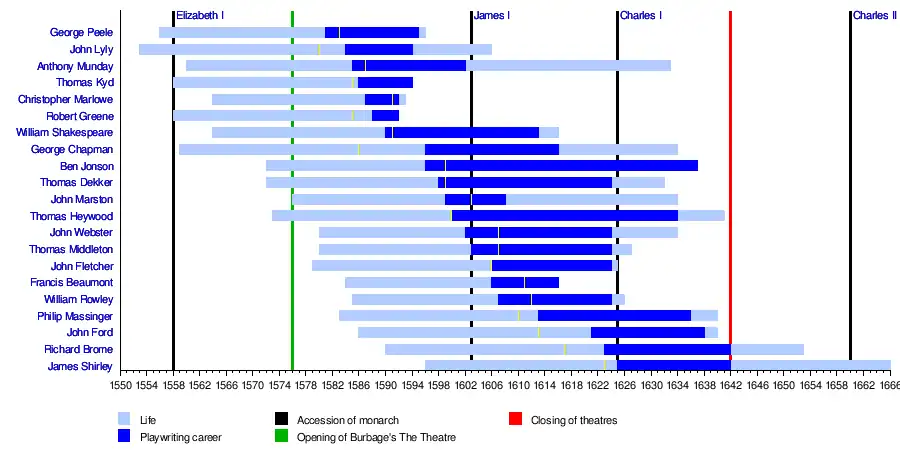
Short yellow lines indicate 27 years—the average age these authors began their playwriting careers
Genres
Genres of the period included the history play, which depicted English or European history. Shakespeare's plays about the lives of kings, such as Richard III and Henry V, belong to this category, as do Christopher Marlowe's Edward II and George Peele's Famous Chronicle of King Edward the First. History plays also dealt with more recent events, like A Larum for London which dramatizes the sack of Antwerp in 1576. A better known play, Peele's The Battle of Alcazar (c. 1591), depicts the battle of Alcácer Quibir in 1578.
Tragedy was a very popular genre. Marlowe's tragedies were exceptionally successful, such as Dr. Faustus and The Jew of Malta. The audiences particularly liked revenge dramas, such as Thomas Kyd's The Spanish Tragedy. The four tragedies considered to be Shakespeare's greatest (Hamlet, Othello, King Lear and Macbeth) were composed during this period. Comedies were common, too. A subgenre developed in this period was the city comedy, which deals satirically with life in London after the fashion of Roman New Comedy. Examples are Thomas Dekker's The Shoemaker's Holiday and Thomas Middleton's A Chaste Maid in Cheapside.
Though marginalised, the older genres like pastoral (The Faithful Shepherdess, 1608), and even the morality play (Four Plays in One, ca. 1608–13) could exert influences. After about 1610, the new hybrid subgenre of the tragicomedy enjoyed an efflorescence, as did the masque throughout the reigns of the first two Stuart kings, James I and Charles I. Plays on biblical themes were common, Peele's David and Bethsabe being one of the few surviving examples.
Printed texts
Only a minority of the plays of English Renaissance theatre were ever printed. Of Heywood's 220 plays, only about 20 were published in book form.[92] A little over 600 plays were published in the period as a whole, most commonly in individual quarto editions. (Larger collected editions, like those of Shakespeare's, Ben Jonson's, and Beaumont and Fletcher's plays, were a late and limited development.) Through much of the modern era, it was thought that play texts were popular items among Renaissance readers that provided healthy profits for the stationers who printed and sold them. By the turn of the 21st century, the climate of scholarly opinion shifted somewhat on this belief: some contemporary researchers argue that publishing plays was a risky and marginal business[93]—though this conclusion has been disputed by others.[94] Some of the most successful publishers of the English Renaissance, like William Ponsonby or Edward Blount, rarely published plays.
A small number of plays from the era survived not in printed texts but in manuscript form.[h]
Music
The music of English Renaissance theatre played a pivotal role in shaping the theatrical experience of the time. This period was marked by a flourishing music serving as a vital component of theatrical productions. Composers and musicians created a rich tapestry of melodies that complemented the spoken word, enhancing the emotional depth and narrative of the plays. The integration of music into performances was not merely an afterthought; it was carefully crafted to resonate with the audience, often reflecting the themes and moods of the scenes. Music was diverse, ranging from lively dance tunes to somber ballads. The use of instruments such as lutes, viols, and recorders added layers of texture to the performances, while vocal music often featured harmonies that captivated listeners.[95]
Theatres became hubs for this musical innovation, where playwrights like Shakespeare and Marlowe collaborated with musicians to create works that were not only visually stunning but also sonically rich. Songs were strategically placed within the dialogue, allowing characters to express their innermost thoughts and feelings, thus deepening the audience's connection to the story. Moreover, the music of this era was influenced by the broader cultural shifts occurring in England, including the rise of humanism and the exploration of new ideas. This led to a greater emphasis on individual expression and emotional authenticity in both music and theatre. As a result, the compositions from this time often reflected the complexities of human experience, from love and joy to despair and conflict.[96]
The end of English Renaissance theatre
The rising Puritan movement was hostile toward theatre, as they felt that "entertainment" was sinful. Politically, playwrights and actors were clients of the monarchy and aristocracy, and most supported the Royalist cause. The Puritan faction, long powerful in London, gained control of the city early in the First English Civil War, and on 2 September 1642, the Long Parliament, pushed by the Parliamentarian party, under Puritan influence, banned the staging of plays in the London theatres though it did not, contrary to what is commonly stated, order the closure, let alone the destruction, of the theatres themselves:
Whereas the distressed Estate of Ireland, steeped in her own Blood, and the distracted Estate of England, threatened with a Cloud of Blood by a Civil War, call for all possible Means to appease and avert the Wrath of God, appearing in these Judgements; among which, Fasting and Prayer, having been often tried to be very effectual, having been lately and are still enjoined; and whereas Public Sports do not well agree with Public Calamities, nor Public Stage-plays with the Seasons of Humiliation, this being an Exercise of sad and pious Solemnity, and the other being Spectacles of Pleasure, too commonly expressing lascivious Mirth and Levity: It is therefore thought fit, and Ordained, by the Lords and Commons in this Parliament assembled, That, while these sad causes and set Times of Humiliation do continue, Public Stage Plays shall cease, and be forborn, instead of which are recommended to the People of this Land the profitable and seasonable considerations of Repentance, Reconciliation, and Peace with God, which probably may produce outward Peace and Prosperity, and bring again Times of Joy and Gladness to these Nations.
— His Majesty's Stationery Office, Acts and Ordinances of the Interregnum, 1642–1660, "September 1642: Order for Stage-plays to cease"[97]
The Act purports the ban to be temporary ("... while these sad causes and set Times of Humiliation do continue, Public Stage Plays shall cease and be forborn") but does not assign a time limit to it.
Even after 1642, during the English Civil War and the ensuing Interregnum (English Commonwealth), some English Renaissance theatre continued. For example, short comical plays called drolls were allowed by the authorities, while full-length plays were banned. The theatre buildings were not closed but rather were used for purposes other than staging plays.[i]
The performance of plays remained banned for most of the next eighteen years, becoming allowed again after the Restoration of the monarchy in 1660. The theatres began performing many of the plays of the previous era, though often in adapted forms. New genres of Restoration comedy and spectacle soon evolved, giving English theatre of the later seventeenth century its distinctive character.
List of playwrights
- William Alabaster[88]
- William Alexander, 1st Earl of Stirling
- Robert Armin
- Barnabe Barnes
- Lording Barry
- Francis Beaumont
- William Berkeley
- William Bird
- Samuel Brandon
- Antony Brewer
- Richard Brome
- Samuel Brooke
- William Browne (poet)
- Thomas Campion
- Lodowick Carlell
- William Cartwright
- Elizabeth Cary, Viscountess Falkland
- Robert Cecil, 1st Earl of Salisbury
- George Chapman
- Henry Cheke
- Henry Chettle
- John Clavell
- Anthony Chute
- Robert Daborne
- Samuel Daniel
- William Davenant
- Robert Davenport
- John Davidson
- John Day
- Thomas Dekker
- Michael Drayton
- Richard Edwardes
- George Ferebe
- Nathan Field
- John Fletcher
- Phineas Fletcher
- John Ford
- Abraham Fraunce
- Ulpian Fulwell
- William Gager
- George Gascoigne
- Henry Glapthorne
- Thomas Goffe
- Arthur Golding
- Robert Greene
- Fulke Greville
- Matthew Gwinne
- William Haughton
- Walter Hawkesworth
- Mary Herbert
- Thomas Heywood
- Thomas Hughes
- Thomas Ingelend
- John Jeffere
- Ben Jonson
- Henry Killigrew
- Thomas Killigrew
- Thomas Kyd
- Sir Henry Lee
- Thomas Legge
- Thomas Lodge
- Thomas Lupton
- John Lyly
- Lewis Machin
- Francis Marbury
- Gervase Markham
- Christopher Marlowe
- Shackerley Marmion
- John Marston
- John Mason
- Philip Massinger
- Thomas May
- Thomas Middleton
- Anthony Munday
- Thomas Nabbes
- Thomas Nashe
- Thomas Nelson
- Thomas Norton
- George Peele
- William Percy
- John Phillip
- John Pickering (dramatist)
- Henry Porter
- Thomas Preston
- Samuel Rowley
- William Rowley
- George Ruggle
- Joseph Rutter
- Thomas Sackville
- William Sampson
- William Shakespeare
- Edward Sharpham
- James Shirley
- Sir Philip Sidney
- Wentworth Smith
- John Stephens
- Sir John Suckling
- Robert Tailor
- Richard Tarlton
- Thomas Tomkis
- Cyril Tourneur
- Francis Verney
- William Wager
- George Wapull
- William Warner (poet)
- John Webster
- George Whetstone
- George Wilkins
- Robert Wilmot
- Arthur Wilson
- Robert Wilson
- Nathaniel Woodes
- Robert Yarington
Actors
- William Alabaster
- Edward Alleyn
- Robert Armin
- William Barksted
- Richard Brome
- Richard Burbage
- William Cavendish
- Henry Condell
- Nathan Field
- Alexander Gough
- Thomas Greene
- Richard Gunnell
- Stephen Hammerton
- Charles Hart
- John Heminges
- Thomas Heywood
- John Honyman
- Ben Jonson
- Will Kempe
- John Lowin
- William Ostler
- Andrew Pennycuicke
- Augustine Phillips
- Thomas Pollard
- Thomas Pope
- Timothy Read
- Richard Robinson
- Samuel Rowley
- William Rowley
- William Shakespeare
- William Sly
- Robert Wilson
Playhouses
- Blackfriars Theatre
- Cockpit Theatre
- Cockpit-in-Court
- Inn-yard theatres
- Newington Butts Theatre
- Red Bull Theatre
- Red Lion (theatre)
- Salisbury Court Theatre
- The Curtain
- The Fortune
- The Globe
- The Hope
- The Phoenix
- The Rose
- The Swan
- The Theatre
- Whitefriars Theatre
Playing companies
- King's Revels Children
- King's Revels Men
- Lady Elizabeth's Men
- Leicester's Men
- Lord Strange's Men (later Derby's Men)
- Oxford's Boys
- Oxford's Men
- Pembroke's Men
- Prince Charles's Men
- Queen Anne's Men
- Queen Elizabeth's Men
- Queen Henrietta's Men
- The Admiral's Men
- The Children of Paul's
- The Children of the Chapel (Queen's Revels)
- The King's Men
- The Lord Chamberlain's Men
- Sussex's Men
- Warwick's Men
- Worcester's Men
Timeline of English Renaissance playing companies
English Renaissance playing company timeline
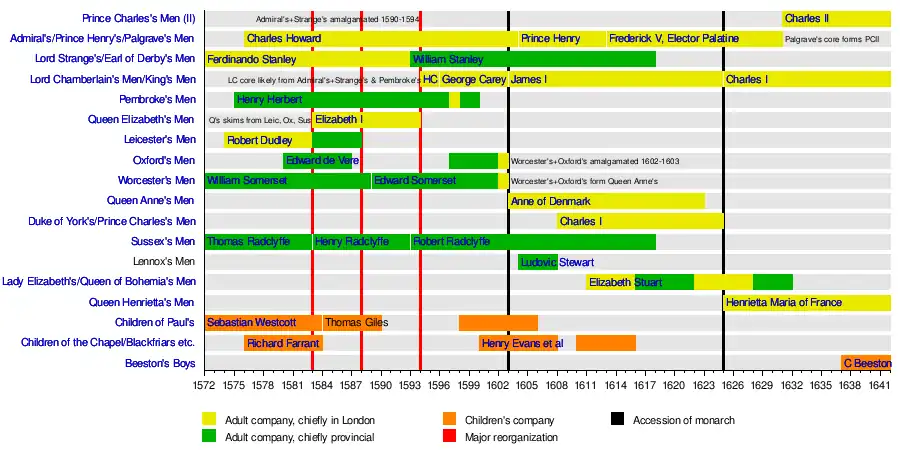
This timeline charts the existence of major English playing companies from 1572 ("Acte for the punishment of Vacabondes", which legally restricted acting to players with a patron of sufficient degree) to 1642 (the closing of the theatres by Parliament). A variety of strolling players, and even early London-based troupes existed before 1572. The situations were often fluid, and much of this history is obscure; this timeline necessarily implies more precision than exists in some cases. The labels down the left indicate the most common names for the companies. The bar segments indicate the specific patron. In the case of children's companies (a distinct legal situation) some founders are noted.
Other significant figures
- Susan Baskervile, investor and litigant
- William Beeston, manager
- George Buc, Master of the Revels 1609–1622
- Cuthbert Burbage, entrepreneur
- James Burbage, entrepreneur
- Ralph Crane, scribe
- Philip Henslowe, entrepreneur
- Henry Herbert, Master of the Revels 1623–1673
- Edward Knight, prompter
- Francis Langley, entrepreneur
- John Rhodes, manager
- Edmund Tilney, Master of the Revels 1579–1609
See also
- Accession Day tilt
- History of theatre
- The Subject of Tragedy by Catherine Belsey
Notes and references
Notes
- ^ A complete roster of what the Elizabethans called "public" theatres would include the Boar's Head Inn (1598), and the Hope Theatre (1613), neither of them major venues for drama in the era.
- ^ The Blackfriars site was used as a theatre in the 1576–84 period; but it became a regular venue for drama only later.
- ^ Other "private" theaters of the era included the theatre near St Paul's Cathedral used by the Children of Paul's (1575) and the occasionally used Cockpit-in-Court (1629).
- ^ For example, Romeo and Juliet was performed in Nördlingen in 1605.[70]
- ^ E. K. Chambers' The Elizabethan Stage (1923), reflects an earlier interpretation of the identity of the Hieronimo play.[74]
- ^ For example the King's Revels Children, Children of Paul's, and the Children of the Chapel. Shakespeare even alludes to such companies, with a certain amount of scorn, in Hamlet act 2, scene 2.[75]
- ^ A few aristocratic women engaged in closet drama or dramatic translations. Chambers lists Elizabeth, Lady Cary; Mary Herbert, Countess of Pembroke; Jane, Lady Lumley; and Elizabeth Tudor.[88]
- ^ For example Sir Thomas More, John of Bordeaux, Believe as You List, and Sir John van Olden Barnavelt.
- ^ See for example the Red Bull Theatre and Robert Cox
References
- ^ "The story of theatre · V&A". Victoria and Albert Museum. Retrieved 16 January 2024.
- ^ "William Shakespeare (English author)". Britannica Online encyclopedia. Archived from the original on 31 August 2012. Retrieved 26 February 2006.
- ^ MSN Encarta Encyclopedia article on Shakespeare. Archived from the original on 9 February 2006. Retrieved 26 February 2006.
- ^ Rogers 2001, p. 135.
- ^ Gurr 2009, pp. 12–18.
- ^ "Key features of Renaissance culture Andrew Dickson, "An English Renaissance: Key features of Renaissance culture". British Library online, 2017". Archived from the original on 14 January 2021. Retrieved 9 January 2021.
- ^ "Life in Renaissance England". www.uh.edu. Archived from the original on 23 January 2018. Retrieved 5 December 2015.
- ^ Christiansen 1997.
- ^ Astington 2010, p. 45.
- ^ Christiansen 1997, p. 298.
- ^ Astington 2010, p. 42.
- ^ Astington 2010, p. 43.
- ^ Astington 2010, p. 49.
- ^ Astington 2010, pp. 48–50.
- ^ Astington 2010, p. 51.
- ^ Gurr 2009, p. 45.
- ^ Astington 2010, p. 54.
- ^ Gurr 2009, pp. 67–68.
- ^ a b Boas 1914, p. 346.
- ^ Boas 1914, p. 8.
- ^ Boas 1914, p. 13.
- ^ Boas 1914, pp. 14–15.
- ^ Boas 1914, pp. 14–18.
- ^ Boas 1914, p. 25.
- ^ Boas 1914, pp. 89–108, 252–285.
- ^ Astington 2010, p. 69.
- ^ Astington 2010, pp. 69–71.
- ^ a b c Cunningham 2007, p. 200.
- ^ a b Astington 2010, p. 70.
- ^ Astington 2010, p. 74.
- ^ Barbara J. Harris, "The View from My Lady's Chamber: New Perspectives on the Early Tudor Monarchy", Huntington Library Quarterly, 60:3 (1997), p. 236.
- ^ Ian Smith, 'White Skin, Black Masks', Jeffrey Masten & Wendy Wall, Renaissance Drama 32 (Evanson, 2003), p. 44.
- ^ Nicholas Harris Nicolas, Privy Purse Expenses of Elizabeth of York: Wardrobe Accounts of Edward the Fourth (London: Pickering, 1830), pp. 21, 78.
- ^ Michelle Beer, Queenship at the Renaissance Courts of Britain: Catherine of Aragon and Margaret Tudor (Woodbridge, 2018), p. 81.
- ^ Peter Happé, "Dramatic Genre and the Court of Henry VIII", Thomas Betteridge & Suzannah_Lipscomb, Henry VIII and the Court: Art, Politics and Performance(Ashgate, 2013) p. 274.
- ^ Meg Twycross and Sarah Carpenter, Masks and Masking in Medieval and Early Tudor England (Ashgate, 2002), p. 164: Rawdon Brown, Four years at the court of Henry VIII, 1 (London, Smith, Elder, & Co, 1854), p. 93.
- ^ Skiles Howard, "Henrician Masque", Peter C. Herman, Rethinking the Henrician Era: Essays on Early Tudor Texts and Contexts (University of Illinois, 1994), p. 24: Sydney_Anglo, Spectacle Pageantry and Early Tudor Policy (Oxford: Clarendon Press, 1969), p. 117.
- ^ Hall's chronicle: containing the history of England (London, 1809), p. 526
- ^ John Gough Nichols, Chronicle of Calais (London: Camden Society, 1846), p. 70.
- ^ Rawdon Brown, Four years at the court of Henry VIII, 1 (London, Smith, Elder, & Co, 1854), p. 90–93.
- ^ Richard P. Sylvester and Davis P. Harding, Two Earl Tudor Lives: Life and Death of Cardinal Wolsey (Yale, 1962), pp. 27–28.
- ^ Meg Twycross and Sarah Carpenter, Masks and Masking in Medieval and Early Tudor England (Ashgate, 2002), pp. 166–168.
- ^ Janette Dillon, 'Shakespeare and the Masque', Shakespeare Survey, 60: Theatres for Shakespeare (Cambridge, 2007), pp. 68–70.
- ^ Kevin A. Quarmby, The Disguised Ruler in Shakespeare and his Contemporaries (Ashgate, 2012), p. 198: Richard S. Sylvester & Davis P. Harding, Two Early Tudor Lives (Yale, 1962), p. 27.
- ^ Skiles Howard, "Henrician Masque", Peter C. Herman, Rethinking the Henrician Era: Essays on Early Tudor Texts and Contexts (University of Illinois, 1994), pp. 30–31.
- ^ Skiles Howard, The Politics of Courtly Dancing in Early Modern England (Amherst, 1998), p. 41.
- ^ Maria Hayward, Dress at the Court of Henry VIII (Maney, 2007), p. 181.
- ^ Sydney Anglo, Spectacle Pageantry and Early Tudor Policy (Oxford: Clarendon Press, 1969), p. 133: John Gough Nichols, Chronicle of Calais (London: Camden Society, 1846), p. 120.
- ^ Eleanor Lowe, Martin Wiggins, Janette Dillon, "Accounts and inventories of the Revels Office", Malone Society Collections, XVII (2016), pp. 12–16.
- ^ Gabriel Heaton, 'Elizabethan Entertainments in Manuscript: The Harefield Festivities and the Dynamics of Exchange', in Jayne Elisabeth Archer, Elizabeth Goldring, Sarah Knight, Progresses, Pageants, and Entertainments of Queen Elizabeth (Oxford, 2007), pp. 227–244.
- ^ Martin Butler, The Stuart Court Masque and Political Culture (Cambridge, 2008), pp. 125–7: Clare McManus, 'When is woman not a woman?', Modern Philology, 105 (2008), pp. 437–74.
- ^ Henry Harington, Nugae Antiquae, vol. 1 (London, 1804), pp. 348–351
- ^ Martin Butler, The Stuart Court Masque and Political Culture (Cambridge, 2008), pp. 8, 77, 214.
- ^ Lesley Lawson, Out of the Shadows: Lucy, Countess of Bedford (London, 2007), p. 55.
- ^ Karen L. Middaugh, '"Virtues Sphear": Court vs. Country in the 1618 Masque at Coleorton", David Allen and Robert White, Subjects On The World's Stage: Essays on British Literature of the Middle Ages and the Renaissance (University of Delaware, 1995), pp. 280–294.
- ^ Marion O'Connor, "Entertainments and Poems by Lady Rachel Fane", Malone Society Collections, 17 (2016), pp. 151–196.
- ^ Bryson 2008, p. 28.
- ^ a b Ordish 1899, p. 30.
- ^ Bowsher & Miller 2010, p. 19.
- ^ Wickham, Berry & Ingram 2000, p. 320.
- ^ Ingram 1992, p. 170.
- ^ Dobson, Michael; Wells, Stanley, eds. (2001). The Oxford Companion to Shakespeare. Oxford University Press. p. 257. ISBN 978-0198117353.
- ^ Gurr 2009, pp. 123–131, 142–146.
- ^ Ichikawa 2012, pp. 1–12.
- ^ Hattaway 2008, p. 40.
- ^ Cook 2014, pp. 176–178.
- ^ MacIntyre 1992, p. 322.
- ^ Keenan 2002.
- ^ Dawson 2002, pp. 174–193.
- ^ Dawson 2002, p. 176.
- ^ Melissa Thomas (2009). "Theatre Culture Of Early Modern England". Archived from the original on 7 December 2020. Retrieved 18 November 2020.
- ^ Tucker, Patrick (2002). Secrets of Acting Shakespeare: The Original Approach. Routledge. p. 8.
- ^ Halliday 1964, p. 374.
- ^ Chambers 1923, p. 396.
- ^ Hamlet 2.2/337–391, Folger Shakespeare Library
- ^ Bellinger 1927, pp. 207–213.
- ^ Ichikawa 2012, p. 100.
- ^ a b c Maclennan 1994.
- ^ Calore 2003.
- ^ a b Kregor 1993.
- ^ Triesault 1970.
- ^ MacIntyre 1992.
- ^ a b Keenan 2014, pp. 109–110.
- ^ Mann 1991.
- ^ Montrose 1996, pp. 35–37.
- ^ Martin Wiggins, in association with Catherine Richardson, British Drama 1533–1642: A Catalogue (Oxford: Oxford UP, 2012–).
- ^ McInnis, D., Steggle, M. (2014). "Introduction: Nothing Will Come of Nothing? Or, What can we Learn from Plays that Don’t Exist?". In: McInnis, D., Steggle, M. (eds.) Lost Plays in Shakespeare’s England. Early Modern Literature in History. Palgrave Macmillan, London. doi:10.1057/9781137403971_1
- ^ a b Chambers 1923.
- ^ Halliday 1964, pp. 374–375.
- ^ Gurr 2009, p. 72.
- ^ Halliday 1964, pp. 108–109, 374–375, 456–457.
- ^ Halliday 1964, p. 375.
- ^ Blayney 1997.
- ^ Farmer & Lesser 2005.
- ^ "Renaissance Drama | Drama and Theater Arts | Research Starters | EBSCO Research". EBSCO. Retrieved 6 June 2026.
- ^ Price, David C. (5 February 1981). Patrons and Musicians of the English Renaissance. Cambridge University Press. ISBN 978-0-521-22806-0.
- ^ Firth & Rait 1911.
Sources
- Astington, John H. (2010). Actors and Acting in Shakespeare's Time: The Art of Stage Playing. Cambridge: Cambridge University Press. doi:10.1017/CBO970511761379 (inactive 12 July 2025). ISBN 9780511761379 – via Cambridge Core.
{{cite book}}: CS1 maint: DOI inactive as of July 2025 (link) - Bellinger, Martha Fletcher (1927). A Short History of the Drama. New York: Henry Holt and Company. hdl:2027/mdp.39015008227087. OL 17749089M.
- Blayney, Peter W. M. (1997). "The Publication of Playbooks". In Cox, John D.; Kastan, David Scott (eds.). A New History of Early English Drama. New York: Columbia University Press. pp. 383–422. ISBN 9780231102438.
- Boas, Frederick S. (1914). University Drama in the Tudor Age. Oxford: Clarendon Press. hdl:2027/mdp.39015030766243. OL 7149074M.
- Bowsher, Julian; Miller, Pat (2010). The Rose and the Globe: Playhouses of Shakespeare's Bankside, Southwark: Excavations 1988–91. Museum of London Archaeology. ISBN 978-1-901992-85-4.
- Bryson, Bill (2008). Shakespeare: The World as a Stage. HarperPerennial. p. 78. ISBN 978-0007197903.
- Calore, Michela (2003). "Elizabethan Plots: A Shared Code of Theatrical and Fictional Language". Theatre Survey. 44 (2). Cambridge University Press: 249–261. doi:10.1017/S0040557403000127. eISSN 1475–4533. ISSN 0040-5574. S2CID 162509372 – via Cambridge Core.
{{cite journal}}: Check|eissn=value (help) - Chambers, E.K. (2009) [first published 1923]. The Elizabethan Stage. Vol. 3. New York: Oxford University Press. ISBN 9780199567508.
- Christiansen, Nancy L. (1997). "Rhetoric as Character-Fashioning: The Implications of Delivery's 'Places' in the British Renaissance Paideia". Rhetorica: A Journal of the History of Rhetoric. 15 (3). International Society for the History of Rhetoric: 297–334. doi:10.1525/rh.1997.15.3.297. eISSN 1533-8541. ISSN 0734-8584. JSTOR 10.1525/rh.1997.15.3.297. S2CID 170122602.
- Cook, Ann Jennalie (2014). The Privileged Playgoers of Shakespeare's London, 1576-1642. Princeton: Princeton University Press. ISBN 9780691614953.
- Cunningham, Karen J. (2007). "'So Many Books, So Many Rolls of Ancient Time': The Inns of Court and Gorboduc". In Kezar, Dennis (ed.). Solon and Thespis: Law and Theater in the English Renaissance. Notre Dame, Indiana: University of Notre Dame Press. pp. 197–217. ISBN 978-0-268-03313-2.
- Dawson, Anthony B. (2002). "International Shakespeare". In Wells, Stanley; Stanton, Sarah (eds.). The Cambridge Companion to Shakespeare on Stage. Cambridge Companions to Shakespeare. Cambridge: Cambridge University Press. pp. 174–193. doi:10.1017/CCOL0521792959.010. ISBN 9780511999574 – via Cambridge Core.
- Farmer, Alan B.; Lesser, Zachary (2005). "The Popularity of Playbooks Revisited". Shakespeare Quarterly. 56 (1). Folger Shakespeare Library: 1–32. doi:10.1353/shq.2005.0043. eISSN 1538–3555. JSTOR 3844024. S2CID 59134858.
{{cite journal}}: Check|eissn=value (help) - Firth, C.H.; Rait, R.S., eds. (1911). "September 1642: Order for Stage-plays to cease". Acts and Ordinances of the Interregnum, 1642-1660. Laws, etc. London: His Majesty's Stationery Office. hdl:2027/inu.30000046036137. OL 6559925M.
- Gurr, Andrew (2009). The Shakespearean Stage 1574–1642 (4th ed.). Cambridge: Cambridge University Press. doi:10.1017/CBO9780511819520. ISBN 9780511819520 – via Cambridge Core.
- Halliday, F.E. (1964). A Shakespeare Companion 1564–1964. Baltimore: Penguin. OCLC 683393. OL 5906173M.
- Hattaway, Michael (2008). Elizabethan Popular Theatre: Plays in Performance. London: Routledge. ISBN 9780415489010.
- Ingram, William (1992). The Business of Playing: The Beginnings of The Adult Professional Theater in Elizabethan London. Cornell University Press. ISBN 978-0-8014-2671-1.
- Ichikawa, Mariko (2012). The Shakespearean Stage Space. Cambridge: Cambridge University Press. doi:10.1017/CBO9781139097192. ISBN 9781139097192 – via Cambridge Core.
- Keenan, Siobhan (2002). Travelling Players in Shakespeare's England. Basingstoke: Palgrave Macmillan. doi:10.1057/9780230597549. ISBN 978-0-333-96820-8.
- Keenan, Siobhan (2014). Acting Companies and their Plays in Shakespeare's London. London: Bloomsbury Publishing. doi:10.5040/9781472575692. ISBN 9781408146637.
- Kregor, Karl H. (1993). "Doubled Roles in English Renaissance Drama: Problems, Possibilities and Marlowe's Edward II". Theatre History Studies. 13. University of Alabama Press. ISSN 0733-2033.
- MacIntyre, Jean (1992). Costumes and Scripts in the Elizabethan Theatres. Edmonton: University of Alberta Press. ISBN 978-0-88864-226-4.
- Maclennan, Ian Burns (1994). "If I were a woman": A study of the boy player in the Elizabethan public theatre (PhD thesis).
- Mann, David Albert (1991). The Elizabethan Player: Contemporary Stage Representation. Routledge Library Editions. Routledge. ISBN 9781138235656.
- Montrose, Louis (1996). The Purpose of Playing: Shakespeare and the Cultural Politics of the Elizabethan Theatre. University of Chicago Press. ISBN 9780226534831.
- Ordish, T. Fairman (1899). Early London Theatres: In the Fields. Antiquary's library. London: Elliot Stock. hdl:2027/hvd.hnnr4j. OL 16796098M.
- Rogers, Pat (2001). The Oxford Illustrated History of English Literature. Oxford University Press. ISBN 978-0-19-285437-7.
- Triesault, Jon Lloyd (1970). Elizabethan public playhouse acting: Its development and complex style (MA thesis). University of Southern California. Archived from the original on 28 February 2018. Retrieved 28 February 2018.
- Wickham, Glynne; Berry, Herbert; Ingram, William (2000). English professional theatre, 1530–1660. Cambridge: Cambridge University Press. ISBN 978-0-521-23012-4.
External links


- Early Modern Drama database
- Shakespeare and the Globe from Encyclopædia Britannica; a more comprehensive resource on the theatre of this period than its name suggests.
- A Lecture on Elizabethan Theatre by Thomas Larque
- A site discussing the influence of Ancient Rome on English Renaissance Theatre
- Richard Southern archive at the University of Bristol Theatre Collection, University of Bristol
- Roy, Pinaki. "All the World's a Stage: Remembering the Prominent Renaissance London Playhouses". Yearly Shakespeare (ISSN 0976-9536), 11 (April 2013): 24–32.
- Roy, Pinaki. " If we ever meet again: The Three Groups of English Renaissance Playwrights". Yearly Shakespeare (ISSN 0976-9536), 17 (April 2019): 31–38.
- The Francis Longe Collection at the Library of Congress contains some early editions of theatrical works published in English between 1607 and 1812.
- [1]
| Plays |
| ||||||||||
|---|---|---|---|---|---|---|---|---|---|---|---|
| Poems |
| ||||||||||
| Apocrypha |
| ||||||||||
| Life and works |
| ||||||||||
| Legacy |
| ||||||||||
| Family |
| ||||||||||
| |||||||||||
