Madhubala
Madhubala | |
|---|---|
 | |
| Born | Mumtaz Jehan Begum Dehlavi 14 February 1933 |
| Died | 23 February 1969 (aged 36) Bombay, Maharashtra, India |
Cause of death | Ventricular septal defect (hole in the heart) |
Resting place | Juhu Muslim Cemetery, Santa Cruz, Mumbai |
| Occupation | Actress |
| Years active | 1942–1964 |
| Works | Full list |
| Spouse | |
| Relatives | Chanchal (sister) Ganguly family (by marriage) |
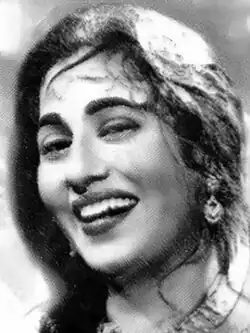
Mumtaz Jehan Begum Dehlavi (14 February 1933 – 23 February 1969), known professionally as Madhubala (pronounced [məd̪ʱubɑːlɑː]), was an Indian actress who worked in Hindi films. She is regarded to have been one of the greatest and finest actresses in the history of Indian cinema. One of the country's highest-paid stars in the 1950s,[1] Madhubala appeared in over 70 films—ranging from slapstick comedies to historical dramas—in a two decade-long career. Long after her death, she remains a Bollywood icon, particularly noted for her beauty and unconventional screen persona.[2] Media outlets often refer to her as "The Venus of Indian cinema".
Born and raised in Delhi, Madhubala relocated to Bombay (now Mumbai) with her family when she was 8 years old and shortly after began playing minor roles, starting with Basant (1942). She progressed to leading roles in the late 1940s, and earned success with the dramas Neel Kamal (1947) and the horror film Mahal (1949), the romantic films Badal (1951), Tarana (1951), and Amar (1954). Following a brief setback, Madhubala found continued success with her roles in the comedies Mr. & Mrs. '55 (1955), Chalti Ka Naam Gaadi (1958) and Half Ticket (1962), the crime films Howrah Bridge and Kala Pani (both 1958), and the musical Barsaat Ki Raat (1960).
Madhubala's portrayal of Anarkali in the historical epic drama Mughal-e-Azam (1960)—the highest-grossing film in India at the time—earned her widespread critical acclaim and her only nomination for the Filmfare Award for Best Actress; her performance has since been described by critics as one of the finest in Indian cinematic history.[3][4] She worked sporadically in film in the 1960s, making her final appearance in the drama Sharabi (1964). Additionally, she produced three films under her production house Madhubala Private Ltd., which was co-founded by her in 1953.
Despite maintaining strong privacy, Madhubala earned significant media coverage for her charity work and personal life. In the early 1950s, she had a highly-publicised relationship with actor Dilip Kumar that ended amidst the Naya Daur court case (1956–57). She married actor-singer Kishore Kumar in 1960. Throughout her adult life, Madhubala suffered from recurring bouts of breathlessness and hemoptysis caused by a ventricular septal defect, ultimately leading to her death at the age of 36, in 1969. Throughout this period, Kishore kumar dedicatedly nursed for Madhubala, sending for doctors on time along with a nurse and a driver at her mansion. During her final years,Kishore Kumar worked for more hours just to support her treatment, as it was very costly,thus, making the couple see each other for lesser time. However, he managed to see her every 2-3 days, besides his hectic schedule.
Life and career
Birth and childhood (1933–1940)
.jpg)
Madhubala was born as Mumtaz Jehan Begum Dehlavi in Delhi, British India, on 14 February 1933.[5] She was the fifth of eleven children of Ataullah Khan and Aayesha Begum.[6] Khan belonged to the Yusufzai tribe of Pashtuns from Peshawar valley, originating from Swabi District, North-West Frontier Province,[7] and was an employee at the Imperial Tobacco Company in Delhi.[7] Aayesha Begum was originally from Lahore.[8] Five of Madhubala's siblings died in infancy; her sisters who survived to adulthood were Kaneez Fatima, Altaf, Zeb (known professionally as Chanchal), Shahida and Zahida.[9][a] Unknown to her family members, Madhubala was born with a ventricular septal defect, a congenital heart disorder which had no treatment at the time.[12]
Madhubala spent most of her childhood in Delhi and grew up without any kind of health issues.[6] Owing to the orthodox ideas of their Muslim father, neither Madhubala nor any of her sisters, except Zahida, attended school.[13] Madhubala nevertheless learnt Urdu and Pashto under her father's guidance.[14][15] An avid movie viewer from a young age, she often performed her favorite scenes for her mother and spent her time dancing and imitating film characters to entertain herself.[6]
Early roles and financial struggles (1941–1946)
In 1940, Khan lost his job for misbehaving with a senior officer, leaving the family without an income.[16] To help earn money, seven-year-old Madhubala began working at All India Radio, singing compositions by Khwaja Khurshid Anwar. She continued to worked there for several months[17] and became acquainted with Rai Bahadur Chunnilal, the general manager of the Bombay Talkies studio in Bombay.[17] Chunnilal took an immediate liking to Madhubala and suggested that Khan visit Bombay for better employment opportunities.[18]
.jpg)
In the summer of 1941, Khan, along with Madhubala and other family members, relocated to Bombay and settled in a cowshed in the Malad suburbs.[19] Rai Bahadur Chunnilal of Bombay Talkies signed Madhubala for a juvenile role in the production Basant, at a salary of ₹150.[18] The acting role was uncredited, and she also recorded two songs for herself.[20] Released in July 1942, Basant became a major commercial success;[17][21] however, the studio terminated her contract as it had no further need for a child actor at the time.[22] Disappointed, Khan returned his family to Delhi, where he continued to struggle financially.[23]
In 1944, Bombay Talkies' head Devika Rani sent for Khan to summon Madhubala for a role in Jwar Bhata (1944).[23] Although Madhubala did not get the role, Khan decided to settle permanently in Bombay after seeing prospects in the film industry.[23] The family returned to their temporary residence in Malad and Madhubala and her father began making frequent visits to film studios in search of work.[6] In April 1944, their Malad residence was completely destroyed during the Bombay Dock explosion; the family survived because it had left for a local cinema shortly before the blast.[24] They subsequently had to seek shelter in a friend's residence.[24][b]
At this time, Khan aimed for Madhubala to become the breadwinner of the family, although her sister Zahida has asserted that Madhubala was not forced to work: "My sister loved to sing and dance and was fond of music and poetry. It's wrong to accuse my father of compelling her to work in films – films came her way, he never pushed her into anything. [...] He couldn't imagine he'd get so caught up chaperoning her that he’d never get back to working himself."[26]
Madhubala eventually signed a three-year contract with Ranjit Studios in 1944. As studio executive Chandulal Shah found her "not old enough to fill a leading role", she was given child roles in five of Ranjit films, including Mumtaz Mahal (1944) and Phoolwari (1946), under the screen name Baby Mumtaz.[27] She was paid a monthly salary of ₹300,[28] and became the sole earning member of a family of eight people.[29]
While filming Phoolwari (1946), Madhubala suffered her first bout of haemoptysis (coughing up blood). This signaled the onset of the heart defect that would progressively worsen throughout her career.[30]
Transition to leading roles and rise to stardom (1947–1952)
As the Ranjit contract reached its end in 1946, Madhubala became the protégé of director Kidar Sharma.[8][31] Sharma cast the 14-year-old in her first leading role in the melodrama Neel Kamal, portraying a young princess raised by a lower caste family, who gets involved in a love triangle with characters played by Raj Kapoor and Begum Para.[32] However, while Sharma was impressed by her "raw talent" and enthusiasm, Chandulal Shah deemed Madhubala and Kapoor unsuitable for leading roles and refused to finance the film; consequently, Sharma funded the production using his personal assets.[33][34] Neel Kamal proved to be a commercial flop on its release,[32] but, according to biographer Harish S. Booch, "put both Raj and Madhubala on the road to full-fledged stardom".[35]
Madhubala and Kapoor were noted for their onscreen chemistry, and went on to appear together in more films: Mohan Sinha's Chittor Vijay and Dil Ki Rani (both 1947), and N. M. Kelkar's mythological Amar Prem (1948),[14] but these productions were also not successful.[6] Initially credited as "Mumtaz" in Neel Kamal,[36] she adopted the screen name "Madhubala" on the suggestion of Mohan Sinha.[37][38] The change served as a pseudonym to navigate pressure from the All India League of Censorship, a Hindu nationalist organization that targeted Muslim identities in the film industry.[39] She kept her fees low to attract more film offers, and worked prolifically in this period to provide financial stability for her family. However, most of her early films went unnoticed and failed to propel her career.[40][6]
Madhubala began receiving critical attention starting with the drama Lal Dupatta (1948).[14] Film critic Baburao Patel called it the "first milestone of her maturity in screen acting", noting that Madhubala had grown from an "erstwhile child" to an "attractive maiden".[41][42] She was further praised for her supporting parts in Parai Aag (1948) and Paras (1949), with Jagdish Bhatia comapring her performance of a "made-dumb girl" in the latter to that of Jane Wyman in Johnny Belinda.[23][41] In 1949, while filming J. K. Nanda's Singaar, Madhubala fainted on set and was subsequently diagnosed with an incurable ventricular septal defect (a "hole in the heart"); the diagnosis was kept private to avoid jeopardizing her career.[27]
Madhubala's portrayal of an elusive woman who pretends to be an apparition in Bombay Talkies' Mahal—the first horror film of Indian cinema—established her status as a leading lady.[43] Starring opposite Ashok Kumar, the role was specifically written for Suraiya, who was the most celebrated star of the time, but director Kamal Amrohi insisted on casting Madhubala as he felt that the latter's ignorance among wide audience would add to the character's mysterious nature.[44] While the studio executives did not appreciate Madhubala's casting,[45] Amrohi later reflected that "[it] was with this film that her true capabilities came to the fore and she was acknowledged as a polished actress."[44] Booch commented that she "virtually lived her unusual role", and Mahal became one of the biggest box-office successes of the year on its October 1949 release.[46][47] Rachel Dwyer notes that Madhubala's relative anonymity at the time of release contributed to her character's mysterious nature, enhancing her image as a "beautiful stranger".[48] The success resulted in Madhubala signing a string of starring roles opposite the leading actors of the time.[49]
According to biographer Khatija Akbar, the success of Mahal turned Madhubala into a "nation-wide sensation".[41] Madhubala had further commercial success in the musical Dulari (1949),[47] and also earned critical praise for her supporting role in Singaar (1949), with critics arguing that her performance eclipsed that of the leading star, Suraiya.[36] Madhubala subsequently starred opposite Dev Anand in Ranjit's Madhubala (1950)—which was named after herself.[50] As her stardom grew, she gained a reputation for strict punctuality and keeping a low public profile, and the media increasingly scrutinized her father Ataullah Khan's influence over her career.[51] Madhubala's reclusivity was attributed to Khan, who reportedly restricted her studio hours from 8 a.m. to 6 p.m., and prohibited her from attending press previews, granting interviews, or interacting with film magazines.[37][52]
In early 1950, Madhubala became the subject of a smear campaign by the film press, originating from a production dispute during the filming of Nirala.[53] She had refused to enter a pool for a sequence, citing hygiene concerns; this upset director P. L. Santoshi, who halted filming for days and disseminated accounts of the incident portraying her as difficult to work with.[54] Although Santoshi was later pacified by Khan's apology and filming resumed, the press continued to publish vilifying reports. In response to these accounts, Khan began inserting contract clauses that prohibited journalists from entering Madhubala's film sets.[55][56]
The ban was poorly received by journalists, and subsequently the All India Action Committee—headed by veteran journalists Lala Karam Chand and V. K. Nayyar—declared a formal media boycott against Madhubala.[57] In August 1950, she donated ₹50,000 to the East Bengali refugees relief fund.[58][c] The donation was commended by Morarji Desai, the then-Home Minister of Bombay State,[62] although segments of the media dismissed it as a publicity stunt.[63] Her releases amidst the boycott, Beqasoor and Hanste Aansoo (both 1950), nevertheless proved to be popular with audiences;[64][65] the latter was notably the first Indian film to receive an "A" (Adult) certification from the Central Board of Film Certification.[66] In collaboration with Prem Narayan Arora, she also ventured into production with the drama Pardes (1950).[67]
The conflict escalated in early 1951 when Madhubala refused to grant interviews to visiting journalists on the set of Baadal. Her stance drew criticism from other leading stars—including Nargis, Suraiya, Raj Kapoor and Dilip Kumar, as well as from veteran producer Abdur Rashid Kardar.[68] The only major personality who defended Madhubala at the time was Baburao Patel, who argued in his magazine that the 17 year old actress had the right to professional privacy.[63] After receiving kidnapping and death threats, Madhubala was granted armed security and a license to carry a revolver by Desai.[63][69]
Madhubala's conflict with the press concluded in early 1951 following an apology mediated by journalist B. K. Karanjia, who was one of the leaders of the boycott.[64] Karanjia later observed that "the press needs Madhubala as much as Madhubala needs the press", acknowledging in his autobiography that the journalists had "over-reacted" due to "ego problems".[54][70] The controversy did not impact Madhubala's popularity.[71] Contemporary reports mentioned that her fees had significantly inflated to ₹1.5 lakh per film.[72][73] Commercial success continued with the swashbuckler Baadal (1951), which was one of the top-grossing productions of the year.[74]
In her private life, Madhubala had a brief relationship with actor Prem Nath, with whom she starred in Baadal, Aaram (both 1951) and Saqi (1952).[75] Although they earlier contemplated marriage, they broke up due to religious differences and her burgeoning involvement with Dilip Kumar,[13] with whom she was simultaneously working on Tarana.[76] Released in October 1951, Tarana became a success and established them as a popular onscreen pairing; critic Baburao Patel noted their chemistry, stating that Madhubala "discovered her soul" in Kumar's company and delivered the "best performance of her screen career".[77]
Continuing her collaboration with Kumar, Madhubala starred with him in Sangdil, an adaptation of Charlotte Brontë's novel Jane Eyre.[40] In it she played a devadasi (temple dancer), a role that scholar Dina Khdair interprets as part of her continued casting since Mahal as an "Other", positioned outside respectable society and coded as a figure of "sexual transgression".[78] The film became one of the year's most popular releases, though it had modest financial returns.[79] Further films were announced to capitalise on Madhubala and Kumar's popularity as a pair, including a color production named Chitralekha, which was later shelved.[80] To further refine her screen persona, Madhubala began English lessons with Sushila Rani Patel and classical dance training under Sitara Devi. Despite a lack of formal schooling, she grew fluent in English within three months; however, she struggled with the physical demands of dance rehearsals due to her recurring heart condition.[37][81]
The series of successful films in this phase of her career established Madhubala as one of the top female stars of the 1950s.[82] She drew the attention of photojournalist James Cobb Burke, who photographed her for a proposed Life magazine feature on Asian film actresses, titled "Movie Queens".[83] The photographs were, however, not included in the published feature and would remain largely inaccessible for decades until the 2008 digitization of the Time Life archive.[84][d] In his autobiography Blundering in Wonderland (1990), journalist B. K. Karanjia mentioned that during a visit to Bombay in 1952, Frank Capra was "simply enraptured" after seeing a photograph of Madhubala in a magazine, and expressed interest in meeting her, hinting at an offer for her in Hollywood. Karanjia subsequently tried to arrange a meeting but was declined by her father.[85] In August 1952, David Cort of Theatre Arts Magazine named her as the highest-paid star in the Indian film industry.[86]
Career expansion and fluctuations (1953–1957)
Once I have finished work at the studio, I do not want to be Madhubala, the star. I'm just a normal, average girl, and only at home am I treated as such. That is why I remain so much within the four walls of my home.[87]
Madhubala's two film releases of 1953—Rail Ka Dibba and Armaan—were both unsuccessful.[88] The former, which she also produced,[89] was not well-received by critics; Ranjit Singh of The Sunday Standard found the subject matter to be overused, and called it "an average sort of a picture".[90] Armaan was not a local success, but was significantly popular in Singapore, with The Straits Times hailing it among the "best Indian pictures to be shown in the East since the war".[91]
In April 1953, Madhubala co-founded the production company Madhubala Private Ltd. with her father, Ataullah Khan.[92] The venture was initially marked by a series of setbacks; a project titled Sayyad, directed by Kamal Amrohi, was scrapped after the loss of ₹3 lakh, while another one named Shan-e-Awadh was cancelled by Khan due to professional disagreements with the director.[93] Madhubala meanwhile sought dramatic roles where she could showcase her acting range; she lobbied herself for the titular role in the upcoming production Biraj Bahu, but director Bimal Roy feared he could not afford Madhubala's high market price and passed the film over to Kamini Kaushal.[94]
Later in 1953, Madhubala accepted the role of the 16th century courtesan Anarkali opposite Dilip Kumar in K. Asif's historical epic Mughal-e-Azam.[95] Production commenced that same year but progressed slowly, due to both the project's immense scale and Asif's demands of perfectionism.[96][97] The filming process of Mughal-e-Azam was physically taxing for Madhubala from the beginning. In one notable incident, she reportedly came close to suffocation while encased in heavy body paint to portray a marble statue.[98] Later, she committed to rigorous training under Kathak master Lachhu Maharaj[99] for the "Mohe Panghat Pe Nandlal Chhed Gayo Re" musical sequence, despite being medically advised against dancing.[100][101] Notwithstanding these physical hardships, Madhubala remained dedicated to the production; she would continue filming Mughal-e-Azam intermittently over the next seven years while simultaneously working on other film projects.[102]
Madhubala's health faltered in early 1954 during the filming of S. S. Vasan's Bahut Din Huwe in Madras.[103] She suffered from bouts of haemoptysis, leading to a brief sabbatical that marked the first time her illness was widely reported in the press.[104][105] After her recovery, she returned to complete the four-month production schedule.[106] To show her gratitude for Vasan's support during her illness, she made a rare exception by attending the film's premiere.[107] Bahut Din Huwe, however, was an unpopular release among audiences.[106]
Directed by Mehboob Khan, the drama Amar (1954) starred Madhubala as a social worker who faces a moral crisis when she discovers that her fiancé (Dilip Kumar) has raped another woman (Nimmi).[108] Scholar Bhaskar Sarkar views the role as an embodiment of the ideal and "modern (perhaps protofeminist)" Indian woman in post-partition cinema, and adds that Madhubala's "angelic" persona increased the character's appeal.[109] While critic Dinesh Raheja retrospectively named this one of her earliest accomplished performances,[110][111] contemporary reviews were mixed; a critic for Swatantra argued that she failed to meet the emotional demands of the role.[112] Despite its high production values and star-studded cast, Amar turned out to be a box-office failure.[113][114] Following a series of unsuccessful high-budget films, including Saqi, Bahut Din Huwe, and Amar, the trade press labelled Madhubala "box office poison".[94] In early 1955, Baburao Patel reported that although she had earned over ₹15 lakhs until then in her career, these commercial failures led some producers to view her as a "jinx".[88]
During the first quarter of 1955, Madhubala balanced the filming of Guru Dutt's social comedy Mr. & Mrs. '55 with the production of Naata, a venture under her own production house.[115] In February, she announced her directorial debut with a project titled Sham-e-Oudh,[116] stating a desire to take a break from acting: "All these years I have been acting, acting and acting [...] I want a change; and directing serves the purpose best." However, the project was shelved by March 1955.[115]
In Mr. & Mrs. '55, a satire on marriage of convenience and the highly debated Hindu code bills,[117] Madhubala played Anita Verma, a naive heiress who is forced by her aunt into a sham marriage with Dutt's character.[118] With little prior experience in comedy, Madhubala was initially sceptical of the genre, but she became more comfortable as filming progressed.[119] Abrar Alvi, who served as the assistant director, observed:
the role was completely foreign to her [but] once she walked through the scenes, she got the nuances and acted them with aplomb. Her timing was perfect. She knew exactly how to get a reaction from the audience and how long to hold that reaction ... By the time we finished the film, she had come to realise that she could be a great comic artist too.[120]
Mr. & Mrs. '55 emerged as one of the year's highest-grossing films,[121] and re-established Madhubala as a commercial star.[122] Her comedic performance dismantled her "tragic heroine" typecasting, with the Indian Daily Mail crediting her "spontaneity, youthful charm, effervescence and lively sense of humour" for the film's success.[123]
Media reports from 1955 indicated that Madhubala was planning to marry Dilip Kumar; she publicly confirmed their relationship that year with a rare appearance at the premiere of his film, Insaniyat.[124] While Khan was not explicitly against the marriage,[125] Akbar noted that he viewed Kumar’s influence as a threat to his primary source of income—particularly as Kumar wanted Madhubala to retire from acting after marriage.[126] Later that year, Madhubala Private Ltd. released its debut production: D. N. Madhok's Naata, starring Madhubala alongside her sister Chanchal—in her first major role—and Abhi Bhattacharya. The film failed commercially, and Madhubala was forced to mortgage her personal bungalow to offset the financial loss.[9]
Following the failure of Naata, Khan proposed a business venture to bring Kumar under their production house, which the actor refused, citing his need for creative independence. In his autobiography, Kumar asserted that Khan successfully convinced Madhubala that this rejection was "rude and presumptuous", and Madhubala eventually sided with her father, causing a significant strain on their relationship.[127] Conversely, family accounts attribute the relationship's collapse to Kumar's condition that Madhubala sever all ties with her family, which she ultimately declined.[128]
Madhubala and Kumar ended their relationship in 1956 during a legal dispute over B. R. Chopra's production Naya Daur.[129] After fifteen days of filming with the pair in lead roles, a conflict arose regarding a scheduled outdoor shoot in Bhopal. Citing health and safety concerns, Khan refused her travel; consequently, Chopra filed a criminal complaint at Girgaum Magistrate's court for cheating and breach of contract.[130][127] Seeking the return of a ₹32,000 advance,[131] Chopra also ran a two-page advertisement in Screen featuring a red cross over Madhubala's image to announce her replacement by actress Vyjayanthimala.[132]
The trial went on for four months and received extensive media coverage. Chopra accused Khan of "unmanageable tyranny", alleging he demanded a role for Madhubala's sister, Chanchal, and an additional ₹20,000 for Madhubala to resume filming.[131] A turning point occurred when Kumar testified in support of Chopra,[133] stating Madhubala's reluctance to work stemmed from "fear of her father".[134] According to her sister Zahida, Madhubala was deeply hurt by Kumar's testimony, leading to their breakup. Chopra withdrew the charges following the film's success and before the defense called its witnesses.[126]
The lawsuit generated negative publicity for Madhubala and led to her replacement in productions like Sohni Mahiwal and Savera.[100][135] Madhubala, nevertheless, gained the role of Shirin in Aspi Irani's Shirin Farhad (1956), opposite Pradeep Kumar.[136] She went on to star in Sohrab Modi's costume drama Raj Hath, which became one of the highest earning films of 1956.[137][138]
Following Madhubala's break-up with Kumar, filming for Mughal-e-Azam was briefly suspended before resuming on the condition that it would be their final collaboration.[139] The personal friction between the leads occasionally affected the production; notably, during a scene where Kumar's character was required to slap Anarkali, he reportedly struck Madhubala with actual force repeatedly. Despite the incident, Madhubala continued with the take and resumed filming after mediation by director K. Asif.[140][141] The actors completed their remaining romantic scenes while being no longer on speaking terms.[142] By 1957, the majority of Mughal-e-Azam's principal photography was complete; the remaining segments, which included the "Pyar Kiya To Darna Kya" musical number and the sequences involving Anarkali's imprisonment, were scheduled for a later filming phase.[143]
Mughal-e-Azam and Om Prakash's Gateway of India (1957) were the only two productions where Madhubala participated in late-night filming sessions, a practice Khan typically discouraged.[144] She played a young woman on the run from her greedy uncle as she moves through Bombay while evading pursuers in the black comedy Gateway of India, which was a rare female-led film at the time.[145] The role was stripped of glamour, featuring her in a single "Chaplinesque" attire with short trousers and jacket.[145] Scholar Arti Wani reads the film as using Madhubala's character to show the city as a space where women move freely through different situations, take on different roles, and experience new forms of independence and desire.[146] Reviewing retrospectively, critic Deepa Gahlot included Gateway of India in the book Take-2: 50 Films That Deserve a New Audience, and called it one of Madhubala's finest performances.[147] Her other release that year, the drama Ek Saal (1957), became a box office hit.[137] Both Madhubala and Nargis declined Guru Dutt's offer to star in Pyaasa (1957) after they struggled to choose between the two lead female roles.[148]
Continued success, release of Mughal-e-Azam, and marriage (1958–1960)
Following her separation from Dilip Kumar, Madhubala focused heavily on her work;[149] the year 1958 saw her reinforce her status as a leading lady, as she headlined four of the top-grossing productions of the year: the crime thrillers Kala Pani and Howrah Bridge, the musical Phagun and the comedy Chalti Ka Naam Gaadi.[150][151] Madhubala waived her entire fees to play Edna, an Anglo-Indian club singer in Shakti Samanta's Howrah Bridge, a whodunit influenced by Hong Kong cinema.[152][153] Marking a departure from previous portrayals of sophisticated characters,[154][110] the role, according to Wani, blurs the usual distinction between the "heroine" and the "other" women by expressing sexual agency and initiating romance, even though the film eventually restores Edna to domestic respectability.[155] Film critic Vijay Lokapally noted that in the role of Edna, Madhubala "blazed a trail", adding that in later years "almost every heroine had to meet the challenge of equating, if not improving upon her performance".[156]
In Chalti Ka Naam Gaadi, Madhubala portrayed Renu, a wealthy city woman involved in a love affair with Kishore Kumar's character,[137][157] whom columnist Rinki Bhattacharya refers to as "top favourite" and a rare example of an independent, urban woman.[158] Chalti Ka Naam Gaadi emerged as one of the biggest money-making films of the 1950s,[159] and also marked the beginning of Madhubala's relationship with co-star and childhood acquaintance, Kishore Kumar.[157][160] At the time, Kumar was going through divorce proceedings with his first wife, Ruma Guha Thakurta, who was also a friend of Madhubala.[161] Kumar later said that their relationship grew out of mutual sympathy over their respective personal problems before developing into a romance.[162] Their relationship attracted media attention after the couple appeared together at the premiere of the film Love Marriage in 1959, leading to speculation that Kishore, a Hindu, would convert to Islam to marry Madhubala.[163] However, in an interview with Rangbhumi that year, Madhubala asserted that she would not require her partner to change his religion for marriage.[163][e]
During the extended production of Mughal-e-Azam through 1958 and early 1959, Madhubala continued to work in physically taxing scenes, one of which led to her collapsing on set.[167] For the sequences depicting her character's imprisonment, she insisted on wearing authentic iron chains. The weight of these chains resulted in skin abrasions and necessitated intervals of bed rest.[168] The musical sequence "Pyar Kiya To Darna Kya" was to be filmed in Eastmancolor; it required complex choreography that Madhubala was unable to perform due to her sickness. K. Asif instead utilized male Kathak dancer Laxmi Narayan as a body double for the long shots and wide-angle footwork.[101] Narayan performed the choreography wearing a rubber face mask to resemble Madhubala; she filmed only for the close-up shots and facial expressions.[169] Principal photography for Mughal-e-Azam eventually concluded in May 1959.[170] The film's production is credited for the subsequent deterioration of Madhubala's health; Asif's then-wife Sitara Devi commented, "The chains, the continuous night shootings … killed her."[168]
Madhubala continued to work through 1959; in August, Kishore Kumar launched his ambitious project Suhana Geet with her as the leading lady.[171] Madhubala's film releases of 1959 included Insan Jaag Utha and Kal Hamara Hai;[122][110] she particularly received critical praise for her dual roles as lookalike sisters in the latter.[172] Critic K. B. Goel described her as impactful in both characters, observing that she brought "a sensuality rare in Indian films" as the modern, rebellious sister.[173] She reunited with Raj Kapoor after a decade and played his love interest in Do Ustad.[40] In November, Madhubala's declining health forced a brief sabbatical, halting production on Jhumroo, Suhana Geet (both opposite Kishore Kumar), and Sharabi (opposite Dev Anand).[163] She returned to work in early 1960 for the second venture of Madhubala Private Ltd., a comedy titled Mehlon Ke Khwab.[174] The film, which starred Madhubala alongside Kishore Kumar and Chanchal, released in March 1960. It was panned by Baburao Patel, who bemoaned that Madhubala appeared sick and "neither acts well nor looks good".[175]
Released on 5 August 1960, Mughal-e-Azam broke several box office records and became the highest-grossing Indian film at the time.[176][137][177] A reviewer for The Indian Express commented, "Scene after scene bears testimony to the outstanding gifts of Madhubala as a natural actress [...] The way she presents Anarkali's changing moods as she passes through the lightning vicissitudes in her life is superb."[178] The film received 11 nominations at the 8th Filmfare Awards, including Best Actress for Madhubala.[179][180][f] She also won the Film Journalists' Association Award for Best Actress, but did not attend the ceremony to receive the trophy.[181] Commenting retrospectively, film critic Dinesh Raheja described the film as the "crowning glory" of Madhubala's career,[182] and her contemporary actress Nimmi remarked: "With Mughal-e-Azam, Madhubala showed the world just what she could do. All the signs of a good artiste were there as far back as Basant, but Mughal-e-Azam was the final proof that she was an artiste par supreme."[96]
Madhubala starred in two more films in 1960: the crime thriller Jaali Note and the musical Barsaat Ki Raat.[183] The latter is particularly noted for its portrayals of headstrong women, including Shabnam, played by Madhubala, who elopes with her lover (Bharat Bhushan) when her parents disapprove of the relationship.[184] Both films performed well,[185] with Barsaat Ki Raat becoming the year's second highest-grosser, trailing only Mughal-e-Azam.[177] The consecutive successes prompted Box Office India to name Madhubala as the most successful leading lady of the year.[82] A string of offers in major roles followed, but she had to refuse them owing to her worsening health.[103] Among the final films Madhubala completed was Kishore Kumar's Jhumroo (1961). The film was slated for a late 1960 release, but production got delayed due to her worsening health.[186] Filming period was also disrupted by an on-set structural collapse at Filmistan Studio, though Madhubala and Kumar escaped uninjured.[186]
Ataullah Khan had planned a visit to London for Madhubala to seek specialized treatment for her heart condition.[187] Because the impending operation carried a substantial risk, veteran journalist Isaq Mujawar noted that Madhubala feared dying during the procedure and wished to marry beforehand.[188] She proposed to Kishore Kumar, whose divorce from Thakurta had been finalized, and he accepted.[188]
Madhubala married Kishore Kumar in a civil ceremony on 16 October 1960, and publicly announced her retirement on the next day.[188] Anirudha Bhattacharjee described the marriage as "the unglamorous alliance of two of the most glamorous stars of Bombay"; contemporaries similarly viewed the couple as a mismatch due to their contrasting temperaments.[189][190] The interfaith marriage was disapproved of by Kishore's parents, particularly his mother, who made the couple marry again in a Vedic ceremony.[189] They briefly lived away from Kumar's family home owing to tensions with his family.[191]
Final work and health decline (1960–1969)
"[I] brought her home as my wife, even though I knew she was dying from a congenital heart problem. For 9 long years, I nursed her. I watched her die before my own eyes. You can never understand what this means until you live through this yourself. She was such a beautiful woman and she died so painfully. She would rave and rant and scream in frustration. How can such an active person spend 9 long years bed-ridden? And I had to humour her all the time. That's what the doctor asked me to. That's what I did till her very last breath. I would laugh with her. I would cry with her."[192]
Madhubala's health began declining after her marriage;[193] her sister Madhur Bhushan recalled increasing episodes of vomiting blood and breathlessness which led to severe physical weakness.[11][13] Madhubala consulted cardiologist Rustom Jal Vakil, who offered little hope for her recovery but recommended seeking a senior medical opinion in London.[193] She and Kumar completed Jhumroo in May 1961; the film became a box office success on its release.[186][194]
Madhubala and Kumar subsequently traveled to London with physician S. V. Golwala.[193] The trip combined their honeymoon with specialized treatment for Madhubala's heart disease. Doctors in London declined to operate due to the risk of complications and instead advised her to avoid stress and anxiety. She was also discouraged from having children and given a life expectancy of two years.[195] In a 1981 interview, Kumar disclosed that the terminal diagnosis drove Madhubala to depression, and that she attempted suicide during their brief stay in London.[196] "She continued to live another seven and a half years", Kumar said, "but died every moment."[196]
Following their return from London, Madhubala withdrew from several film productions that were underway, and moved into Kumar's flat on Carter Road in Bombay.[197] However, she soon returned to her paternal home; according to Kumar, she was affected by the noise of aircraft from a nearby airport.[198] Bhushan, however, later alleged that Kumar had abandoned Madhubala in the flat, prompting her return home.[11] Bhushan also claimed that Kumar visited infrequently thereafter in an attempt to emotionally distance himself from her impending death, which led to Madhubala feeling isolated.[11][199] This account has been disputed by Kumar's son, Amit, as well as associates including Aloke Dasgupta and Iftekhar, all of whom maintained that Kumar visited regularly and was devoted to her care.[200][201] Madhubala's illness coincided with a period when Kumar's career was rising, during which he became increasingly busy, and the couple reportedly argued over his rumored relationships with female co-stars.[201][202][203]
Madhubala's withdrawal from the film industry led to her replacement in several productions, while body doubles were used to complete others. Suchitra Sen and Kalpana Mohan replaced her in Bombai Ka Babu and Naughty Boy, respectively.[204][185] In Boy Friend (1961), opposite Shammi Kapoor, Madhubala's unfinished scenes were completed by her sister, Chanchal.[103] The comedy Half Ticket (1962), which Madhubala managed to complete herself, marked her final collaboration with Kishore Kumar.[205][206] The film was moderately successful on its initial release;[207] it later attained cult popularity through re-releases in the late 1970s.[208]
Filmmaker Kishore Sahu intended to collaborate with Madhubala on a project, which he ultimately had to abandon.[209] Other productions, including Suhana Geet, Yeh Basti Yeh Log opposite Balraj Sahni, and Chalaak opposite Raj Kapoor, remained unfinished.[210] She also quit Pathan, directed and produced by her father Ataullah Khan.[211] Sharabi (1964), co-starring Dev Anand, was released after prolonged delays and became Madhubala's final release during her lifetime.[212] A review in Shankar's Weekly observed that she appeared "a bit jaded", though the critic speculatively attributed this to the "imaginative camerawork".[213]
In June 1966, after a temporary improvement in her condition, Madhubala attempted to resume work on Chalaak,[214] which required only a small amount of filming to be completed. The trade press widely publicized the effort as her "comeback".[215] However, the demanding studio environment triggered an episode of vomiting blood on set; the film was ultimately abandoned.[216][217]
By 1967, Madhubala became largely bedridden and lost considerable weight.[218] She spent her time reading Urdu poetry and watching her films, particularly Mughal-e-Azam (1960), using a home projector.[202][13] She restricted her contact with the film industry to a few associates, maintaining a sporadic correspondence with co-workers like Bharat Bhushan and Shakti Samanta.[219][220] Following a request from Madhubala, Dilip Kumar also visited her a final time; he later wrote that she appeared "frail" and that her signature "impish smile seemed such an effort".[221]
Death
On 21 February 1969, Madhubala's condition deteriorated sharply as she developed a high fever of 105 °F (41 °C), which was complicated by jaundice.[222][223] She had a marginal improvement the following afternoon, but she began vomiting blood.[223] Her health collapsed entirely on the evening of 22 February, requiring emergency oxygen administration and pain management.[224] After struggling through the night in the company of her family, she died at 9:30 a.m. on 23 February,[10] nine days after her 36th birthday.[225]
Madhubala was buried as per Sunni rites at the Juhu Muslim Cemetery in Santacruz, Bombay, along with her personal diary.[224][226] Her tomb was constructed of marble and featured inscriptions of aayats from the Quran and various verse dedications.[226] As reported by The Indian Express, Madhubala's funeral was attended by "most of the well known personalities of Hindi screen".[227] Besides her family, Kishore and Ashok Kumar, among the industry figures present were her contemporary stars Nargis, Meena Kumari, Raj Kapoor, Prithviraj Kapoor and Sunil Dutt,[228] as well as directors K. Asif, Kamal Amrohi and M. Sadiq.[224] Mughal-e-Azam's music composer Naushad said, "Like Anarkali, Madhubala's share of sorrows overwhelmed her joys and alas we did not sympathize with her in life but came to mourn her death."[228]
Because Madhubala had been absent from the social scene for nearly a decade, her death was perceived as unexpected and received extensive coverage in the Indian press.[229] The Indian Express described her as "the most sought-after Hindi film actress" of her era,[227] while Filmfare likened her to "a Cinderella whose clock had struck twelve too soon."[230] She became the first Indian star whose death was officially mourned by the Pakistani Film Producers' Association.[224][231] Several colleagues, including Premnath (who wrote a commemorative poem),[232] B. K. Karanjia and Shakti Samanta expressed their grief. Gossip columnist Gulshan Ewing published a personal tribute titled "The Passing of Anarkali," writing: "She loved life, she loved the world and she was often shocked to find that the world did not always love her back. [...] To her, all life was love, all love was life. That was Madhubala—loveliest of the shining stars."[230]
The swashbuckler film Jwala was initially launched by M. V. Raman in 1958, with Kishore Kumar starring opposite Madhubala. However, her sickness led to Kishore getting replaced by Sunil Dutt and the film was shelved indefinitely for more than a decade. It was eventually finished using body doubles for Madhubala and released in 1971, two years after her death, marking her final appearance on screen.[233] On Dutt's insistence, Madhubala was given the top-billing over him to reflect her seniority, even though he had become more popular by the 1970s.[234]
In 2010, Madhubala's tomb—along with those of other industry figures such as Mohammed Rafi and Sahir Ludhianvi—was demolished to make room for new interments. Her remains were moved to an undisclosed location.[235]
Public image and reception
Madhubala was widely described by both her peers and contemporary critics as one of the most beautiful actresses of her time, prompting editor Baburao Patel to dub her the "Venus of the Indian screen".[236] Her lopsided smile was often considered the distinctive feature of her face.[237] Scholar Dina Khdair writes that Madhubala earned success featuring as a "scopophilic gem" in roles that often relied on her beauty and sex appeal.[238] For example, she portrayed mysterious and alluring women in the noir films Mahal (1949) and Howrah Bridge (1958), while appearing as a modern and "Westernized" star in such comedies as Mr. & Mrs. '55 (1955) and Chalti Ka Naam Gaadi (1958).[238] Madhubala's image was associated with a range of modern fashion trends, including off-shoulder dresses, trousers, and a distinctive wavy hairstyle, which contrasted with the more traditional attire commonly worn by Hindi film actresses of the period.[137][239]
Film historian Bhagwan Das Garga likewise argues that Madhubala embodied a broader sociological shift in the representation of women in Hindi cinema, when the distinction between the virtuous heroine and the sexually alluring vamp became increasingly blurred.[240] This duality is especially evident in her performance as Anarkali in Mughal-e-Azam (1960), whom Garga describes as "at once vulnerable and aggressively erotic".[240] Writing on the same role, Corey K. Creekmur observes that Madhubala is largely presented as an "object to be looked at" for both the male characters as well as the audience.[241] However, he argues that her performance is also self-aware, drawing upon the Hindu practice of darshan to acknowledge and return the gaze directed at her.[241]
In contrast to her glamorous screen image, Madhubala was portrayed in film magazines as a modest, work-focused actress who led a simple lifestyle despite her wealth and stardom.[242] Scholar Sabina Gadhihoke describes such image construction as "downsizing" in 1950s film media, in which actresses were framed as simple and domestic figures to enhance their relatability to mass audiences.[243] At the same time, her image became shaped by persistent rumours of romances with several co-stars and public figures, leading popular journalism to frame Madhubala as "flirtatious" and "carefree".[238] Hence, despite maintaining strong privacy, Madhubala's private life — including her relationship with her father as well as her romances — became a subject of media scrutiny.[244][245] As Women's Trend noted in 1953, she "lives in seclusion, shuns publicity but has actually made news more often than any other star."[246]
Khdair contrasts Madhubala's public image with that of her contemporary star, Nargis, despite their shared Muslim background. She argues that whereas Nargis became discursively associated with the nationalist Mother India archetype through her film roles, Madhubala remained constructed as an Other figure.[238] According to Khdair, this perception was shaped by Madhubala's sexually charged screen roles, Westernized star image, and the extensive gossip and mythmaking that surrounded her romantic relationships, illness, and early death.[238]
"The story of India for the past ten years may be condensed as: the war, the movie boom, independence, and Madhubala."
Madhubala emerged as one of the most celebrated film stars of the post-independence era, a period referred to by film historians as the Golden Age of Hindi cinema.[247] Her rise to stardom in the early 1950s coincided with the rapid expansion of the Indian film industry.[248][249] A 1952 feature in Theatre Arts Magazine, written by David Cort, described Madhubala as "the biggest star in the world" in terms of potential audience size, noting that her local reach extended across the 420 million people of India and Pakistan.[86][250] In the textbook A History of World Civilization (1957), historian Max Savelle stated that the Indian film industry had become the second largest in the world, and that Madhubala was the industry's highest-paid star despite perceived conservative attitudes towards women in India.[251]
According to Pakistani film historian Mushtaq Gazdar, Madhubala was the most popular actress among young Pakistani audiences during the 1950s, with her screen persona influencing rising local actresses such as Sabiha Khanum.[252] Beyond the domestic market, Madhubala's films were also internationally distributed in Burma, Malaya, Indonesia, and East Africa.[86] Writer Mohamad Hatta Azad Khan wrote that despite language barriers, Hindi film stars like Madhubala became "household names" among moviegoers in Malaya and Singapore during the mid-20th century.[253] In oral histories collected by historian Laura Fair in coastal Tanzania, Madhubala was one of the Hindi film stars most frequently recalled as a favorite by audiences who attended cinemas during the 1940s–1960s.[254]
Madhubala's widespread popularity in post-war Greece inspired a club named after her in Athens.[255] Singer Stelios Kazantzidis composed the laïko song "Mantoubala" (1959), named after her, which became one of the best-selling records in Greek history.[256][257] The song remains a part of Greek popular culture,[258] including a performance during the closing ceremony of the 2004 Summer Olympics in Athens.[259]
Madhubala was the brand ambassador of Lux and Godrej.[260][261] While her glamorous image earned her widespread success, several critics believe it deflected attention away from her acting talents.[262][263][264] Co-star Shammi Kapoor, who named her the most beautiful woman of the era, also described her as a "highly underrated actress" whose work was overshadowed by her beauty.[265][266] Unlike her contemporaries Nargis and Meena Kumari, Madhubala never received a competitive acting award. Dilip Kumar argued that audiences "missed out" on her technical attributes due to their preoccupation with her beauty,[267] describing her as an "instantaneous" actor capable of meeting any level of emotional involvement demanded by a script.[268] Ashok Kumar called her his favourite actress alongside Geeta Bali, noting that "the director did not have to teach them and even their rehearsals were like 'takes'."[269]
Works and accolades
Madhubala appeared in 72 films between 1942 and 1964, including Basant (1942), Neel Kamal (1947), Mahal (1949), Badal (1951), Tarana (1951), Amar (1954), Mr. & Mrs. '55 (1955), Kala Pani (1958), Howrah Bridge (1958), Chalti Ka Naam Gaadi (1958), Mughal-e-Azam (1960), Barsaat Ki Raat (1960), Half Ticket (1962) and Sharabi (1964). Her seventy-third and last film was the posthumously released Jwala (1971).
Under the production house Madhubala Private Ltd., she produced three films: Naata (1955), Mehlon Ke Khwab (1960) and Pathan (1962).[211]
Awards and nominations
| Year | Award | Category | Work | Result | Notes |
|---|---|---|---|---|---|
| 1961 | Filmfare Awards | Best Actress | Mughal-e-Azam | Nominated | [180] |
| Film Journalists' Association of Bombay | Best Actress | Won | [181] |
Legacy
Film analyst Khalid Mohamed referred to Madhubala as a "one-of-a-kind phenomenon", noting that "although over 50 years have elapsed since she passed away [...] Madhubala reigns as the poster queen of Bollywood."[270] An online poll conducted by Outlook in 2008 saw her receive the highest number of votes as the "all-time favorite female star" in Indian film history,[271] while in a 2013 poll by Eastern Eye, she ranked 24th on the list of "100 Greatest Bollywood Stars".[272][g] The Economic Times has featured her in its list of "33 Women who made India proud."[282]
Over the years, Madhubala's legacy has continued to attract a diverse fan base and is sustained by recurring media coverage.[2] Modern publications frequently feature her on covers to increase sales, often focusing on the intersection of her personal life and career.[270] Her work has influenced celebrities such as Madhuri Dixit and Kangana Ranaut,[283][284][285] while actor Naseeruddin Shah described her as "a wonderful comedienne", placing her among the "all-time greats" of the industry.[286]
Madhubala's enduring popularity is often attributed to her conflicted public image.[154] She is considered a beauty icon and one of the biggest stars of classic Indian cinema,[287] but is also remembered for her unsuccessful relationships, chronic health struggles, and an early death.[270][288] In her legacy, Madhubala is often compared to Hollywood's Marilyn Monroe; Mrinal Pande noted that both remain "timeless icons" due to their early deaths,[289] while scholar Ashish Rajadhyaksha highlighted Madhubala's status as "the greatest and most glamorous star of the 50s Hindi musical", whose image was preserved by her death before her career could decline.[290] Her life and career have been a subject of biographies, including works by Mohan Deep (1996),[291] Khatija Akbar (1997),[292][293] Shashikant Kinikar (2000),[294] and Sushila Kumari (2010).[264] Filmmaker Imtiaz Ali initially attempted a biographical film on Madhubala, but shut down the production due to opposition from her family.[295][296] In April 2026, Variety India reported that Sanjay Leela Bhansali is producing a biopic on Madhubala, in collaboration with director Jasmeet K. Reen. Madhubala will be played by actress Sara Arjun.[297][h]
Madhubala's work has undergone a critical re-evaluation in the 21st century, and her reception as an actress has improved.[302][263] Biographer Khatija Akbar argued that Madhubala's "brand of acting had an underplayed and spontaneous quality" which was lesser noted by contemporary critics, who were more used to the theatrical acting style which was then common among actors.[303] Pande said that while Madhubala may not have been a "polished actress", "she was a presence, [and] some of her best scenes play out through the haunting music that accompanies her arrival."[289] Yasser Usman described her acting style as natural and character-driven,[304] with M. L. Dhawan of The Tribune noting that she "could communicate more with her delicately raised eyebrows than most performers could with a raised voice."[305] Film critic Sukanya Verma noted that Madhubala and Geeta Bali were among the earliest actresses of Hindi cinema to dabble in comedy,[306] and Shantanu Ray Chaudhuri likewise credited her for "[making] it fashionable for actresses to attempt comedy, inspiring latter-day stars like Sridevi and Madhuri Dixit".[307]
Filmfare has ranked Madhubala's performance as Anarkali in Mughal-e-Azam (1960) at 11th on its list of "80 Iconic Performances of Bollywood",[308] and Canadian scholar Murray Pomerance included it among 26 international performances in his book Close-Up: Great Cinematic Performances.[4] Her work in the film has received widespread critical acclaim from modern critics, with scholar Corey K. Creekmur arguing that her portrayal grounded the historical epic and remains "vital to securing the film's ongoing status as one of popular Indian cinema's emotional touchstones".[309] A digitally colorized version of Mughal-e-Azam was released in 2004 and emerged as a commercial success.[310][311] Madhubala's Anarkali salwar kameez has also influenced Indian fashion trends,[312][313] while the film is consistently ranked by critics among the best Bollywood films ever made, alongside her other films like Mahal (1949), Mr. & Mrs. '55 (1955) and Chalti Ka Naam Gaadi (1958).[i]
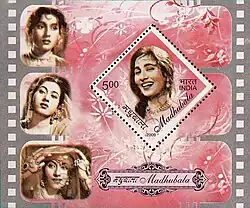
National recognition for Madhubala includes a 2008 commemorative postage stamp issued by India Post; at the time, Nargis was the only other Indian actress to have been similarly honored.[320][321] In 2010, the National Archives of India (NAI) included Madhubala's stamp in the "Pride of India" gold-layered silver ingot collection, placing her alongside 24 other "important facet[s] of Indian history, life and culture",[322] such as the Taj Mahal and Mahatma Gandhi.[323]
In 2017, Madame Tussauds Delhi unveiled a wax figure inspired by her role as Anarkali.[324] In 2018, The New York Times published an obituary for the actress, comparing her life to that of Marilyn Monroe.[325] On 14 February 2019, Google commemorated her 86th birth anniversary with a dedicated Doodle,[326][327] commenting:
While her breathtaking appearance earned comparisons to Venus, Madhubala was a gifted actor with an understated style well suited for comedies, dramas, and romantic roles alike. [...] Appearing in over 70 films over the course of a tragically brief career, Madhubala—who would have turned 86 today—was called "The Biggest Star in the World" in 1952 by Theatre Arts Magazine.[328]
Footnotes
- ^ Zahida's post-marital name is Madhur Bhushan.[10] As of 2017, four of the sisters were alive, excluding Shahida.[11]
- ^ After securing her family's finances in the late 1940s, Madhubala rented a bungalow on Peddar Road in Bombay named "Arabian Villa," which remained her permanent residence until her death.[25]
- ^ As her donation triggered controversy, Madhubala began conducting her charitable activities more privately and often donated anonymously.[59] In 1954, it was revealed that she had been providing monthly bonuses to the lower-level staff at her studios, which prompted leading editor Baburao Patel to call her the "queen of charity".[60] She also gifted a camera crane to the Film and Television Institute of India in 1962, which remains operational as of 2017.[61]
- ^ Other actresses photographed for the feature included Nalini Jaywant, Kamini Kaushal, and Begum Para; only Para's photographs were ultimately published.[84]
- ^ Madhubala's statement to a journalist: "[Am] I that cheap to even think of changing our religion for the sake of love? We are not married yet, and when it happens, we shall inform you first." In 1981, Kishore Kumar denied having converted for marriage: "It is absolutely wrong to think that I had converted for the marriage. I am not against Islam or any other religion but I am equally proud of my Hindu Brahmin roots."[164] Despite persistent rumors of Kishore converting to Islam for the marriage, Leena Chandavarkar (his fourth wife) and Madhur Bhushan have also denied these claims in separate accounts.[165][166]
- ^ The Filmfare award was won by actress Bina Rai for her work in Ghunghat (1960).
According to journalist Asif Noorani, Madhubala actually won the highest number of public votes from Filmfare readers for the award, but the trophy went to Rai due to favoritism within the Times of India Group, noting Rai's friendship with executive J. C. Jain.[17] - ^ In a 2007 International Women's Day special, Rediff.com ranked her second on its list of "Bollywood's best actresses."[273]
She has also appeared in rankings by India Today (2012),[274] Yahoo.com (2012),[275] Rediff.com (2013),[276] News18 (2013) and Time Out (2025).[277][278]
Additionally, Madhubala was named the second sexiest Bollywood star of all time by Eastern Eye in 2010.[279] Publications such as Hindustan Times regard her as a sex symbol.[280][281] - ^ Madhubala's life has served as the inspiration behind the characters of Soha Ali Khan and Kangana Ranaut in Khoya Khoya Chand (2007) and Once Upon a Time in Mumbaai (2010) respectively.[298][299]
In the 2011 film Mere Brother Ki Dulhan, the song "Madhubala", written by Irshad Kamil and picturized on Katrina Kaif, pays tribute to Madhubala.[300][301] - ^ Mughal-e-Azam was included in the 2002 British Film Institute (BFI) poll of Top 10 Indian Films,[314] and was named the greatest Bollywood film of all time by a poll celebrating 100 years of Indian cinema by British Asian weekly newspaper Eastern Eye in 2013.[315] In 2015, BFI included Mahal in the list of "10 great romantic horror films".[316] In 2019, Time Out placed Mughal-e-Azam at 2nd and Mr. & Mrs. '55 at 57th place in the list of "The 100 Best Bollywood movies".[317] In 2025, Filmfare placed Chalti Ka Naam Gaadi at 22nd place among "Top 44 Comedy Films Made In Bollywood".[318] Half Ticket (1962) was named by The Indian Express on its list of "10 Bollywood comedies to watch in your lifetime".[319]
References
- ^ Jain 1960, p. 133.
- ^ a b c Sirur, Simrin (23 February 2019). "Remembering Madhubala, film screen legend who was 'story of India' and wanted 'to live'". ThePrint. Retrieved 12 July 2021.
- ^ Pothukuchi, Madhavi (16 February 2020). "Madhubala and K Asif's grandeur is what makes Mughal-e-Azam an epic". The Print. Retrieved 29 April 2021.
- ^ a b Creekmur 2018, pp. 161–170.
- ^ Akbar 2011, p. 39; Booch & Doyle 1962, p. 75; Lanba & Patel 2012, p. 115.
- ^ a b c d e f Lanba & Patel 2012, p. 115.
- ^ a b Khan, Javed (18 January 2015). "Madhubala: From Peshawar with love ..." Dawn. Archived from the original on 20 April 2018. Retrieved 20 April 2018.
- ^ a b The Women of Punjab. Chic Publications. 1983. p. 54.
- ^ a b Akbar 2011, p. 61.
- ^ a b "She could never forget Dilip saab". Filmfare. Retrieved 21 September 2021.
- ^ a b c d "Madhubala's sister, Madhur Bhushan, reveals the most shocking details about the late actor's life". Filmfare. Retrieved 12 July 2021.
- ^ "The blue baby syndrome". Deccan Herald. 25 September 2015. Retrieved 4 October 2021.
- ^ a b c d "Madhubala was sad when Dilip Kumar got married". Filmfare. Retrieved 12 July 2021.
- ^ a b c Booch & Doyle 1962, p. 76.
- ^ Akbar 2011, p. 55.
- ^ Lanba & Patel 2012, p. 112.
- ^ a b c d Noorani, Asif (10 February 2019). "Flashback: Fifty Years Without Madhubala". Dawn. Retrieved 16 June 2021.
- ^ a b Patel, Baburao (1952). Stars of The Indian Screen. Parker & Sons. p. 13.
- ^ Akbar 2011, p. 40.
- ^ Akbar 2011, p. 39–40.
- ^ "Box Office 1942". Box Office India. 5 February 2010. Archived from the original on 5 February 2010. Retrieved 21 November 2021.
- ^ Akbar 2011, pp. 40–41.
- ^ a b c d Bhatia 1952, p. 142.
- ^ a b Akbar 2011, p. 39.
- ^ Akbar 2011, p. 78.
- ^ Akbar 2011, p. 38–39.
- ^ a b Akbar 2011, p. 42.
- ^ Bhattacharjee & Dhar 2022, p. 218.
- ^ Akbar 2011, pp. 41–44 for "Baby Mumtaz", 203–205 for films; Booch & Doyle 1962, p. 75.
- ^ Bhattacharjee & Dhar 2022, p. 237.
- ^ Akbar 2011, p. 44; Lanba & Patel 2012, pp. 114–115.
- ^ a b Rajadhyaksha & Willemen 2014, p. 308.
- ^ Akbar 2011, pp. 41–43.
- ^ Lanba & Patel 2012, pp. 114–115.
- ^ Akbar 2011, p. 45; Booch & Doyle 1962, p. 76.
- ^ a b Akbar 2011, p. 45.
- ^ a b c Bhattacharjee & Dhar 2022, p. 219.
- ^ N, Patcy (15 August 2019). "I still regret saying no to Raj Kapoor for Satyam Shivam Sundaram". Rediff.com. Retrieved 30 July 2021.
- ^ Mishra 2002, p. 217.
- ^ a b c Akbar 2011, p. 104.
- ^ a b c Akbar 2011, p. 47.
- ^ Patel, Baburao (1 February 1949). "'Lal Dupatta' becomes an attractive picture!". Filmindia. Retrieved 28 March 2026.
- ^ Rajadhyaksha & Willemen 2014, p. 314.
- ^ a b Abbasi 2018, p. 240.
- ^ "Testing times for Madhubala". Pune Mirror. 6 May 2013. Archived from the original on 12 July 2021. Retrieved 12 July 2021.
- ^ Akbar 2011, p. 52–53; Booch & Doyle 1962, p. 76.
- ^ a b "Box Office 1949". Box Office India. 16 October 2013. Archived from the original on 16 October 2013. Retrieved 27 September 2021.
"Box Office Results (1940–49)". Box Office India. Archived from the original on 14 October 2013. Retrieved 26 September 2021. - ^ Dwyer 2011, pp. 130–155.
- ^ Akbar 2011, p. 42, 70; Booch & Doyle 1962, p. 76; Lanba & Patel 2012, p. 116.
- ^ Akbar 2011, p. 46.
- ^ Akbar 2011, p. 67, 72.
- ^ Akbar 2011, pp. 18, 44, 79, 102.
- ^ Akbar 2011, p. 74.
- ^ a b Karanjia 1990, pp. 35–37.
- ^ Akbar 2011, pp. 74–76.
- ^ "Decades before cancel culture, Madhubala survived an orchestrated smear campaign with a loaded gun and armed guards". The Indian Express. 14 February 2026. Retrieved 10 April 2026.
- ^ Karanjia 1990, p. 36.
- ^ Akbar 2011, p. 166.
- ^ Akbar 2011, pp. 70, 83.
- ^ Akbar 2011, p. 167.
- ^ Phadnis, Mayuri (4 November 2017). "Kher video tweets Madhubala's gift to FTII". The Times of India. Retrieved 24 July 2021.
- ^ "Rs. 50,000 for relief of refugees". The Indian Express. 21 August 1950. p. 5. Retrieved 9 April 2026.
- ^ a b c Akbar 2011, p. 76.
- ^ a b Akbar 2011, pp. 76–78.
- ^ "Box Office 1950". Box Office India. 7 February 2009. Archived from the original on 7 February 2009. Retrieved 1 August 2021.
- ^ Akbar 2011, pp. 92–93.
- ^ Thought. Siddhartha Publications. 1951.
- ^ Aziz, S. A. (25 March 1951). "Parade of Thrills". The Civil & Military Gazette (Lahore). p. 3. Retrieved 23 May 2026.
- ^ "Mughal- e-Azam star Madhubala once had to carry a revolver in order to feel safe". The Economic Times. Retrieved 10 April 2026.
- ^ Karanjia, B. K. (17 December 2006). "Dates with Diva". Deccan Chronicle.
- ^ Akbar 2011, pp. 75–76.
- ^ Gooptu, Sharmistha (31 May 2018). Bengali Cinema: An Other Nation. Roli Books Private Limited. p. 174. ISBN 978-81-937049-5-0.
- ^ Aziz, S. A. (11 February 1951). "Masqueraders". Civil & Military Gazette (Lahore). p. 3. Retrieved 30 April 2026.
- ^ "Box Office 1951". Box Office India. Archived from the original on 2 January 2010. Retrieved 26 April 2021.
- ^ Akbar 2011, p. 115–116; Lanba & Patel 2012, p. 116.
- ^ Akbar 2011, p. 108; Pandhye 2020, p. 141; Lanba & Patel 2012, p. 122.
- ^ Akbar 2011, pp. 108–111; Khdair 2020, p. 52; Lanba & Patel 2012, pp. 116–117.
- ^ Khdair 2020, p. 8.
- ^ "Box Office 1952". Box Office India. 22 September 2012. Archived from the original on 22 September 2012. Retrieved 13 July 2021.
- ^ Akbar 2011, p. 106.
- ^ Akbar 2011, p. 53–54, 59.
- ^ a b "Top Actress". Box Office India. 15 January 2013. Archived from the original on 15 January 2013. Retrieved 27 April 2021.
- ^ Gadhihoke 2022, p. 149.
- ^ a b Gadhihoke 2022, p. 153.
- ^ Karanjia 1990, p. 38.
- ^ a b c d Cort 1952, p. 25.
- ^ "Madhubala: Filmland's Loveliest Star". Filmfare. 29 October 1954. pp. 20–23.
- ^ a b Patel, Baburao (1 May 1955). Filmindia. Filmindia Publications. p. 22.
- ^ "Rail-Ka-Dibba". Indian Daily Mail. 1 December 1953. p. 4. Retrieved 10 April 2026.
- ^ Singh, Ranjit (29 November 1953). "Good stars don't make a film". The Sunday Standard. p. 13. Retrieved 10 April 2026.
- ^ "'Arman' is packing them in at TheGarrick". The Straits Times. 5 March 1954. p. 8. Retrieved 10 April 2026.
- ^ "Madhubala Private LTD Information". The Economic Times. Archived from the original on 8 May 2019. Retrieved 25 April 2021.
- ^ Akbar 2011, p. 57.
- ^ a b Lanba & Patel 2012, p. 102.
- ^ Akbar 2011, pp. 124–126.
- ^ a b Akbar 2011, p. 127.
- ^ Pandhye 2020, pp. 145–146.
- ^ Akbar 2011, p. 129.
- ^ Abbasi 2018, p. 104.
- ^ a b Pandhye 2020, p. 155.
- ^ a b Akbar 2011, p. 147.
- ^ Akbar 2011, p. 128.
- ^ a b c Lanba & Patel 2012, p. 125.
- ^ Akbar 2011, p. 108, 164.
- ^ Bhattacharjee & Dhar 2022, pp. 237–238.
- ^ a b Akbar 2011, p. 109.
- ^ Akbar 2011, p. 66–67.
- ^ Rajadhyaksha & Willemen 2014, p. 334.
- ^ Sarkar 2009, p. 76.
- ^ a b c "Remembering Madhubala's best roles". Filmfare. Retrieved 25 April 2021.
- ^ Raheja, Dinesh (18 October 2002). "Madhubala: a sweet seduction". Rediff.com. Retrieved 27 October 2021.
- ^ Swatantra. 1954. p. 48.
- ^ Akbar 2011, p. 112; Lanba & Patel 2012, p. 116.
- ^ "Box Office 1954". 30 October 2013. Archived from the original on 30 October 2013. Retrieved 25 April 2021.
- ^ a b "WHY SHE TOOK TO DIRECTING?". Indian Daily Mail. 18 March 1955. p. 3. Retrieved 3 May 2026.
- ^ "Madhubala Has No hero!". Indian Daily Mail. 18 February 1955. p. 4. Retrieved 3 May 2026.
- ^ Wani 2016, p. 71.
- ^ Akbar 2011, pp. 117–118.
- ^ Akbar 2011, p. 110.
- ^ Saran & Alvi 2008, p. 40–41.
- ^ "Box Office 1955". Box Office India. Archived from the original on 30 October 2013. Retrieved 26 September 2021.
- ^ a b Rajpal, Roktim (14 February 2021). "Birth Anniversary Special: 5 iconic Madhubala movies too good to miss". Deccan Herald. Retrieved 4 March 2026.
- ^ "Artful Madhubala". Indian Daily Mail. 4 March 1956. p. 3. Retrieved 11 April 2026.
- ^ Akbar 2011, p. 66–67 for Insaniyat, 176.
- ^ Kumar 2014, p. 133.
- ^ a b Akbar 2011, p. 85.
- ^ a b Kumar 2014, pp. 133–136.
- ^ Akbar 2011, p. 108, 115; Lanba & Patel 2012, p. 121–122, 124; Wani 2016, pp. 144–150, 156, 158.
- ^ Akbar 2011, pp. 61, 91–92; Lanba & Patel 2012, p. 121; Wani 2016, p. 150; Pandhye 2020, pp. 155–156.
- ^ Akbar 2011, pp. 87–92; Lanba & Patel 2012, p. 121; Pandhye 2020, pp. 155–156; Wani 2016, p. 158.
- ^ a b "Film Stars Tyranny: Letter to F. F. I. chief cited in Madhubala case". The Indian Express. 5 May 1957. Retrieved 28 November 2021.
- ^ Akbar 2011, p. 81.
- ^ Akbar 2011, pp. 63, 87–92; Lanba & Patel 2012, p. 121; Pandhye 2020, pp. 155–156; Wani 2016, p. 158.
- ^ "Case against Madhubala; more evidence by Dilip Kumar". The Indian Express. 28 April 1957. Retrieved 28 November 2021.
- ^ Jana: The Newspaper of Resurgent Asia and Africa. Associated Newspapers of Ceylon. 1956. p. 40.
- ^ "Madhubala to play in 'Shirin Farhad'". Indian Daily Mail. 4 January 1956. pp. 3–4. Retrieved 11 April 2026.
- ^ a b c d e Lanba & Patel 2012, p. 117.
- ^ "Box office 1956". 21 January 2011. Archived from the original on 21 January 2011. Retrieved 21 January 2021.
- ^ Pandhye 2020, pp. 155–156.
- ^ Pandhye 2020, pp. 156–157.
- ^ Akbar 2011, pp. 151–152.
- ^ Kumar 2014, pp. 130–131.
- ^ Pandhye 2020, p. 158.
- ^ Akbar 2011, p. 93, 164.
- ^ a b Wani 2016, p. 44.
- ^ Wani 2016, p. 45.
- ^ Gahlot 2015, p. 143.
- ^ Raheja, Dinesh (23 June 2003). "Pyaasa: Guru Dutt's masterpiece". Rediff.com. Retrieved 8 November 2021.
- ^ Akbar 2011, p. 178.
- ^ "Box Office 1958". 22 September 2012. Archived from the original on 22 September 2012. Retrieved 28 April 2021.
- ^ Akbar 2011, p. 179; Lanba & Patel 2012, p. 117.
- ^ Us Salam 2012, p. 145.
- ^ Rajadhyaksha & Willemen 2014, p. 354.
- ^ a b Mishra, Nivedita (14 February 2018). "Madhubala's 85th birth anniversary: Beyond her arresting beauty, a look at her life's tragedies". Hindustan Times. Retrieved 13 December 2021.
- ^ Wani 2016, p. 47.
- ^ Us Salam 2012, p. 147.
- ^ a b Raheja, Dinesh (8 January 2003). "Classics Revisited: Why Chalti Ka Naam Gaadi is nonstop fun". Rediff.com. Retrieved 18 October 2021.
- ^ Roy, Rinki (17 September 2012). "Give the Bollywood woman some respect!". Rediff.com. Retrieved 28 April 2021.
- ^ "Box Office Results (1950—59)". Box Office India. 5 February 2010. Archived from the original on 5 February 2010. Retrieved 29 November 2021.
- ^ Akbar 2011, p. 189; Lanba & Patel 2012, p. 125.
- ^ Bhattacharjee & Dhar 2022, p. 221, 236–237.
- ^ Bhattacharjee & Dhar 2022, p. 276.
- ^ a b c Bhattacharjee & Dhar 2022, p. 266.
- ^ Bhattacharjee & Dhar 2022, p. 266–268.
- ^ Akbar 2011, p. 189.
- ^ "Kishore Kumar was a Hindu, didn't change religion to marry Madhubala: Her sister". Hindustan Times. 4 July 2022. Retrieved 22 March 2026.
- ^ Akbar 2011, p. 138.
- ^ a b Akbar 2011, p. 139.
- ^ Pandhye 2020, pp. 163–164.
- ^ Pandhye 2020, p. 164.
- ^ Bhattacharjee & Dhar 2022, p. 258–259.
- ^ Lanba & Patel 2012, p. 117; Akbar 2011, p. 103.
- ^ Thought. Siddhartha Publications. 1959. p. 18.
- ^ Bhattacharjee & Dhar 2022, p. 267.
- ^ Patel, Baburao (1960). ""Mehlon Ke Khwab" Is Sheer Nonsense". Filmindia. pp. 55–56. Retrieved 24 May 2026.
- ^ Patsy N (10 November 2004). "The making of Mughal-e-Azam". Rediff.com. Archived from the original on 25 January 2012. Retrieved 29 November 2021.
- ^ a b "Box Office 1960". Box Office India. Archived from the original on 22 September 2012.
- ^ "Mughal-E-Azam". The Indian Express. 12 August 1960. p. 3. Retrieved 28 October 2017.
- ^ "Filmfare Award Winners 1961 – 8th (Eighth) Filmfare Popular Awards". Awardsandshows.com. Archived from the original on 30 July 2012. Retrieved 29 November 2021.
- ^ a b Lanba & Patel 2012, p. 118.
- ^ a b "Film World: Film Journalists Association Awards". Careers and Courses (March to December 1961). 3–12: 724. 1961 – via Internet Archive.
- ^ Raheja, Dinesh (15 February 2003). "Mughal-e-Azam: A work of art". Rediff.com. Archived from the original on 17 October 2012. Retrieved 10 June 2012.
- ^ "Barsaat Ki Raat". The Indian Express. 30 December 1960. Retrieved 24 May 2021.
- ^ Parsa, Venkat (29 September 2020). "Barsaat Ki Raat: Greatest-Ever Musical". The Siasat Daily. Retrieved 1 December 2020.
- ^ a b "Great Gambler". Screen. Archived from the original on 15 February 2009. Retrieved 15 February 2021.
- ^ a b c Bhattacharjee & Dhar 2022, p. 273.
- ^ Bhattacharjee & Dhar 2022, p. 238.
- ^ a b c Bhattacharjee & Dhar 2022, p. 268.
- ^ a b Bhattacharjee & Dhar 2022, pp. 268–269.
- ^ Akbar 2011, p. 185.
- ^ Bhattacharjee & Dhar 2022, pp. 270.
- ^ Nandy, Pritish (4 August 2018). "When Kishore Kumar spoke to Pritish Nandy about Bombay, Hitchcock and his many wives". The Print. Retrieved 11 October 2021.
- ^ a b c Bhattacharjee & Dhar 2022, p. 274.
- ^ "Box Office 1961". Box Office India. 5 February 2010. Archived from the original on 5 February 2010. Retrieved 21 November 2021.
- ^ Akbar 2011, pp. 182–185.
- ^ a b Bhattacharjee & Dhar 2022, pp. 277–278.
- ^ Bhattacharjee & Dhar 2022, pp. 274–275.
- ^ Bhattacharjee & Dhar 2022, p. 278.
- ^ Akbar 2011, p. 183.
- ^ Bhattacharjee & Dhar 2022, pp. 275–277 for Amit and Dasgupta.
- ^ a b Abbasi 2018, p. 52 for Iftekhar's statement.
- ^ a b Bhattacharjee & Dhar 2022, pp. 318–319.
- ^ Akbar 2011, p. 184.
- ^ Bhattacharjee & Dhar 2022, pp. 259–260.
- ^ Bhattacharjee & Dhar 2022, p. 286.
- ^ Verma, Sukanya (3 August 2019). "Classic revisited: Kishore Kumar's return ticket to childhood". Rediff.com. Retrieved 22 November 2021.
- ^ "Box Office 1962". Box Office India. 5 February 2010. Archived from the original on 5 February 2010. Retrieved 21 November 2021.
- ^ Bhattacharjee & Dhar 2022, p. 289.
- ^ Gurunathan, S. K. (24 August 1963). "Not all old is Gold!". Sports and Pastime. Madras. p. 448. Retrieved 24 December 2021.
- ^ Akbar 2011, p. 116 for Yeh Basti Yeh Log.
- ^ a b Bhattacharjee & Dhar 2022, p. 267–268.
- ^ Akbar 2011, p. 98.
- ^ Shankar Pillai, Ravi (1963). Shankar's Weekly. p. 21.
- ^ "Madhubala Returns". The Malabar Herald. 18 June 1966. p. 7. Retrieved 30 April 2026.
- ^ Akbar 2011, pp. 95–96.
- ^ Bhattacharjee & Dhar 2022, p. 318.
- ^ Akbar 2011, p. 96.
- ^ "Madhur Bhushan: I won't give up on my dream of making a biopic on Madhubala". The Times of India. 3 March 2020. ISSN 0971-8257. Retrieved 28 February 2026.
- ^ Akbar 2011, pp. 187–188.
- ^ Lanba & Patel 2012, p. 126.
- ^ Kumar 2014, p. 206.
- ^ "Her Sister's Recollections". Cineplot. 16 April 2016. Archived from the original on 17 September 2016. Retrieved 19 August 2016.
- ^ a b Bhattacharjee & Dhar 2022, pp. 334.
- ^ a b c d Bhattacharjee & Dhar 2022, p. 335.
- ^ Akbar 2011, pp. 189–190.
- ^ a b Akbar 2011, p. 191.
- ^ a b "Madhubala dead". The Indian Express. 24 February 1969. p. 1. Retrieved 7 August 2021.
- ^ a b Akbar 2011, p. 190.
- ^ Akbar 2011, pp. 191–196.
- ^ a b Akbar 2011, p. 196.
- ^ "Pakistan mourns Madhubala". The Malabar Herald. 3 May 1969. p. 10. Retrieved 30 April 2026.
- ^ Akbar 2011, p. 195.
- ^ Akbar 2011, p. 121; Bhattacharjee & Dhar 2022, p. 230.
- ^ Akbar 2011, p. 115.
- ^ Jaisinghani, Bella (11 February 2020). "Rafi, Madhubala don't rest in peace here". The Times of India. Retrieved 17 June 2021.
- ^ Akbar 2011, pp. 25–27, 29–31.
- ^ Creekmur 2018, p. 165.
- ^ a b c d e Khdair 2020, p. ch. "A historical legacy".
- ^ "6 Iconic fashion statements we owe to Madhubala!". The Times of India. 14 February 2019. Archived from the original on 15 February 2019. Retrieved 15 February 2019.
- ^ a b Garga 2005, p. 186.
- ^ a b Creekmur 2018, p. 163.
- ^ Booch & Doyle 1962, pp. 77–78.
- ^ Gadhihoke 2022, p. 152.
- ^ Akbar 2011, pp. 64, 69–76, 81–84; Booch & Doyle 1962, p. 78.
- ^ "The Valentine girl". Bangalore Mirror. 12 February 2010. Retrieved 24 July 2021.
- ^ Talyarkhan, Frene (16 May 1953). "For Her... Only Work, No News Reporters". Women's Trend. 2 (16).
- ^ Creekmur 2018, p. 162.
- ^ Cort 1952, p. 25; Savelle 1957, p. 604.
- ^ Time 1959, Movies Abroad: The New Maharajahs.
- ^ Akbar 2011, p. 75; Lanba & Patel 2012, p. 119.
- ^ Savelle 1957, p. 604.
- ^ Gazdar 1997, p. 108.
- ^ Khan 1994, p. 117.
- ^ Fair 2010, p. 95.
- ^ Abadzi 1967, p. 14.
- ^ Abadzi 1967, pp. 92–93.
- ^ "When Greece fell in love with Madhubala". The Indian Express. 14 February 2018. Retrieved 24 July 2021.
- ^ Grewal, Kairvy (14 February 2020). "Mantoubala — when Greece serenaded Madhubala". ThePrint. Retrieved 2 May 2026.
- ^ Nag, Uthathya (11 March 2022). "Madhubala at Athens 2004: Greece's love letter to India's Marilyn Monroe". Olympics.com. Retrieved 3 May 2022.
- ^ Salam, Ziya Us (1 February 2015). "The soap opera continues". The Hindu. ISSN 0971-751X. Retrieved 1 October 2021.
- ^ Chandna, Himani (28 April 2019). "Godrej Vatni was India's foremost Swadeshi soap, and it didn't remind you of Partition". The Print. Retrieved 1 December 2021.
- ^ Akbar 2011, p. 135, 159; Lanba & Patel 2012, p. 118.
- ^ a b Haasan, Mehndi (5 June 2011). "The legend of Madhubala". Dawn. Retrieved 17 December 2021.
- ^ a b Kumar, Anuj (6 January 2010). "Capturing Madhubala's pain". The Hindu. ISSN 0971-751X. Retrieved 13 December 2021.
- ^ "The rock 'n' roll Romeo". The Hindu. 27 February 2016. ISSN 0971-751X. Retrieved 24 July 2021.
- ^ Rauf, Ahmed (3 February 2016). "When Shammi Kapoor fell for Madhubala". Rediff.com. Retrieved 6 July 2021.
- ^ Akbar 2011, p. 114.
- ^ Kumar 2014, p. 123.
- ^ Akbar 2011, p. 100.
- ^ a b c Mohamed, Khalid (16 December 2017). "Here's Why Madhubala Has a Huge Millennial Fan Following". The Quint. Retrieved 27 July 2021.
- ^ Outlook. Outlook Publishing. 13 May 2008. p. 31.
- ^ "Amitabh Bachchan crowned greatest Bollywood star in UK poll". India Today. 27 July 2013. Retrieved 9 July 2021.
- ^ "Bollywood's best actresses. Ever. (Wet, wild and on the run, honey)". Rediff.com. Archived from the original on 24 May 2012. Retrieved 2 June 2012.
- ^ "Top heroines of Bollywood". India Today. May 2012. Retrieved 9 July 2021.
- ^ "Most popular actresses of all time Photos | Pictures – Yahoo! Movies India". 16 June 2012. Archived from the original on 16 June 2012. Retrieved 9 July 2021.
- ^ "Readers' Pick: Top 10 Bollywood Actresses OF ALL TIME!". Rediff. Retrieved 9 July 2021.
- ^ "The ten best Bollywood actresses". Time Out London. Retrieved 9 July 2021.
- ^ "IBNLive Poll: Sridevi voted the greatest Indian actress in 100 years". News18. 7 March 2013. Retrieved 9 July 2021.
- ^ "Sexiest Bollywood stars of all times". Rediff.com. Retrieved 27 November 2021.
- ^ "Thinking man's sex symbol". Hindustan Times. 15 September 2011. Retrieved 27 November 2021.
- ^ "Readers Choice: The Sexiest Actresses of All Time". Rediff.com. Retrieved 27 November 2021.
- ^ "33 Women who made India proud". The Economic Times. 9 March 2010. Retrieved 29 March 2026.
- ^ "Madhuri Dixit remembers Madhubala on her birth anniversary. See pic". Hindustan Times. 14 February 2019. Retrieved 13 December 2021.
- ^ "Kangana Ranaut wants to play Madhubala". The Times of India. Retrieved 13 December 2021.
- ^ Jha, Subhash K. (30 July 2024). "When Kangana Ranaut was nervous about playing Madhubala in 'Once Upon A Time In Mumbaai'". Times Now. Retrieved 29 March 2026.
- ^ Akbar 2011, p. 103 for Shah's quote.
- ^ Ramani, Priya (30 April 2011). "Madhubala and that almost-forgotten age". Mint. Retrieved 13 December 2021.
- ^ "Madhubala's father 'ruined her life'; pushed her to work even when she vomited blood, fainted on sets". The Indian Express. 14 February 2025. Retrieved 29 March 2026.
- ^ a b Pande, Mrinal (3 November 2024). "The Enduring Legacy of Madhubala". The Wire. Retrieved 29 March 2026.
- ^ Rajadhyaksha & Willemen 2014, p. 140.
- ^ "Indiscreet Liaisons". Outlook India. 1 July 1996. Retrieved 2 March 2026.
- ^ "Indian cinema's greatest beauty Madhubala—victim of a despotic father". India Today. 21 May 2011. Retrieved 13 December 2021.
- ^ Masud, Iqbal (28 February 1997). "Trivial tale". India Today. Archived from the original on 28 July 2021. Retrieved 31 July 2021.
- ^ "Ashok Kumar Releases Biography Edition". Film Information. 24 February 2001. Retrieved 8 June 2026.
- ^ "Imtiaz Ali terminates his contract on Madhubala biopic". Bollywood Hungama. 14 February 2020. Retrieved 16 June 2026.
- ^ "Love Aaj Kal director Imtiaz Ali is no longer making the much-awaited Madhubala biopic?". The Times of India. 14 February 2020. Retrieved 27 December 2021.
- ^ Raut, Rahul (22 April 2026). "Madhubala Biopic To Release Direct-To-Digital; Sara Arjun Confirmed As Lead". Variety India. Retrieved 16 June 2026.
- ^ "Is Madhubala the Marilyn Monroe of Indian cinema?". Firstpost. 14 February 2013. Retrieved 7 September 2021.
- ^ "'My character is a mix of Madhubala and Haji Mastan's wife'". Hindustan Times. 21 June 2010. Archived from the original on 20 March 2014. Retrieved 7 September 2021.
- ^ IANS (14 April 2012). "Ali Zafar mesmerises fans in true Bollywood style". Hindustan Times. Archived from the original on 27 September 2016. Retrieved 15 January 2025.
- ^ "Katrina's tribute to Madhubala". Times of India. 6 May 2011. Retrieved 21 February 2025.
- ^ Lanba & Patel 2012, pp. 118–123.
- ^ Akbar 2011, p. 159.
- ^ Gulati, Triya (14 February 2026). "Madhubala brought songs to life—Mohe Panghat Pe to Aaiye Meherbaan". The Print. Retrieved 29 March 2026.
- ^ Dhawan, M. L. (25 July 1999). "The Immortal Magic of Madhubala". The Tribune. Retrieved 17 June 2021.
- ^ Verma, Sukanya (2 December 2004). "What do Sridevi, Kajol and Preity have in common?". Rediff.com. Retrieved 16 November 2021.
- ^ Chaudhuri 2005, pp. 77–78.
- ^ "80 Iconic Performances". Filmfare Via Tanqeed.com. 4 June 2010. Retrieved 12 January 2012.
- ^ Creekmur 2018, p. 170.
- ^ Unnithan, Sandeep (19 July 2004). "Epic movie Mughale-Azam returns in colour cinemascope, digital sound". India Today. Retrieved 16 June 2021.
- ^ "'Chori Chori', 'Half Ticket' – black and white classics now in colour". Business Standard India. 29 May 2013. Retrieved 16 June 2021.
- ^ "Bollywood's most iconic outfits that became fashion trends". India Today. 27 June 2012. Retrieved 29 March 2026.
- ^ "10 films that shaped fashion trends across different generations". Cosmopolitan. Retrieved 29 March 2026.
- ^ "Top 10 Indian Films". British Film Institute. 2002. Archived from the original on 15 May 2011. Retrieved 29 March 2026.
- ^ "'Mughal-e-Azam' named greatest Bollywood film in UK poll". CNN-News18. Press Trust of India. 18 July 2013. Archived from the original on 8 May 2016. Retrieved 29 March 2026.
- ^ Blyth, Michael (21 May 2015). "10 great romantic horror films". British Film Institute. Retrieved 29 March 2026.
- ^ "The 100 best Bollywood movies of all time". Time Out Worldwide. Archived from the original on 9 November 2025. Retrieved 29 March 2026.
- ^ "Top 44 Comedy Films Made In Bollywood | Filmfare.com". Filmfare. Retrieved 29 March 2026.
- ^ "Seriously Funny: 10 Bollywood comedies to watch in your lifetime". The Indian Express. 20 November 2018. Retrieved 4 March 2026.
- ^ Mihir, Trivedi (19 March 2008). "Postal Dept. stamps yesteryear star Madhubala". IBN Live. Archived from the original on 17 May 2012. Retrieved 2 June 2012.
- ^ Dhawan, M. L. (6 April 2008). "Mark of Madhubala". Tribune India. Retrieved 22 March 2026.
- ^ "India's history stamped in silver and gold". The New Indian Express. 15 May 2012. Retrieved 29 March 2026.
- ^ Akbar 2011, p. 194–195.
- ^ "Madhubala, As Anarkali, Unveiled in Madame Tussauds Delhi". NDTV. Archived from the original on 31 August 2019. Retrieved 31 August 2019.
- ^ Khan, Aisha (8 March 2018). "Madhubala, a Bollywood Legend Whose Tragic Life Mirrored Marilyn Monroe's". The New York Times. Archived from the original on 8 March 2018. Retrieved 9 March 2018.
- ^ "Google doodle pays a beautiful tribute to Madhubala on her 86th birth anniversary". Times Now. 14 February 2019. Archived from the original on 14 February 2019. Retrieved 14 February 2019.
- ^ "Madhubala: Google paid tribute to Madhubala on 86th birth anniversary with doodle". The Economic Times. Retrieved 16 October 2021.
- ^ "Madhubala's 86th Birthday". 14 February 2019. Archived from the original on 14 February 2019. Retrieved 14 February 2019.
Bibliography
- Abadzi, Helen (1967). Indoprepōn apokalypsē apo tēn India tou exōtesmou stē laikē mousa tōn Hellēnōn (in Greek). Atrapos. ISBN 9789607412775.
- Abbasi, Yasir (2018). Yeh Un Dinoñ Ki Baat Hai: Urdu Memoirs of Cinema Legends. Bloomsbury Publishing. ISBN 978-9387471054.
- Akbar, Khatija (2011). 'I Want to Live': The Story of Madhubala. Hay House. ISBN 978-9386832023.
- Bhatia, Jagdish (1952). "Madhubala". Celebrities: A Comprehensive Biographical Thesaurus of Important Men and Women in India. Aeon.
- Bhattacharjee, Anirudha; Dhar, Parthiv (2022). Kishore Kumar: The Ultimate Biography. Harper Collins India. ISBN 978-9356291713.
- Booch, Harish S.; Doyle, Karing (1962). Star Portrait. Jai Gujerat Press. ISBN 978-0670001040.
{{cite book}}: ISBN / Date incompatibility (help) - Chaudhuri, Shantanu Ray (2005). Icons from Bollywood. Puffin Books. ISBN 978-0143334910.
- Cort, David (August 1952). "The Biggest Star In The World—and she's not in Beverly Hills". Theatre Arts Magazine. 36 (8): 24–26.
- Creekmur, Corey K. (2018). "Chapter 14: Madhubala in Mughal-e-Azam". In Pomerance, Murray; Stevens, Kyle (eds.). Close-Up: Great Cinematic Performances Volume 2: International. Edinburgh University Press. ISBN 978-1474417037.
- Dwyer, Rachel (2011). "Bombay Gothic: On the 60th Anniversary of Kamal Amrohi's Mahal". In Dwyer, Rachel; Pinto, Jerry (eds.). Beyond the Boundaries of Bollywood: The Many Forms of Hindi Cinema. Oxford University Press. ISBN 978-0198069263.
- Fair, Laura (2010). "'They stole the show!': Indian films in coastal Tanzania, 1950s–1980s". Journal of African Media Studies. 2 (1). Intellect: 91–106. doi:10.1386/jams.2.1.91/1.
- Gadhihoke, Sabina (2022). "Excavating Movie Queens". In Majumdar, Neepa; Mazumdar, Ranjani (eds.). A Companion to Indian Cinema. Publisher: John Wiley & Sons. ISBN 978-1119048190.
- Gahlot, Deepa (2015). Take-2: 50 Films That Deserve a New Audience. Hay House. ISBN 978-9384544850.
- Garga, Bhagwan Das (2005). Art of Cinema. Penguin UK. ISBN 978-8184754315.
- Gazdar, Mushtaq (1997). Pakistan Cinema, 1947–1997. Oxford University Press. ISBN 978-0195778175.
- Jain, Rikhab Dass (1960). The Economic Aspects of the Film Industry in India. Atma Ram.
- Karanjia, B. K. (1990). Blundering in Wonderland. Vikas Publishing House. ISBN 978-0706949612.
- Khan, Mohamad Hatta Azad (1994). The Malay Cinema, 1948–1989: Early History and Development in the Making of a National Cinema (PhD thesis). Sydney: University of New South Wales.
- Khdair, Dina (2020). Crossover Stars in the Hindi Film Industry: Globalizing Pakistani Identity. Taylor & Francis. ISBN 9781000069600.
- Kumar, Dilip (2014). Dilip Kumar: The Substance and the Shadow. Hay House, Inc. ISBN 978-9381398968.
- Lanba, Urmila; Patel, Bhaichand (2012). Bollywood's Top 20: Superstars of Indian Cinema. Penguin Books. ISBN 9780670085729.
- Mishra, Vijay (2002). Bollywood Cinema: Temples of Desire. Routledge. ISBN 978-0415930147.
- Pandhye, Anitaa (2020). Ten Classics. Manjul Publishing. ISBN 978-9389647822.
- Rajadhyaksha, Ashish; Willemen, Paul (2014). Encyclopedia of Indian Cinema. British Film Institute. ISBN 978-1135943189.
- Saran, Sathya; Alvi, Abrar (2008). Ten Years with Guru Dutt: Abrar Alvi's Journey. Penguin Books India. ISBN 978-0670082216.
- Sarkar, Bhaskar (2009). Mourning the Nation: Indian Cinema in the Wake of Partition. Duke University Press. ISBN 978-0822392217.
- Savelle, Max (1957). A History of World Civilization. Vol. 2. New York: Henry Holt. OCLC 1702485.
- "Movies Abroad: The New Maharajahs". Time. Vol. 73, no. 1. New York. 5 January 1959.
- Us Salam, Ziya (2012). Housefull: The Golden Age of Hindi Cinema. Om Books International. ISBN 978-9380070254.
- Wani, Aarti (2016). Fantasy of Modernity. Cambridge University Press. ISBN 9781107117211.
Further reading
- Bajaj, Rajiv K. (26 May 1996). "'The Mystery and Mystique of Madhubala'—Review". The Daily.
- Kamath, M. V. (1 June 1996). "Madhubala". The Daily.
- Clifford, Sawhney (1 June 1996). "Madhubala". Debonair.
- Singh, Khushwant (23 June 1996). "Madhubala". Sunday Observer.
- Akbar, M. J. (5 August 1996). "Madhubala and Mughal-e-Azam". The Sunday Magazine.
- Karanjia, B. K. (17 December 2006). "Dates with Diva". Deccan Chronicle.
- Joshi, Meera (14 May 2008). "Madhubala: Tears in Heaven". Filmfare.