Adams' catalyst
| Names
|
| IUPAC name
Platinum(IV) oxide
|
| Other names
platinum dioxide, platinic oxide
|
| Identifiers
|
|
|
|
|
|
|
| ChemSpider
|
|
| ECHA InfoCard
|
100.013.840
|
|
|
|
| UNII
|
|
|
|
|
InChI=1S/2O.Pt  Y YKey: YKIOKAURTKXMSB-UHFFFAOYSA-N YInChI=1/2O.Pt/rO2Pt/c1-3-2 Key: YKIOKAURTKXMSB-FVLSDXBIAR
|
|
|
| Properties
|
|
|
PtO2
|
| Molar mass
|
227.08 g/mol
|
| Appearance
|
black solid
|
| Density
|
10.2 g/cm3
|
| Melting point
|
450 °C (842 °F; 723 K)
|
|
|
insoluble
|
| Solubility
|
insoluble in alcohol, acid, aqua regia
soluble in caustic potash solution
|
Magnetic susceptibility (χ)
|
−37.70·10−6 cm3/mol
|
| Hazards
|
| GHS labelling:[1]
|
Pictograms
|
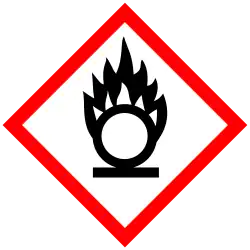 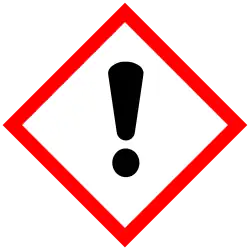
|
|
|
Danger
|
Hazard statements
|
H271, H272, H319
|
Precautionary statements
|
P210, P220, P264+P265, P280, P283, P305+P351+P338, P306+P360, P337+P317, P370+P378, P371+P380+P375, P420, P501
|
Except where otherwise noted, data are given for materials in their standard state (at 25 °C [77 °F], 100 kPa). Infobox references
|
Adams' catalyst, also known as platinum dioxide, is usually represented as platinum(IV) oxide hydrate, PtO2·xH2O. It is a catalyst for hydrogenation and hydrogenolysis in organic synthesis.[2] This dark brown powder is commercially available. The oxide itself is not an active catalyst, but it becomes active after exposure to hydrogen whereupon it converts to platinum black, which is responsible for reactions.
Preparation
Adams' catalyst is prepared from chloroplatinic acid H2PtCl6 or ammonium chloroplatinate, (NH4)2PtCl6, by fusion with sodium nitrate. The first published preparation was reported by V. Voorhees and Roger Adams.[3] The procedure involves first preparing a platinum nitrate which is then heated to expel nitrogen oxides.[4]
- H2PtCl6 + 6 NaNO3 → Pt(NO3)4 + 6 NaCl (aq) + 2 HNO3
- Pt(NO3)4 → PtO2 + 4 NO2 + O2
The resulting brown cake is washed with water to free it from nitrates. The catalyst can either be used as is or dried and stored in a desiccator for later use. Platinum can be recovered from spent catalyst by conversion to ammonium chloroplatinate using aqua regia followed by ammonia.
Uses
Adams' catalyst is used for many applications. It has shown to be valuable for hydrogenation, hydrogenolysis, dehydrogenation, and oxidation reactions. During the reaction, platinum metal (platinum black) is formed which has been cited to be the active catalyst.[5][6] Hydrogenation occurs with syn stereochemistry when used on an alkyne resulting in a cis-alkene. Some of the most important transformations include the hydrogenation of ketones to alcohols or ethers (the latter product forming in the presence of alcohols and acids)[7] and the reduction of nitro compounds to amines.[8] However, reductions of alkenes can be performed with Adams' catalyst in the presence of nitro groups without reducing the nitro group.[9] When reducing nitro compounds to amines, platinum catalysts are preferred over palladium catalysts to minimize hydrogenolysis. The catalyst is also used for the hydrogenolysis of phenyl phosphate esters, a reaction that does not occur with palladium catalysts. The pH of the solvent significantly affects the reaction course, and reactions of the catalyst are often enhanced by conducting the reduction in neat acetic acid, or solutions of acetic acid in other solvents.
Development
Before development of Adams' catalyst, organic reductions were carried out using colloidal platinum or platinum black. The colloidal catalysts were more active but posed difficulties in isolating reaction products. This led to more widespread use of platinum black. In Adams' own words:
"...Several of the problems I assigned my students involved catalytic reduction. For this purpose we were using as a catalyst platinum black made by the generally accepted best method known at the time. The students had much trouble with the catalyst they obtained in that frequently it proved to be inactive even though prepared by the same detailed procedure which resulted occasionally in an active product. I therefore initiated a research to find conditions for preparing this catalyst with uniform activity."[5]
Safety
Little precaution is necessary with the oxide but, after exposure to H2, the resulting platinum black can be pyrophoric. Therefore, it should not be allowed to dry and all exposure to oxygen should be minimized.
See also
- Platinum on carbon
- Platinum black
- Rhodium-platinum oxide
- Palladium on carbon
References
- ^ PubChem. "Platinum(IV) oxide". pubchem.ncbi.nlm.nih.gov. Retrieved 2026-04-25.
- ^ Nishimura, Shigeo (2001). Handbook of Heterogeneous Catalytic Hydrogenation for Organic Synthesis (1st ed.). New York: Wiley-Interscience. pp. 30, 32, 64–137, 170–225, 315–386, & 572–663. ISBN 9780471396987.
- ^ Voorhees, V.; Adams, R. (1922). "The Use of the Oxides of Platinum for the Catalytic Reduction of Organic Compounds". J. Am. Chem. Soc. 44 (6): 1397. Bibcode:1922JAChS..44.1397V. doi:10.1021/ja01427a021.
- ^ Adams, Roger; Voorhees, V.; Shriner, R. L. (1928). "Platinum catalyst for reductions". Organic Syntheses. 8: 92. doi:10.15227/orgsyn.008.0092.
- ^ a b Hunt, LB (October 1962). "The Story of Adams' Catalyst: Platinum Oxide in Catalytic Reductions" (PDF). Platinum Metals Rev. 6 (4): 150–2. doi:10.1595/003214062X64150152. Archived from the original (PDF) on 2015-09-24. Retrieved 2007-02-20.
- ^ Scheeren, CW; Domingos, Josiel B.; MacHado, Giovanna; Dupont, Jairton (October 2008). "Hydrogen Reduction of Adams' Catalyst in Ionic Liquids: Formation and Stabilization of Pt(0) Nanoparticles". J. Phys. Chem. C. 112 (42): 16463–9. doi:10.1021/jp804870j.
- ^ Verzele, M.; Acke, M.; Anteunis, M. (1963). "A general synthesis of ethers". Journal of the Chemical Society: 5598–5600. doi:10.1039/JR9630005598.
- ^ Adams, Roger; Cohen, F. L. (1928). "Ethyl p-Aminobenzoate". Organic Syntheses. 8: 66. doi:10.15227/orgsyn.008.0066.
- ^ van Tamelen, Eugene E.; Thiede, Robert J. (1952). "The Synthetic Application and Mechanism of the Nef Reaction". Journal of the American Chemical Society. 74 (10): 2615–2618. Bibcode:1952JAChS..74.2615T. doi:10.1021/ja01130a044.
External links
|
|---|
| Pt(−II) | |
|---|
| Pt(0) | |
|---|
| Pt(II) |
- Pt(NH3)2(CO2)2C4H6
- cis-Pt(NH3)2Cl2
- (NH4)2[PtCl4]
- trans-Pt(NH3)2Cl2
- K2Pt(CN)4 / Pt(CN)−2
4
- Pt(NH3)4PtCl4
- Pt(NH3)2CO2CH2O
- (Cy(NH2)2)PtC2O4
- NH3PtCl2(PyrMe)
- Pt(OAc)2
- PtBr2
- PtCl2
- PtF2
- PtI
2
- PtP2
- K2PtCl4
- [(PtCl(NH3)2(C6H12(NH2)2))Pt(NH3)2](NO3)4
- Pt(OH)2
- Pt(C5H7O2)2
- PtS
| Organoplatinum(II) compounds |
PtCl2(Cod)
Pt(CNO)2
KPtCl3C2H4
|
|---|
|
|---|
| Pt(IV) |
- PtO2
- PtBr4
- PtCl4
- PtF4
- (NH4)2[PtI6]
- Pt(OAc)2Cl2(NH3)(NH2Cy)
- Pt(OH)4
- PtI4
- PtS2
- PtSe2
| Hexachloroplatinates |
H2PtCl6
Na2PtCl6
K2PtCl6
(NH4)2PtCl6
|
|---|
- [PtCl(NH3)5]Cl3
- [Pt(NH3)6]Cl4
|
|---|
| Pt(V) | |
|---|
| Pt(VI) | |
|---|
Salts and covalent derivatives of the oxide ion |
|---|
| H2O
|
|
|
|
He
|
| Li2O
|
BeO
|
B6O
BO
B2O3
|
C2O
C12O9
C3O2
CO
CO2
CO3
CxOy
|
N2O
NO
N2O2
N2O3
N2O4
NO2
N2O5
NxOy
|
O2−2
|
F
|
Ne
|
| Na2O
|
MgO
|
Al2O
AlO
Al2O3
|
SiO
SiO2
|
PO
P4O6
P4O10
|
SO
S2O2
SO2
SO3
|
Cl2O
ClO
Cl2O4
ClO2
Cl2O5?
Cl2O6
Cl2O7
|
Ar
|
| K2O
|
CaO
|
|
Sc2O3
|
TiO
Ti2O3
TiO2
|
VO
V2O3
VO2
V2O5
|
CrO
Cr2O3
CrO2
CrO3
|
MnO
Mn3O4
Mn2O3
MnO2
Mn2O7
|
FeO
Fe3O4
Fe2O3
|
CoO
Co3O4
Co2O3
|
NiO
Ni2O3
|
Cu2O
CuO
|
ZnO
|
Ga2O
Ga2O3
|
GeO
GeO2
|
As2O3
As2O5
|
SeO2
SeO3
|
Br2O
BrO
BrO2
Br3O8
|
Kr
|
| Rb2O
|
SrO
|
|
YO
Y2O3
|
ZrO
ZrO2
|
NbO
NbO2
Nb2O5
|
MoO2
MoO3
|
TcO2
Tc2O7
|
RuO2
RuO4
|
Rh2O3
RhO2
|
PdO
|
Ag2O
Ag4O4
Ag2O3
|
CdO
|
In2O3
|
SnO
SnO2
|
Sb2O3
Sb2O4
Sb2O5
|
TeO2
TeO3
|
I2O
IO
IO2
I2O5
|
XeO3
XeO4
|
| Cs2O
|
BaO
|
*
|
Lu2O3
|
HfO2
|
Ta2O5
|
W2O3
WO2
"W2O5"
WO3
|
ReO2
ReO3
Re2O7
|
OsO2
OsO4
|
IrO2
IrO4
|
PtO2
|
Au2O3
|
Hg2O
HgO
|
Tl2O
Tl2O3
|
PbO
Pb3O4
PbO2
|
Bi2O3
Bi2O5
|
PoO
PoO2
PoO3
|
At
|
Rn
|
| Fr
|
RaO
|
**
|
Lr
|
RfO2?
|
Db2O5?
|
SgO3
|
Bh2O7?
|
HsO4
|
Mt
|
Ds
|
Rg
|
Cn
|
Nh
|
Fl
|
Mc
|
Lv
|
Ts
|
Og
|
|
|
|
| *
|
La2O3
|
Ce2O3
CeO2
|
Pr2O3
Pr6O11
PrO2
|
Nd2O3
|
Pm2O3
|
Sm2O3
|
EuO
Eu2O3
|
Gd2O3
|
Tb2O3
Tb4O7
TbO2
|
Dy2O3
|
Ho2O3
|
Er2O3
|
Tm2O3
|
Yb2O3
|
| **
|
Ac2O3
|
ThO
ThO2
|
PaO
PaO2
Pa2O5
|
UO2
U2O5
U3O8
UO3
|
Np2O3
NpO2
Np2O5
NpO3
|
Pu2O3
PuO2
PuO3
|
Am2O3
AmO2
|
Cm2O3
CmO2
|
BkO
Bk2O3
BkO2
|
Cf2O3
CfO2
|
Es2O3
|
Fm
|
Md
|
No
|
|
Topics in organic reactions |
|---|
- Addition reaction
- Elimination reaction
- Polymerization
- Reagents
- Rearrangement reaction
- Redox reaction
- Regioselectivity
- Stereoselectivity
- Stereospecificity
- Substitution reaction
|
- A value
- Alpha effect
- Annulene
- Anomeric effect
- Antiaromaticity
- Aromatic ring current
- Aromaticity
- Baird's rule
- Baker–Nathan effect
- Baldwin's rules
- Bema Hapothle
- Beta-silicon effect
- Bicycloaromaticity
- Bredt's rule
- Bürgi–Dunitz angle
- Catalytic resonance theory
- Charge remote fragmentation
- Charge-transfer complex
- Clar's rule
- Conformational isomerism
- Conjugated system
- Conrotatory and disrotatory
- Curtin–Hammett principle
- Dynamic binding (chemistry)
- Edwards equation
- Effective molarity
- Electromeric effect
- Electron-rich
- Electron-withdrawing group
- Electronic effect
- Electrophile
- Evelyn effect
- Flippin–Lodge angle
- Free-energy relationship
- Grunwald–Winstein equation
- Hammett acidity function
- Hammett equation
- George S. Hammond
- Hammond's postulate
- Homoaromaticity
- Hückel's rule
- Hyperconjugation
- Inductive effect
- Kinetic isotope effect
- LFER solvent coefficients (data page)
- Marcus theory
- Markovnikov's rule
- Möbius aromaticity
- Möbius–Hückel concept
- More O'Ferrall–Jencks plot
- Negative hyperconjugation
- Neighbouring group participation
- 2-Norbornyl cation
- Nucleophile
- Kennedy J. P. Orton
- Passive binding
- Phosphaethynolate
- Polar effect
- Polyfluorene
- Ring strain
- Σ-aromaticity
- Spherical aromaticity
- Spiroaromaticity
- Steric effects
- Superaromaticity
- Swain–Lupton equation
- Taft equation
- Thorpe–Ingold effect
- Vinylogy
- Walsh diagram
- Woodward–Hoffmann rules
- Woodward's rules
- Y-aromaticity
- Yukawa–Tsuno equation
- Zaitsev's rule
- Σ-bishomoaromaticity
List of organic reactions |
|---|
Carbon-carbon
bond forming
reactions | | Homologation reactions |
- Arndt–Eistert reaction
- Hooker reaction
- Kiliani–Fischer synthesis
- Kowalski ester homologation
- Methoxymethylenetriphenylphosphorane
- Seyferth–Gilbert homologation
- Wittig reaction
|
|---|
| Olefination reactions |
- Bamford–Stevens reaction
- Barton–Kellogg reaction
- Boord olefin synthesis
- Chugaev elimination
- Cope reaction
- Corey–Winter olefin synthesis
- Dehydrohalogenation
- Elimination reaction
- Grieco elimination
- Hofmann elimination
- Horner–Wadsworth–Emmons reaction
- Hydrazone iodination
- Julia olefination
- Julia–Kocienski olefination
- Kauffmann olefination
- McMurry reaction
- Peterson olefination
- Ramberg–Bäcklund reaction
- Shapiro reaction
- Takai olefination
- Wittig reaction
|
|---|
|
|---|
Carbon-heteroatom
bond forming
reactions |
- Azo coupling
- Bartoli indole synthesis
- Boudouard reaction
- Cadogan–Sundberg indole synthesis
- Diazonium compound
- Esterification
- Grignard reagent
- Haloform reaction
- Hegedus indole synthesis
- Hurd–Mori 1,2,3-thiadiazole synthesis
- Kharasch–Sosnovsky reaction
- Knorr pyrrole synthesis
- Leimgruber–Batcho indole synthesis
- Mukaiyama hydration
- Nenitzescu indole synthesis
- Oxymercuration reaction
- Reed reaction
- Schotten–Baumann reaction
- Ullmann condensation
- Williamson ether synthesis
- Yamaguchi esterification
|
|---|
Degradation
reactions |
- Barbier–Wieland degradation
- Bergmann degradation
- Edman degradation
- Emde degradation
- Gallagher–Hollander degradation
- Hofmann rearrangement
- Hooker reaction
- Isosaccharinic acid
- Marker degradation
- Ruff degradation
- Strecker degradation
- Von Braun amide degradation
- Weerman degradation
- Wohl degradation
|
|---|
Organic redox
reactions |
- Acyloin condensation
- Adkins–Peterson reaction
- Akabori amino-acid reaction
- Alcohol oxidation
- Algar–Flynn–Oyamada reaction
- Amide reduction
- Andrussow process
- Angeli–Rimini reaction
- Aromatization
- Autoxidation
- Baeyer–Villiger oxidation
- Barton–McCombie deoxygenation
- Bechamp reduction
- Benkeser reaction
- Bergmann degradation
- Birch reduction
- Bohn–Schmidt reaction
- Bosch reaction
- Bouveault–Blanc reduction
- Boyland–Sims oxidation
- Cannizzaro reaction
- Carbonyl reduction
- Clemmensen reduction
- Collins oxidation
- Corey–Itsuno reduction
- Corey–Kim oxidation
- Corey–Winter olefin synthesis
- Criegee oxidation
- Dakin oxidation
- Davis oxidation
- Deoxygenation
- Dess–Martin oxidation
- DNA oxidation
- Elbs persulfate oxidation
- Emde degradation
- Eschweiler–Clarke reaction
- Étard reaction
- Fischer–Tropsch process
- Fleming–Tamao oxidation
- Fukuyama reduction
- Ganem oxidation
- Glycol cleavage
- Griesbaum coozonolysis
- Grundmann aldehyde synthesis
- Haloform reaction
- Hydrogenation
- Hydrogenolysis
- Hydroxylation
- Jones oxidation
- Kiliani–Fischer synthesis
- Kolbe electrolysis
- Kornblum oxidation
- Kornblum–DeLaMare rearrangement
- Leuckart reaction
- Ley oxidation
- Lindgren oxidation
- Lipid peroxidation
- Lombardo methylenation
- Luche reduction
- Markó–Lam deoxygenation
- McFadyen–Stevens reaction
- Meerwein–Ponndorf–Verley reduction
- Methionine sulfoxide
- Miyaura borylation
- Mozingo reduction
- Noyori asymmetric hydrogenation
- Omega oxidation
- Oppenauer oxidation
- Oxygen rebound mechanism
- Ozonolysis
- Parikh–Doering oxidation
- Pinnick oxidation
- Prévost reaction
- Reduction of nitro compounds
- Reductive amination
- Riley oxidation
- Rosenmund reduction
- Rubottom oxidation
- Sabatier reaction
- Sarett oxidation
- Selenoxide elimination
- Shapiro reaction
- Sharpless asymmetric dihydroxylation
- Epoxidation of allylic alcohols
- Sharpless epoxidation
- Sharpless oxyamination
- Stahl oxidation
- Staudinger reaction
- Stephen aldehyde synthesis
- Swern oxidation
- Transfer hydrogenation
- Wacker process
- Wharton reaction
- Whiting reaction
- Wohl–Aue reaction
- Wolff–Kishner reduction
- Wolffenstein–Böters reaction
- Zinin reaction
|
|---|
Rearrangement
reactions |
- 1,2-rearrangement
- 1,2-Wittig rearrangement
- 2,3-sigmatropic rearrangement
- 2,3-Wittig rearrangement
- Achmatowicz reaction
- Alkyne zipper reaction
- Allen–Millar–Trippett rearrangement
- Allylic rearrangement
- Alpha-ketol rearrangement
- Amadori rearrangement
- Arndt–Eistert reaction
- Aza-Cope rearrangement
- Baker–Venkataraman rearrangement
- Bamberger rearrangement
- Banert cascade
- Beckmann rearrangement
- Benzilic acid rearrangement
- Bergman cyclization
- Bergmann degradation
- Boekelheide reaction
- Brook rearrangement
- Buchner ring expansion
- Carroll rearrangement
- Chan rearrangement
- Claisen rearrangement
- Cope rearrangement
- Corey–Fuchs reaction
- Cornforth rearrangement
- Criegee rearrangement
- Curtius rearrangement
- Demjanov rearrangement
- Di-π-methane rearrangement
- Dimroth rearrangement
- Divinylcyclopropane-cycloheptadiene rearrangement
- Dowd–Beckwith ring-expansion reaction
- Electrocyclic reaction
- Ene reaction
- Enyne metathesis
- Favorskii reaction
- Favorskii rearrangement
- Ferrier carbocyclization
- Ferrier rearrangement
- Fischer–Hepp rearrangement
- Fries rearrangement
- Fritsch–Buttenberg–Wiechell rearrangement
- Gabriel–Colman rearrangement
- Group transfer reaction
- Halogen dance rearrangement
- Hayashi rearrangement
- Hofmann rearrangement
- Hofmann–Martius rearrangement
- Ireland–Claisen rearrangement
- Jacobsen rearrangement
- Kornblum–DeLaMare rearrangement
- Kowalski ester homologation
- Lobry de Bruyn–Van Ekenstein transformation
- Lossen rearrangement
- McFadyen–Stevens reaction
- McLafferty rearrangement
- Meyer–Schuster rearrangement
- Mislow–Evans rearrangement
- Mumm rearrangement
- Myers allene synthesis
- Nazarov cyclization reaction
- Neber rearrangement
- Newman–Kwart rearrangement
- Overman rearrangement
- Oxy-Cope rearrangement
- Pericyclic reaction
- Piancatelli rearrangement
- Pinacol rearrangement
- Pummerer rearrangement
- Ramberg–Bäcklund reaction
- Ring expansion and contraction
- Ring-closing metathesis
- Rupe reaction
- Schmidt reaction
- Semipinacol rearrangement
- Seyferth–Gilbert homologation
- Sigmatropic reaction
- Skattebøl rearrangement
- Smiles rearrangement
- Sommelet–Hauser rearrangement
- Stevens rearrangement
- Stieglitz rearrangement
- Thermal rearrangement of aromatic hydrocarbons
- Tiffeneau–Demjanov rearrangement
- Vinylcyclopropane rearrangement
- Wagner–Meerwein rearrangement
- Wallach rearrangement
- Weerman degradation
- Westphalen–Lettré rearrangement
- Willgerodt rearrangement
- Wolff rearrangement
|
|---|
Ring forming
reactions |
- 1,3-Dipolar cycloaddition
- Annulation
- Azide-alkyne Huisgen cycloaddition
- Baeyer–Emmerling indole synthesis
- Bartoli indole synthesis
- Bergman cyclization
- Biginelli reaction
- Bischler–Möhlau indole synthesis
- Bischler–Napieralski reaction
- Blum–Ittah aziridine synthesis
- Bobbitt reaction
- Bohlmann–Rahtz pyridine synthesis
- Borsche–Drechsel cyclization
- Bucherer carbazole synthesis
- Bucherer–Bergs reaction
- Cadogan–Sundberg indole synthesis
- Camps quinoline synthesis
- Chichibabin pyridine synthesis
- Cook–Heilbron thiazole synthesis
- Cycloaddition
- Darzens reaction
- Davis–Beirut reaction
- De Kimpe aziridine synthesis
- Debus–Radziszewski imidazole synthesis
- Dieckmann condensation
- Diels–Alder reaction
- Feist–Benary synthesis
- Ferrario–Ackermann reaction
- Fiesselmann thiophene synthesis
- Fischer indole synthesis
- Fischer oxazole synthesis
- Friedländer synthesis
- Gewald reaction
- Graham reaction
- Hantzsch pyridine synthesis
- Hegedus indole synthesis
- Hemetsberger indole synthesis
- Hofmann–Löffler reaction
- Hurd–Mori 1,2,3-thiadiazole synthesis
- Iodolactonization
- Isay reaction
- Jacobsen epoxidation
- Johnson–Corey–Chaykovsky reaction
- Knorr pyrrole synthesis
- Knorr quinoline synthesis
- Kröhnke pyridine synthesis
- Kulinkovich reaction
- Larock indole synthesis
- Madelung synthesis
- Nazarov cyclization reaction
- Nenitzescu indole synthesis
- Niementowski quinazoline synthesis
- Niementowski quinoline synthesis
- Paal–Knorr synthesis
- Paternò–Büchi reaction
- Pechmann condensation
- Petrenko-Kritschenko piperidone synthesis
- Pictet–Spengler reaction
- Pomeranz–Fritsch reaction
- Prilezhaev reaction
- Pschorr cyclization
- Reissert indole synthesis
- Ring-closing metathesis
- Robinson annulation
- Sharpless epoxidation
- Simmons–Smith reaction
- Skraup reaction
- Urech hydantoin synthesis
- Van Leusen reaction
- Wenker synthesis
| Cycloaddition |
- 1,3-Dipolar cycloaddition
- 4+4 Photocycloaddition
- (4+3) cycloaddition
- 6+4 Cycloaddition
- Alkyne trimerisation
- Aza-Diels–Alder reaction
- Azide-alkyne Huisgen cycloaddition
- Bradsher cycloaddition
- Cheletropic reaction
- Conia-ene reaction
- Cyclopropanation
- Diazoalkane 1,3-dipolar cycloaddition
- Diels–Alder reaction
- Enone–alkene cycloadditions
- Hexadehydro Diels–Alder reaction
- Intramolecular Diels–Alder cycloaddition
- Inverse electron-demand Diels–Alder reaction
- Ketene cycloaddition
- McCormack reaction
- Metal-centered cycloaddition reactions
- Nitrone-olefin (3+2) cycloaddition
- Oxo-Diels–Alder reaction
- Ozonolysis
- Pauson–Khand reaction
- Povarov reaction
- Prato reaction
- Retro-Diels–Alder reaction
- Staudinger synthesis
- Trimethylenemethane cycloaddition
- Vinylcyclopropane (5+2) cycloaddition
- Wagner-Jauregg reaction
|
|---|
| Heterocycle forming reactions |
- Algar–Flynn–Oyamada reaction
- Allan–Robinson reaction
- Auwers synthesis
- Bamberger triazine synthesis
- Banert cascade
- Barton–Zard reaction
- Bernthsen acridine synthesis
- Bischler–Napieralski reaction
- Bobbitt reaction
- Boger pyridine synthesis
- Borsche–Drechsel cyclization
- Bucherer carbazole synthesis
- Bucherer–Bergs reaction
- Chichibabin pyridine synthesis
- Cook–Heilbron thiazole synthesis
- Diazoalkane 1,3-dipolar cycloaddition
- Einhorn–Brunner reaction
- Erlenmeyer–Plöchl azlactone and amino-acid synthesis
- Feist–Benary synthesis
- Fischer oxazole synthesis
- Gabriel–Colman rearrangement
- Gewald reaction
- Hantzsch ester
- Hantzsch pyridine synthesis
- Herz reaction
- Knorr pyrrole synthesis
- Kröhnke pyridine synthesis
- Lectka enantioselective beta-lactam synthesis
- Lehmstedt–Tanasescu reaction
- Niementowski quinazoline synthesis
- Nitrone-olefin (3+2) cycloaddition
- Paal–Knorr synthesis
- Pellizzari reaction
- Pictet–Spengler reaction
- Pomeranz–Fritsch reaction
- Prilezhaev reaction
- Robinson–Gabriel synthesis
- Stollé synthesis
- Urech hydantoin synthesis
- Wenker synthesis
- Wohl–Aue reaction
|
|---|
|
|---|
|
