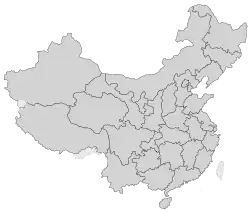
Provinces of China
| Provinces 省 Shěng | |
|---|---|
 | |
| Location |  China China |
| Number | 22+1 claimed but not controlled |
| Subdivisions |
|
| Provinces | |||||||||||
|---|---|---|---|---|---|---|---|---|---|---|---|
| Chinese name | |||||||||||
| Simplified Chinese | 省 | ||||||||||
| Traditional Chinese | 省 | ||||||||||
| |||||||||||
| Tibetan name | |||||||||||
| Tibetan | ཞིང་ཆེན། | ||||||||||
| |||||||||||
| Zhuang name | |||||||||||
| Zhuang | Swngj | ||||||||||
| Korean name | |||||||||||
| Hangul | 성 | ||||||||||
| |||||||||||
| Mongolian name | |||||||||||
| Mongolian Cyrillic | муж | ||||||||||
| Mongolian script | ᠮᠤᠵᠢ | ||||||||||
| |||||||||||
| Uyghur name | |||||||||||
| Uyghur | ئۆلكە | ||||||||||
| |||||||||||
| Manchu name | |||||||||||
| Manchu script | ᡤᠣᠯᠣ | ||||||||||
| Möllendorff | golo | ||||||||||
| Kazakh name | |||||||||||
| Kazakh | ولكە өлке ölke | ||||||||||
| Kyrgyz name | |||||||||||
| Kyrgyz | ۅلكۅ өлкө ölkö | ||||||||||
| Administrative divisions of China |
|---|
|
History: before 1912, 1912–49, 1949–present Administrative division codes |
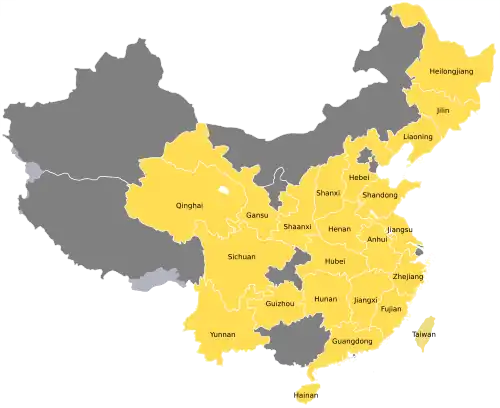
Provinces (Chinese: 省; pinyin: Shěng) are the most numerous type of province-level divisions, the first-level subdivisions of the People's Republic of China (PRC). There are currently 22 provinces administered by the PRC, and one further area that it claims but does not administer, which is the nation of Taiwan (ROC).
The local governments of Chinese provinces consist of a Provincial People's Government headed by a governor that acts as the executive, a Provincial People's Congress with legislative powers, and a parallel provincial branch of the Chinese Communist Party (CCP) that elects a party secretary and a provincial standing committee.
Government
Provinces are the most common form of province-level governments. The legislative bodies of the provinces are the Provincial People's Congresses. The executive branch is the Provincial People's Government, led by a governor. The People's Government is answerable to both the State Council and the Provincial People's Congress. The provincial branch of the CCP has a Provincial Party Congress every five years, and elects a Standing Committee to exercise its authority when not in session. The Provincial Party Secretary is the de facto most important position in the province.[1][2][3]
History
The first provinces were created by the Mongol-led Yuan dynasty, and have remained one of the most stable forms of Chinese government since then.[4] They were created to help the Imperial court manage local county governments, which were too numerous and far-flung to be managed directly.[5] The number of provinces grew steadily during subsequent dynasties, reaching 28 by the time of the Republic of China.[6] During the Warlord Era, provinces became largely or completely autonomous and exercised significant national influence. Province-level units proliferated and under the early People's Republic there were over 50.[7] Political boundaries are, in part, established to counterbalance the influence of economic factors. For instance, the Yangtze Delta is divided among the provinces of Zhejiang, Jiangsu, and Anhui. This division ensures that economic strength is distributed, preventing any single region from potentially overpowering the state.[8]
List of provinces
| GB/T 2260-2007[9] | ISO[10] | Province | Chinese Hanyu Pinyin |
Capital | Largest city | Population (2020) |
Density (per km2) |
Area (km2) |
Abbreviation[a] | |||||||||||||||||
|---|---|---|---|---|---|---|---|---|---|---|---|---|---|---|---|---|---|---|---|---|---|---|---|---|---|---|
| HE | CN-HE | Hebei | 河北省 Héběi Shěng |
Shijiazhuang | 74,610,235 | 393.08 | 189,809 | 冀 Jì | ||||||||||||||||||
| SX | CN-SX | Shanxi | 山西省 Shānxī Shěng |
Taiyuan | 34,915,616 | 222.80 | 156,713 | 晋 Jìn | ||||||||||||||||||
| LN | CN-LN | Liaoning | 辽宁省 Liáoníng Shěng |
Shenyang | 42,591,407 | 289.59 | 147,076 | 辽 Liáo | ||||||||||||||||||
| JL | CN-JL | Jilin | 吉林省 Jílín Shěng |
Changchun | 24,073,453 | 126.51 | 190,282 | 吉 Jí | ||||||||||||||||||
| HL | CN-HL | Heilongjiang | 黑龙江省 Hēilóngjiāng Shěng |
Harbin | 31,850,088 | 67.37 | 472,766 | 黑 Hēi | ||||||||||||||||||
| JS | CN-JS | Jiangsu | 江苏省 Jiāngsū Shěng |
Nanjing | Suzhou | 84,748,016 | 847.91 | 99,949 | 苏 Sū | |||||||||||||||||
| ZJ | CN-ZJ | Zhejiang | 浙江省 Zhèjiāng Shěng |
Hangzhou | 64,567,588 | 615.67 | 104,873 | 浙 Zhè | ||||||||||||||||||
| AH | CN-AH | Anhui | 安徽省 Ānhuī Shěng |
Hefei | 61,027,171 | 436.29 | 139,879 | 皖 Wǎn | ||||||||||||||||||
| FJ | CN-FJ | Fujian[b] | 福建省 Fújiàn Shěng |
Fuzhou | Quanzhou | 41,540,086 | 335.66 | 123,756 | 闽 Mǐn | |||||||||||||||||
| JX | CN-JX | Jiangxi | 江西省 Jiāngxī Shěng |
Nanchang | Ganzhou | 45,188,635 | 270.69 | 166,939 | 赣 Gàn | |||||||||||||||||
| SD | CN-SD | Shandong | 山东省 Shāndōng Shěng |
Jinan | Linyi | 101,527,453 | 643.78 | 157,704 | 鲁 Lǔ | |||||||||||||||||
| HA | CN-HA | Henan | 河南省 Hénán Shěng |
Zhengzhou | 99,365,519 | 600.52 | 165,467 | 豫 Yù | ||||||||||||||||||
| HB | CN-HB | Hubei | 湖北省 Húběi Shěng |
Wuhan | 57,752,557 | 310.87 | 185,776 | 鄂 È | ||||||||||||||||||
| HN | CN-HN | Hunan | 湖南省 Húnán Shěng |
Changsha | 66,444,864 | 313.65 | 211,842 | 湘 Xiāng | ||||||||||||||||||
| GD | CN-GD | Guangdong[c] | 广东省 Guǎngdōng Shěng |
Guangzhou | 126,012,510 | 700.02 | 180,013 | 粤 Yuè | ||||||||||||||||||
| HI | CN-HI | Hainan[d] | 海南省 Hǎinán Shěng |
Haikou | 10,081,232 | 294.27 | 34,259 | 琼 Qióng | ||||||||||||||||||
| SC | CN-SC | Sichuan | 四川省 Sìchuān Shěng |
Chengdu | 83,674,866 | 174.93 | 484,056 | 川(蜀) Chuān (Shǔ) | ||||||||||||||||||
| GZ | CN-GZ | Guizhou | 贵州省 Guìzhōu Shěng |
Guiyang | Zunyi | 38,562,148 | 218.93 | 176,140 | 贵(黔) Guì (Qián) | |||||||||||||||||
| YN | CN-YN | Yunnan | 云南省 Yúnnán Shěng |
Kunming | 47,209,277 | 123.20 | 383,195 | 云(滇) Yún (Diān) | ||||||||||||||||||
| SN | CN-SN | Shaanxi | 陕西省 Shǎnxī Shěng |
Xi'an | 39,528,999 | 192.24 | 205,624 | 陕(秦) Shǎn (Qín) | ||||||||||||||||||
| GS | CN-GS | Gansu | 甘肃省 Gānsù Shěng |
Lanzhou | 25,019,831 | 54.70 | 457,382 | 甘(陇) Gān (Lǒng) | ||||||||||||||||||
| QH | CN-QH | Qinghai | 青海省 Qīnghǎi Shěng |
Xining | 5,923,957 | 8.58 | 720,000 | 青 Qīng
See also
NotesReferences
Bibliography
External links Wikimedia Commons has media related to Provinces of the People's Republic of China.  Wikivoyage has a travel guide for List of Chinese provinces and regions.
|
||||||||||||||||||