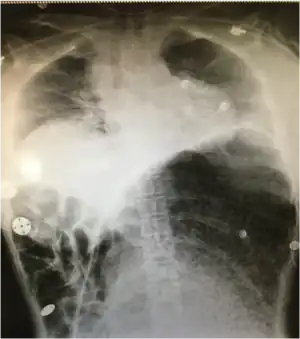
Upright chest x-ray and abdominal series to assess for free air
Can identify large distended stomach on x-ray
CT imaging if safe and indicated
Large distended stomach consistent with gastric dilation
Management
Nasogastric or orogastric decompression is first line therapy
Typically a large special tube required which is placed under anesthesiologist supervision in OR
Resuscitation with fluids and intravenous antibiotics as indicated
If conservative measures fail or gastric infarction suspected, surgical intervention mandatory
Disposition
Patient may require emergent surgical decompression
If improvement with non-operative decompression, may require admission for continued monitoring
Complications
Bowel necrosis with or without perforation
Abdominal compartment syndrome
Sepsis/Septic shock
If gastric necrosis and/or perforation not recognized and treatment delayed, mortality reaches 80%
See Also
Bariatric surgery complications
External Links
References
Dewangan M, Khare MK, Mishra S, and Marhual JC. Binge eating leading to acute gastric dilation, ischemic necrosis and rupture. Journal of Clinical and Diagnostic Research." 2016; 10(3): 6-7.
Lunca S, Rikkers A, and Stanescu A. Acute massive gastric dilation: Severe ischemia and gastric necrosis without perforation. Romanian Journal of Gastroenterology'. 2005; 14(3): 279-283.
Santos T, Freitas C, and Pinto-de-Sousa J. Gastric wall ischemia following massive gastric distention due to pyloric stenosis: a case report. Journal of Surgical Case Reports. 2016; 2: 1-3.