May be fatal when air entry reaches 200-300 mL (pressure gradient of 5 mmHg across 14 ga catheter entrains air at 100 mL/sec)[1]
Dialysis related
Due to negative intrathoracic pressure from spontaneous breathing
Diving related
Results from pulmonary barotrauma (most common) and decompression sickness, most commonly in last 10m of ascent. Patients with a patent foramen ovale may shunt normally-present venous system bubbles into the arterial system with any effortful action which causes valsalva.
Classically presents as LOC within 2 minutes of surfacing, can lead to stroke-like symptoms.
A "lucid interval" of asymptomatic period after initial symptoms, lasting perhaps hours, until progressive decompensation is common. Any report of LOC, seizure-like activity, stroke-like symptoms, or other temporary neurologic impairment within 10 minutes of surfacing, even if it has since resolved, should result in high suspicion for AGE and emergent recompression therapy (hyperbaric chamber treatment) should be pursued. Consult hyperbarics/dive medicine if available or call Divers Alert Network +1-919-684-9111.
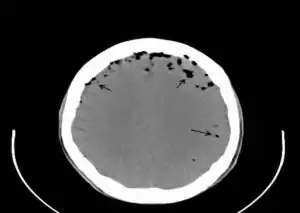
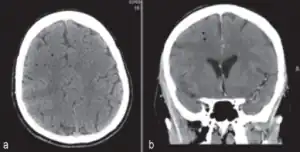
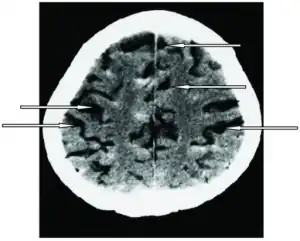
Cerebral air embolism with multiple air bubbles.Fatal cerebral arterial gas embolism. (a) CT head showing air bubbles predominantly in the right cerebral hemisphere (b) CT head showing air bubbles predominantly in the right cerebral hemisphereArterial air embolism (arrows)
Low ETCO2 in significant venous air embolism
TEE: most sensitive, invasive not available in emergencies
Doppler US: noninvasive; air in chamber = high pitch sound
Divers with suspected AGE should likely be screened for patent foramen ovale
Durant's maneuver - left lateral decubitus and Trendelenburg (head down)
Traps air in apex of RV, relieves obstruction of pulmonary outflow tract
Hyperbaric oxygen therapy - descent to an equivalent pressure/depth of 60 feet of sea water (fsw) (US Navy Treatment Table 6) causes any gas bubble to be crushed to approximately 40% of its original size, as well as easing the entry of those gasses into solution so they can be removed with respiration
May require open surgical or angiography for recovery of residual intracardiac or intrapulmonary air
Dialysis Related
Prevent any further air entry
Immediately cover puncture site with saline soaked gauze
↑Vascular Access. In: Marino, P. The ICU Book. 4th, North American Edition. Philadelphia, PA: Wolters Kluwer Health/Lippincott Williams & Wilkins; 2013
↑Diving Medicine, Karen B. Van Hoesen and Michael A. Lang, Auerbach's Wilderness Medicine, Chapter 71, 1583-1618.e6
↑*Shaikh N., Ummunisa F. Acute management of vascular air embolism. J Emerg Trauma Shock. 2009 Sep-Dec; 2(3): 180–185.
↑Gordy S and Rowell S. Vascular air embolism. Int J Crit Illn Inj Sci. 2013 Jan-Mar; 3(1): 73–76.