Thromboangiitis obliterans
Background
- Also known as "Buerger's disease"
- Idiopathic inflammatory occlusive disease of the hands and feet (exact pathogenesis unknown)
Risk factors
- Tobacco use
- Virtually all affected patients are smokers
- Male
- Middle Eastern
Vasculitis Syndrome Types
- Large vessel
- Takayasu arteritis
- Giant cell arteritis (temporal arteritis)
- Medium-vessel
- Kawasaki disease
- Polyarteritis nodosa
- Thromboangiitis obliterans (Buerger's disease)
- Primary angiitis of the central nervous system
- Small-vessel
- Henoch-Schönlein purpura
- ANCA-associated vasculitides
- Granulomatosis with polyangiitis (Wegner's)
- Eosinophilic granulomatosis with polyangiitis (Churg-Strauss)
- Microscopic polyangiitis
- Cutaneous leukocytoclastic angiitis (“hypersensitivity vasculitis”)
- Essential cryoglobulinemia, cryoglobulinemic vasculitis due to hepatitis C
- Behçet's disease]
- Secondary vasculitides and other/miscellaneous
- Drug-induced vasculitis
- Serum sickness
- Vasculitis associated with other rheumatic diseases (e.g. SLE)
Clinical Features
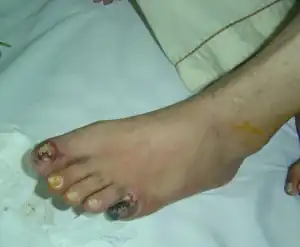
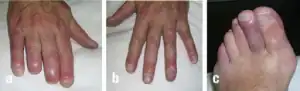
- Red, tender nodules over peripheral arteries
- May have diminished pulses
- In-step claudication
- Hand claudication
- Often bilateral and symmetrical
- May lead to ulceration
- Raynaud phenomenon
- Gangrene and autoamputation of digits in severe disease
Differential Diagnosis
<translate>
Blue Digit
- Acute arterial ischemia
- Atheroembolism (AKA Blue Toe Syndrome)
- Arterial embolism
- Arterial thrombosis
- Vasospastic Disorders
- Raynaud’s disease
- Primary erythromelalgia
- Autoimmune
- Scleroderma
- SLE
- Idiopathic
- Thromboangiitis obliterans (Buerger's disease)
- Chronic peripheral artery disease
- Atherosclerosis obliterans
</translate>
Evaluation
- Clinical criteria for diagnosis (noninvasive testing not necessary)
- History of smoking
- Onset prior to <50 years old
- Absence of atherosclerotic risk factors
- Upper limb involvement
- Infrapopliteal arterial occlusive lesions
Management
- Abstinence from tobacco
- Early symptoms with out threatened tissue loss: outpatient vascular
- Advanced disease: intra-arterial or intravenous PGE1, ASA, Heparin, arterial reconstruction, sympathectomy
Disposition
- Discharge with vascular follow-up if no evidence/threat of tissue loss
- Otherwise admit