Gun shot wounds
Background Bullets
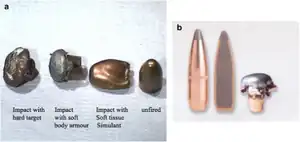
Composed of a full or partial metal "jacket" around a lead alloy core
Shape depends on caliber and tip type (pointed, flat, hollow, soft)
General caliber classification
Small (.22, .25)
Medium (.32, .38, .357, 9mm)
Large (.40, .41, .44, .45, .50)
Common shotgun gauges
12-gauge = bore diameter of .729 inches
20-gauge = .615 inches
Shotgun pellets, small to large
Birdshot (shotshells) - many small pellets, large kill spread
Buckshot - fewer but larger pellets
Slug, sabots - single large solid slug Types High Velocity Bullets Examples: .223 or 30/06 Springfield
Very high kinetic energy
Little deformity when fired
Cavitation is principle mechanism of destruction, the dissipation of energy radially away from the bullet as it travels through tissue
Large zone of tissue injury even away from tract Low Velocity Bullets Examples: .22 long rifle or .45 pistol
Relatively low kinetic energy
Deform from friction
Crash injury is principle mechanism of damage given projectile tumbling and fragmentation Shotgun Very high kinetic energy at close range
Shells contain several to several hundred hundred pellets
Spread of pellets and rapid energy transfer makes these weapons dangerous at close range Clinical Features Assess for number of wounds to help determine if projectile may still present in body
Exit wound may not follow logical trajectory
Strongly consider not documenting "entrance" vs. "exit" given medicolegal implications if not completely sure
Entrance wound (typical features)
Round, punched out hole
Marginal abrasion or abrasion ring
+/- fouling (soot)
+/- stippling (punctate abrasions from gunpowder impact)
Exit wound (typical features)
Usually larger (except head)
Wound edges may be reapproximated
No marginal abrasion
Slit-like, stellate, circular
Irregular due to loss of kinetic energy, bullet deformation, yaw
Range of fire
Contact (< 12 inches) → fouling/soot, muzzle stamp (tight contact)
Intermediate (2.5-3.5 feet) → +/- fouling, stippling
Distant (>3.5 feet) → wound only
Shotgun extrance wounds
Marginal abrasion, fouling, stippling
Plastic wad may be found in body if range <5-10 feet
Close range (<12 inches) may have ~1 inch diameter single hole with fouling
3 feet - round hole, scalloped edges, stippling
4 feet - round hole, scalloping, satellites
Distant (>10 feet) - pellet spread Region Specific Information Evaluation For intra-articular retained bullet, consider risk of developing lead poisoning . ATLS/FAST/Trauma Labs
CT Scan as needed depending on location
X-ray if bony injury suspected
CTA if vascular injury suspected Management Trauma consult depending on location and extent of wound
Ortho consult for bony injuries
Neuro/OMF/ENT as needed
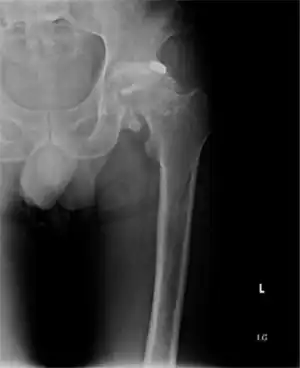
Removal if intraarticular, with case reports of lead toxicity[ 1] Prophylactic Antibiotics Infection after gunshot injury is a rare complication
No prophylactic antibiotics for:[ 2] Soft tissue gun shot wounds
Non-operative fractures caused by gun shot wounds
Give prophylactic for:[ 3] Intra-articular fracture (any type of gun shot wound)
Fractures caused by high-velocity weapons or shotguns
Penetration through contaminated hollow viscous (passage through bowel)[ 4] Disposition To OR if significant injuries
Admission/Obs for less concerning injuries
Minor injuries may be discharged
GSW Protocol allows lower extremity wounds to be discharged from ED after 9 hours without invasive imaging if they have normal ABIs[ 5] See Also References
↑ Lu K et al. Approach to Management of Intravascular Missile Emboli: Review of the Literature and Case Report. West J Emerg Med. 2015 Jul; 16(4): 489–496.
↑ Hot bullet, Dirty Wound? http://wueverydayebm.blogspot.com/2015/02/hot-bullet-dirty-wound.html
↑ Simpson, B. M., Wilson, R. H., & Grant, R. E. (2003). Antibiotic therapy in gunshot wound injuries. Clinical orthopaedics and related research, 408, 82-85.
↑ Lu K et al. Approach to Management of Intravascular Missile Emboli: Review of the Literature and Case Report. West J Emerg Med. 2015 Jul; 16(4): 489–496.
↑ Sandjadi, Javid. Expedited treatment of lower extremity gunshot wounds.