CMV retinitis
Background
- Most frequent and serious ocular opportunistic infection
- Leading cause of blindness in AIDS patients
- Typically occurs with CD4 less than 50
Clinical Features
- Variable, but may include:
- Change in visual acuity, visual loss
- Visual field cuts (Scotomas, loss of central vision)
- Floaters, flashing lights
- Photophobia
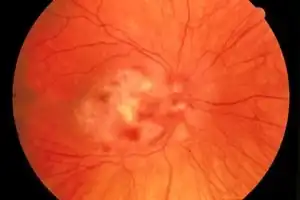
- Fundoscopy:
- Fluffy white perivascular lesions
- Dirty white granular retinal necrosis
- Adjacent hemorrhage - "Pizza pie" appearance
Differential Diagnosis
<translate>
Acute onset flashers and floaters
- Ocular causes
- Floaters and/or flashes
- Posterior vitreous detachment
- Retinal tear or retinal detachment
- Posterior uveitis
- Predominantly floaters
- Vitreous hemorrhage secondary to proliferative retinopathy
- Sympathetic ophthalmia
- Predominantly flashes
- Oculodigital stimulation
- Rapid eye movements
- Neovascular age-related macular degeneration
- Floaters and/or flashes
- Non-ocular causes
- Intraocular foreign body
- Migraine aura (classic)
- Migraine aura (acephalgicmigraine)
- Occipital lobe disorders
- Postural hypotension
</translate>
HIV associated conditions
- HIV neurologic complications
- HIV pulmonary complications
- Ophthalmologic complications
- Other
- HAART medication side effects[1]
- HAART-induced lactic acidosis
- Neuropyschiatric effects
- Hepatic toxicity
- Renal toxicity
- Steven-Johnson's
- Cytopenias
- GI symptoms
- Endocrine abnormalities
Evaluation
- CD4 typically < 50 cells/mm³
Management
Antivirals
====Severe Vision Threatening==== *Ganciclovir intraocular implant for 8 months AND
- Valganciclovir 900mg PO q12hrs x 14 days then 900mg PO q24hrs x 7 days
====Peripheral lesions==== *Valganciclovir 900mg PO q12hrs x 21 days then 900mg PO q24hrs x 7 days
Complications
- Retinal detachment
- Complete vision loss
- Despite treatment, 10% lose vision
- CMV Immune Recovery Uveitis (IRU)
- Patients with retinitis who develop blurry vision after starting HAART need ophtho eval to assess for CMV progression, relapse, or IRU
- Possible cause - T-cell mediated immune reconstitution to latent CMV intraocular antigens
- Symptoms - Floaters, photophobia, blurred vision
- Occurs median 20 weeks after starting HAART
- Urgent ophtho eval
Disposition
See Also
References
- ↑ Gutteridge, David L MD, MPH, Egan, Daniel J. MD. The HIV-Infected Adult Patient in The Emergency Department: The Changing Landscape of the Disease. Emergency Medicine Practice: An Evidence-Based Approach to Emergency Medicine. Vol 18, Num 2. Feb 2016.
- Rothmans RE, Marco CA, Yang S. Human immunodeficiency virus infection and acquired immunodeficiency syndrome, in Tintinalli JE, Stapczynski JS, Ma OJ, et al (eds): Tintinalli’s Emergency Medicine, ed 7. New York, The McGraw-Hill Companies Inc., 2011.