Erythema toxicum neonatorum
Background
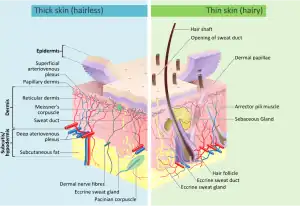 Normal dermal anatomy.
- Most common benign rash of newborns, occurring in ~50% of full-term neonates
- Self-limited condition lasting ~1-2 weeks
- Etiology unclear; thought to be related to activation of the innate immune system at hair follicles
- Onset typically 24-72 hours after birth, but can appear up to 2 weeks of age
- Incidence declines with decreasing gestational age (rare in preterm infants)
Clinical Features
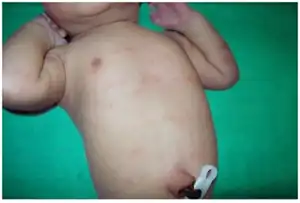 Erythema toxicum
- Erythematous macules, papules, and pustules on a blotchy erythematous base
- Distribution: face, trunk, proximal extremities
- Spares palms and soles (key distinguishing feature)
- Lesions are evanescent — appear, fade, and reappear in different locations over hours to days
- Infant is well-appearing, afebrile, feeding normally
Differential Diagnosis
Evaluation
- Clinical diagnosis in a well-appearing neonate
- If diagnosis uncertain: Wright stain of pustule contents shows eosinophils (pathognomonic)
- No labs, cultures, or imaging needed if classic presentation
Management
- No treatment necessary — reassurance to parents
- Resolves spontaneously within 1-2 weeks without sequelae
Disposition
- Discharge with parental reassurance
- No follow-up needed unless atypical features
See Also
References