Hepatitis E
Background
- Nonenveloped, RNA virus
- Fecal-oral transmission
- Common in Southeast Asia, but different genotypes found globally across Asia, Africa, Latin America[1]
Clinical Features


- Incubation period 2-10 weeks, usually 5-6
- Acute infection typically presents similar to hepatitis A
- Prodrome of nausea/vomiting, mild fever, malaise, anorexia, pruritus
- Jaundice, dark urine/pale stools, RUQ pain, hepatomegaly
- Liver failure rare except in pregnant women
- Pregnant women tend to have more severe disease, higher risk of fulminant hepatitis and liver failure, increased risk of fetal loss
- Mortality of HEV infection in 3rd trimester: 20-25%[2]
Differential Diagnosis
<translate>
Causes of acute hepatitis
- Acetaminophen toxicity (most common cause of acute liver failure in the US[3])
- Viral hepatitis
- Hepatitis A
- Hepatitis B
- Hepatitis C
- Hepatitis D
- Hepatitis E
- HSV
- Epstein-Barr virus
- Varicella zoster virus
- Toxoplasmosis
- Acute alcoholic hepatitis
- Toxins
- Mushroom toxicity
- Crotinarius mushrooms
- Gyromitra mushrooms
- Amanita mushrooms
- Ischemic hepatitis
- Autoimmune hepatitis
- Wilson's disease
</translate>
Evaluation
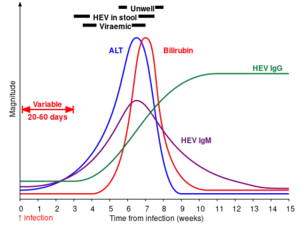
Workup
- LFTs
- INR
- Coagulopathy correlates w/more severe liver dysfunction
- Acute hepatitis panel
- Hep A Ab IgM
- Hep B cAb IgM
- Hep B sAg
- Hep B sAb
- Hep C Ab
Diagnosis
- Clinically indistinguishable from other viral hepatitides, no serologic test available[4]
<translate>
Interpreting Acute Hepatitis Panel Results
| Anti-hepatitis A, IgM | Hepatitis B surface antigen | Anti-hepatitis B core, IgM | Anti-hepatitis C | Interpretation |
|---|---|---|---|---|
| Positive | Negative | Negative | Negative | Acute hepatitis A |
| Negative | Positive | Positive | Negative | Acute hepatitis B |
| Negative | Positive | Negative | Negative | Chronic hepatitis B infection |
| Negative | Negative | Positive | Negative | Acute hepatitis B; quantity of hepatitis B surface antigen is too low to detect |
| Negative | Negative | Negative | Positive | Acute or chronic hepatitis C; additional tests are required to make the determination |
</translate>
Management
- Supportive
- Antiemetics
- Oral or IV hydration
- Avoid hepatotoxic medications
- Patients with fulminant hepatic failure may be considered for liver transplant
Disposition
- Typically discharge, admit if:
- Pregnant
- INR >2
- Unable to tolerate PO
- Intractable pain
- Bilirubin >30
- Hypoglycemia
- Significant comorbidity/immunocompromised
See Also
External Links
References
- ↑ Chaudhry SA et al. Hepatitis E infection during pregnancy. Can Fam Physician. 2015 Jul; 61(7): 607–608.
- ↑ WHO fact sheet https://www.who.int/news-room/fact-sheets/detail/hepatitis-e
- ↑ Ostapowicz G, Fontana RJ, Schiodt FV, et al. Results of a prospective study of acute liver failure at 17 tertiary care centers in the United States. Ann Intern Med. 2002 Dec 17; 137(12): 947-54.
- ↑ https://www.cdc.gov/hepatitis/hev/hevfaq.htm#c1