Internal hemorrhoid
<languages/> <translate>
Background
</translate>
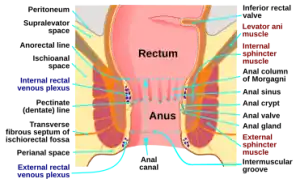
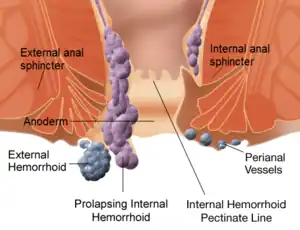
- Pathologic state cccurs when internal or external hemorrhoid plexus become engorged, prolapsed, or thrombosed
- Bleeding is usually limited (surface of stool, on toilet tissue, at end of defecation)
- Passage of blood clots requires evaluation for colon lesions
Risk Factors
- Constipation and straining at stool
- Frequent diarrhea
- Older age
- IBD
<translate>
Clinical Features
- Occur proximal to dentate line
- Constant in their location: 2-, 5-, and 9-o'clock positions (when patient viewed prone)
- Not readily palpable; best visualized through anoscope
- May be palpable when prolapsed or thrombosed
- Painless bleeding
- Only painful when nonreducible, strangulation of prolapsed hemorrhoid, or thrombosis (these can lead to infection/necrosis)
Differential Diagnosis
</translate>
<translate>
Anorectal Disorders
- Anal fissure
- Anal fistula
- Anal malignancy
- Anal tags
- Anorectal abscess
- Coccydynia
- Colorectal malignancy
- Condyloma acuminata
- Constipation
- Crohn's disease
- Cryptitis
- GC/Chlamydia
- Fecal impaction
- Hemorrhoids
- Internal hemorrhoid
- External hemorrhoid
- Levator ani syndrome
- Pedunculated polyp
- Pilonidal cyst
- Proctalgia fugax
- Proctitis
- Pruritus ani
- Enterobius (pinworms)
- Rectal foreign body
- Rectal prolapse
- Syphilitic fissure
Non-GI Look-a-Likes
- Prostatitis
</translate> <translate>
</translate>
Undifferentiated lower gastrointestinal bleeding
- Upper GI Bleeding
- Diverticular disease
- Vascular ectasia / angiodysplasia
- Inflammatory bowel disease
- Infectious colitis
- Mesenteric Ischemia / ischemic colitis
- Meckel's diverticulum
- Colorectal cancer / polyps
- Hemorrhoids
- Aortoenteric fistula
- Nearly 100% mortality if untreated
- Consider in patients with gastrointestinal bleeding and known abdominal aortic aneurysms or aortic grafts
- Rectal foreign body
- Rectal ulcer (HIV, Syphilis, STI)
- Anal fissure
<translate>
Evaluation
</translate>
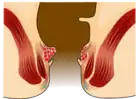
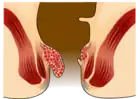
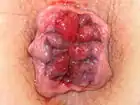
Internal hemorrhoid chart
| Grade | Description | Diagram | Picture |
|---|---|---|---|
| I |
|
 |

|
| II |
|
 |
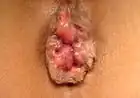
|
| III |
|
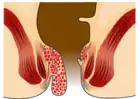 |
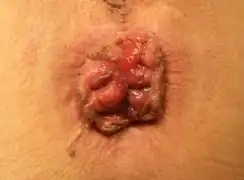
|
| IV |
|
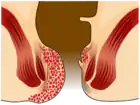 |
|
<translate>
Management
- Conservative treatment
- Indicated for mild to moderate symptomatic patients with grade 1 to grade 3 hemorrhoids
- Stool softeners (psyllium), high-fiber diet, topical analgesics
- Avoid laxatives causing liquid stool (can lead to cryptitis and anal sepsis)
- Sitz bath 15min TID and after each bowel movement (decreases sphincter pressure)
- Outpatient surgical referral
- Prolapsed hemorrhoid in patient with minimal symptoms can be manually reduced
- Emergent surgical consultation and intervention is indicated for:
- Continued and severe bleeding
- Incarceration and/or strangulation (grade 4 hemorrhoids)
- Intractable pain
Prolapse
- When prolapse occurs may develop mucous discharge and pruritus ani
- If prolapse cannot be reduced progressive edema and strangulation may result
- Other complications: severe bleeding, thrombosis, infarction, gangrene, sepsis
Disposition
- Generally may be discharged (unless need for surgical intervention)
See Also
- Anorectal Disorders
- Hemorrhoids
External Links
References
</translate>