Opisthorchis viverrini
<languages/> <translate>
Background
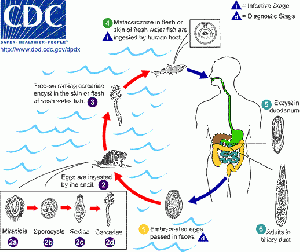
- a.k.a. "southeast asian liver fluke" (endemic)
- Trematode
- Also within genus: opisthorchis felineus (Europe/Asia incl Russia) [1]
Life Cycle
- Eggs pass in feces → freshwater snail ingestion → larval trematode embeds in fish skin/flesh → Fish consumed raw → duodenal cyst and subsequent biliary infection
- Fluke count may effect clinical presentation (lower counts more asymptomatic)
Risk Factors
- Exposure to endemic areas (see above)
- Consumption of raw/undercooked fish
Clinical significance
- May have acute infectious phase
- Source of mild and moderate GI disease
- Chronic infection predisposes to cholangitis, cholcystitis, cholangiocarcinoma (rare)
Clinical Features
- Mild: dyspepsia, diarrhea, abdominal pain, constipation
- Moderate: hepatomegaly, malnutrition
- Felineus species may have an acute phase: alike to schistosomiasis (fever, facial edema, lymphadenopathy, arthralgias, rash, and eosinophilia) and involvement may extend to pancreatic duct in chronic cases
Differential Diagnosis
</translate>
Helminth infections
Cestodes (Tapeworms)
- Taenia saginata
- Taenia solium (Cysticercosis)
- Diphyllobothrium latum
- Hymenolepis nana
- Echinococcus granulosus
Trematodes (Flukes)
- Fasciola hepatica
- Fasciolopsis buski
- Opistorchis viverrini
- Schistosoma spp
- Chlonorchis sinensis
- Paragonimus spp.
Nematodes (Roundworms)
- Ascaris lumbricoides
- Enterobius vermicularis (Pinworm)
- Filarial worms
- Hookworm
- Necator americanus
- Ancylostoma duodenale
- Cutaneous larva migrans (Ancylostoma braziliense)
- Dracunculiasis
- Strongyloides stercoralis
- Trichuris trichiura (Whipworm)
- Anisakis
- Toxocara spp.
- Trichinosis
<translate>
Evaluation
Management
- Praziquantel, 75mg/kg/day orally for 2 days (adults/pediatric) with meal[1]
or
- Albendazole, 10mg/kg/day orally for 7 days (adults/pediatric) with meal [non-FDA alternative][1]
- Identical to treatment for Clonorchis [2]
- In cases of clonorchis in China, Trebindamine 400mg once has less side effects and equal efficacy (not available in U.S.) [3] [4]
See Also
- Helminth infections
References
</translate>