Acquired AV block- 3rd degree block and 2nd degree type II
Chronic Bifascicular or Trifascicular block
After Acute MI-high mortality with persistent AV block post MI
Cardiac Resynchronization Therapy- Conduction delay (>150msec with mortality benefit) in chronic systolic heart failure further decreases EF, increases remodeling and increased MR.
Neurocardiogenic Syncope and Carotid Sinus Syndrome
Lead Location
Atrial
Right Atrial Appendage
Lateral RA wall
Right Ventricle
Apex
Septum
Left Ventricle (most commonly placed for cardiomyopathy or CHF)
Coronary veins along external LV wall via coronary sinus
Rarely, externally placed electrode during open surgical procedure
Additional Pacemaker Functions
Can record rhythm strips of AF, VT, and VF episodes for later review
Keeps track of % of paced vs intrinsic beats
Keeps a rate histogram, as well as % of time spent in AF
Methods to Identify Manufacturer
Patient most often has a pocket card indicating manufacturer
Manufacturer Hotline has patient database
Medtronic Inc. (1-800-328-2518)
St. Jude Medical Inc. (recently acquired by Abbott, Inc.) (1-800-722-3774)
Boston Scientific Inc. (1-800-227-3422)
Magnet mode - with placement of a magnet over the device, the mode changes to asynchronous (i.e. DOO or VOO). Each brand has slightly different rates
Medtronic Inc.: 85 bpm; 65 bpm when battery is ready for replacement
St. Jude Medical Inc.: 98.6 bpm; 86.3 bpm when battery is ready for replacement
Boston Scientific Inc.: 100 bpm; 85 bpm when battery is ready for replacement
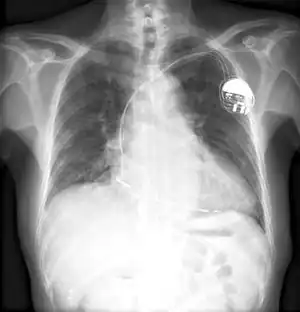
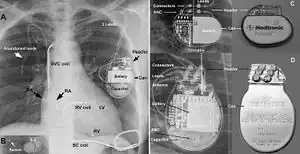
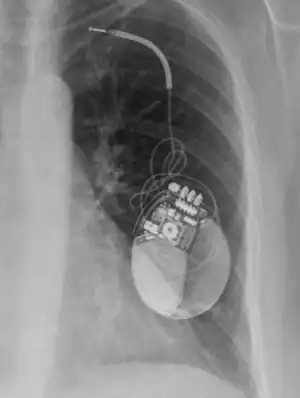
Manufacturer code on pulse generator is visible on Chest Xray
Electromagnetic Interference
Nonmedical
Cell phones: do not interact with device
Airport security: may trigger alarm, no alteration of activity
Medical Sources
MRI: mostly safe, consult cards on device specific recs
Cardioversion: Use AP pads >8cm from device to minimize adverse effects
Unipolar Cautery - can cause sensing and pacing malfunction as well as reprogramming
Differential Diagnosis
Pacemaker Malfunction
Problems with pocket
Infection
Most commonly S. aureus or S. epidermidis
2% local wound infection; 1% sepsis/bacteremia
Hematoma
Typically occurs shortly after placement
Problems with leads
Dislodgment
Perforation (most commonly at RV apex)
Infection can cause severe sepsis
Tricuspid regurgitation
Coiling (ie: Twiddler's Syndrome) Twiddler Syndrome after large pocket and defibrillator wires coiled around the generator
Failure to Capture
Delivery of pacing stimulus without depolarization
Functional - refractory myocardium, desensitized local tissue around the lead
Oversensing - most common cause: can present with symptomatic bradycardia, cause is retrograde P’s, T’s, skeletal muscle myopotentials, can be treated by placing a magnet over the pacemaker to switch to pacer mode
Crosstalk - type of oversensing where the ventricular lead senses atrial pacing stimulus, and ventilator output inhibited
Failure to Sense
Normal function: a sensed myocardial depolarization greater than the programmed threshold causes inhibition of pacing
Failure to sense results in a paced beat on top of an intrinsic beat (as the device is "unaware" of the intrinsic beat")
Voltages of patient's intrinsic QRS complex is too low to be detected
New intrinsic arrhythmia (AF has a smaller depolarization than sinus beat), AMI, electrolyte abnormalities, lead separation, battery depletion
Signals generated by interaction of different portions of the pacing system
Potentially life-threatening as it can cause V-Fib or (paradoxically) bradycardia due to failure to capture
Pacemaker Mediated Tachycardia
Also known as Endless Loop Tachycardia
Formation of a re-entrant circuit causing inappropriate tachycardia
Most commonly: paced ventricular beat -> retrograde AV node conduction -> intrinsic P wave -> device reacts to intrinsic P wave by looking for intrinsic QRS, but since AV node is now refractory it delivers a paced beat at the programmed P-R interval (typically ~200-250ms), starting the process anew
Tachycardia does not exceed programmed upper limit rate on pacemaker
↑Bernstein AD. et al. The revised NASPE/BPEG generic code for antibradycardia, adaptive-rate, and multisite pacing. North American Society of Pacing and Electrophysiology/British Pacing and Electrophysiology Group. Pacing Clin Electrophysiol 2002 Feb; 25(2) 260-4. lmid:11916002
↑EB Medicine- Sept 2014- Managing Pacemaker-Related Complications and Malfunctions in the Emergency Department
↑Barold SS, Falkoff MD, Ong LS, Heinle RA. Pacemaker endless loop tachycardia: termination by simple techniques other than magnet application. Am J Med. 1988;85(6):817-22.