Parsonage-Turner syndrome
Background
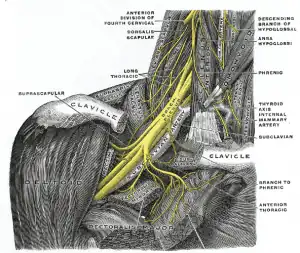
- Syndrome characterized by sudden onset, severe shoulder pain followed by weakness and sensory loss as pain resolves over the course of days to weeks
- Also known by many other names including acute brachial neuritis, acute brachial plexitis, idiopathic brachial plexopathy, neuralgic amyotrophy
- More common in males in the 4th decade of life
- Can affect any part of the brachial plexus
- Most commonly affected nerves: long thoracic nerve, suprascapular nerve, axillary nerve, musculocutaneous nerve, radial nerve
- Up to 1/3 may have bilateral involvement2
- Upper trunk most frequently affected3
- May have preceding viral syndrome
- Two forms
- Idiopathic
- Hereditary
Clinical Features
- Severe shoulder girdle pain
- Weakness, paresthesias, and sensory losses that depend on which nerves are involved
- Muscle atrophy may develop after several weeks of neuropathy
- Loss of reflexes
- Scapular winging
Differential Diagnosis
<translate>
Causes of Brachial plexopathy
- Idiopathic
- Post-infectious
- Viral
- Epstein-Barr, CMV, influenza, parvovirus, coxsackie, HIV, Polio
- Bacterial
- Lyme, Leptospirosis, TB, Salmonella
- Viral
- Post-immunization
- Compressive
- Neoplasm
- Pancoast tumor
- Neoplasm
- Post-traumatic
- Penetrating or blunt neck/shoulder trauma
- Traction injury
- Birth trauma
- Erb's palsy
- Klumpke's paralysis
- Connective tissue disorders
- Autoimmune disorders
- Lupus
- Polyarteritis nodosa
- Temporal arteritis
- Iatrogenic
- Post-surgical
- Medication induced
- Radiation
- Hereditary Neuralgic Amyotrophy
- Rotator Cuff Injury
- Adhesive capsulitis
- Calcific tendinitis
- Thoracic outlet syndrome
- ALS
- Poliomyelitis
- Parsonage-Turner syndrome
</translate>
Upper extremity peripheral nerve syndromes
Median Nerve Syndromes
Ulnar Nerve Syndromes
Radial Nerve Syndromes
- Radial neuropathy at the spiral groove (ie. "Saturday night palsy")
- Posterior interosseous neuropathy
Proximal Neuropathies
- Suprascapular neuropathy
- Long thoracic neuropathy
- Axillary neuropathy
- Spinal accessory neuropathy
- Musculocutaneous neuropathy
Other
Evaluation
- Plain films if there is history of trauma
- Consider MRI in the ED to rule out acute cervical spine pathology
- Outpatient brachial plexus MRI or magnetic resonance neurography
- Outpatient EMG - should be performed at least 3 weeks after symptom onset to show findings4
Management
- Early conservative management
- Operative management considered for space occupying lesions or if no recovery is seen in 6-9 months
- Nerve decompression, neurolysis, neurorrhaphy, nerve transplant/grafting, muscle/tendon transplant/grafting
Disposition
- Depends on etiology - acute traumatic injuries may need urgent or emergent surgery
- Most idiopathic cases can be discharged with neurology/orthopedics follow up
- Full recovery can take up to 2-3 years
See Also
External Links
References
- Feinberg et al. Parsonage-Turner Syndrome. HSSJ. 2010;6:199-205.
- Misamore et al. Parsonage-Turner Syndrome (Acute Brachial Neuritis). Journal of Bone and Joint Surgery. 1996;78(9)1405-1408.
- Moghekar et al. Brachial Plexopathies: Etiology, Frequency, and Electrodiagnostic 4. Localization. Journal of Clinical Neuromuscular Disease. 2007;9(1):243-247.
- Ortiz Torres M et al. Brachial Plexitis (Parsonage Turner Syndrome, Brachial Neuropathy, Brachial Radiculitis) [Updated 2020 Apr 23]. In: StatPearls [Internet]. Treasure Island (FL): StatPearls Publishing; 2020 Jan-. Available from:https://www.ncbi.nlm.nih.gov/books/NBK448114/