Radial neuropathy at the spiral groove
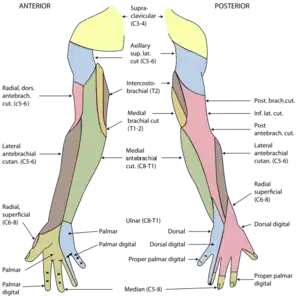
Background Nerves of the left upper extremity. Radial nerve predisposed to compression in area where runs next to humerus (i.e. spiral groove)
Often occurs after prolonged pressure
Frequently from inebriated individuals sleeping with arm resting on hard surface (i.e. "Saturday night palsy") Clinical Features Cutaneous innervation of the upper limb Weakness of wrist extensors ("wrist drop"), finger extensors, and brachioradialisTriceps retains full strength
Possible sensory loss over the dorsum of the hand, sometimes extending up the posterior forearm
Thumb abduction is affected (abductor pollicis longus is a radial-innervated muscle) Differential Diagnosis Median Nerve Syndromes Ulnar Nerve Syndromes Radial Nerve Syndromes Proximal Neuropathies Other Evaluation Workup Diagnosis (Vs. CVA ) Relative preservation of triceps strength
Sensory loss isolated to the dorsum of the hand
Brachioradialis should also be weak Management Wrist splint with 60 degrees of dorsiflexion to avoid contractures[ 1]
Usually spontaneously resolves, but may take 2-4 months, during which splint should be worn Disposition Discharge with neurology follow up See Also External Links References
↑ Bunney EB, Gallagher EJ: Peripheral Nerve Disorders; in Marx JA, Hockberger RS, Walls RM, et al (eds): Rosen’s Emergency Medicine: Concepts and Clinical Practice, ed 8. St. Louis, Mosby, Inc., 2014, (Ch) 107: p 1428-1441.