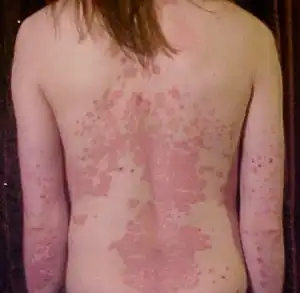
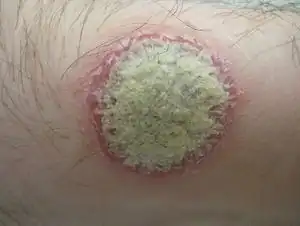
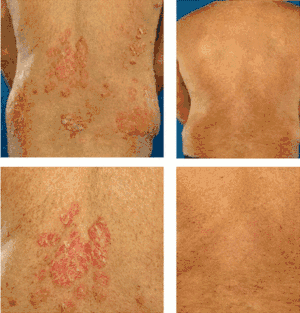
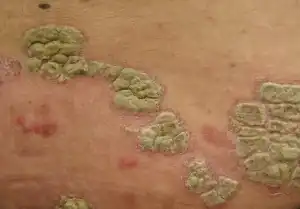
Plaque: also known as psoriasis vulgaris, makes up about 90% of cases. It typically presents as red patches with white scales on top. Areas of the body most commonly affected are the back of the forearms, shins, navel area, and scalp.
Guttate: drop-shaped lesions.
Inverse: red patches in skin folds
Pustular: presents as small non-infectious pus-filled blisters
Erythrodermic: occurs when the rash becomes very widespread, and can develop from any of the other types. Fingernails and toenails are affected in most people with psoriasis at some point in time. This may include pits in the nails or changes in nail color.
Triggers
Stress
Trauma
Drugs: NSAIDs, B-blockers
Clinical Features
Back and arms of a person with psoriasis.Psoriatic plaque, showing a silvery center surrounded by a reddened border.Psoriasis before and after treatment.Plaques of psoriasis
Well-demarcated erythematous plaques and papules with silvery white scales
Epidermal hyperproliferation
Commonly found on the trunk, scalp, nail pitting, and extensor surfaces
Auspitz sign: plaque removal reveals pinpoint-bleeding areas