Tubo-ovarian abscess
Background Typically a complication of PID , although inflammatory bowel, appendicitis , and hematologic nidius have been reported
Mortality if not ruptured: <1% if treated; 2-4% if untreated
Infections are often polymicrobial
Risk factors Multiple sex partners
Age 15-25 years old
Prior history of PID
IUD (within 21 days of insertion[ 1] HIV infectionClinical Features +/-Fever
Vaginal discharge Dyspareunia
Disproportionate unilateral adnexal tenderness or adnexal mass or fullness
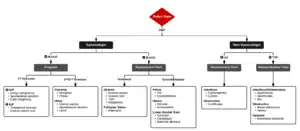
Suspect in patient who does not respond after 72hr of treatment for PID Differential Diagnosis Differential diagnosis of acute pelvic pain Gynecologic/Obstetric Normal variants may be noted on exam but generally do not cause pain or other symptoms
Nabothian cysts: Epithelial cells within mucous glans that appear as yellow inclusions on the cervix
Cervical Ectropion: Edothelial cells on the exterior of the cervix
Parous cervix: The is no longer round but may have multiple shapes after birth
Pregnancy-related
Pelvic organ prolapse
Acute Infections
Vulvovaginitis
Adnexal Disorders
Other
Recurrent
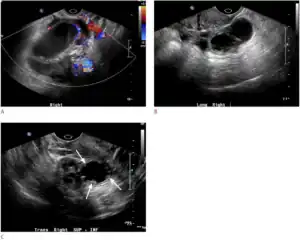
Genitourinary Gastrointestinal Musculoskeletal Vascular Evaluation Dilated, complex, fluid-filled tubular structure is consistent with hydro/pyosalpinx (A, B). Short-axis image (C) demonstrates the “cog-wheel” pattern of the endosalpingeal folds, indicative of tubal inflammation in pelvic inflammatory disease with a pyosalpinx or a hydrosalpinx. (arrows). CBC
ESR/CRP
Transvaginal pelvic ultrasound (Sn 75-82%)
CT pelvis (Sn 78-100%) - preferred in patients in whom associated GI pathology must be excluded Management Operative Drainage OB/GYN consult for possible operative drainage
Majority (60-80%) resolve with antibiotics alone
Predictors of antibiotic treatment failure and possible indications for IR drainage upon admission to Ob[ 3] WBC > 16,000
TOA size > 5.2 cm Antibiotics No sexual activity for 2 weeks;
Treat all partners who had sex with patient during previous 60 days prior to symptom onset Outpatient Antibiotic Options Inpatient Antibiotic Options Disposition Decision should be made in conjunction with gynecological colleague
Patient with fevers, elevated WBC, abscess greater than 5 cm, or systemic toxicity demand admission
Hemodynamically stable, afebrile patients with a relatively small abscess can be safely discharged with close gynecological follow up on antibiotics See Also References
↑ https://www.cdc.gov/std/tg2015/pid.htm ↑ Norris DL, Young JD. UTI. EM Clin N Am. 2008; 26:413-30.
↑ Huma F et al. Inpatient Management of Tubo-Ovarian Abscesses: What Is the Threshold of Parenteral Antibiotic Treatment Failure? Obstetrics & Gynecology: May 2015
↑ Hayes BD. Trick of the Trade: IV ceftriaxone for gonorrhea. October 9th, 2012 ALiEM. https://www.aliem.com/2012/10/trick-of-trade-iv-ceftriaxone-for/ . Accessed October 23, 2018.
↑ Update to CDC's Treatment Guidelines for Gonococcal Infection, 2020 https://www.cdc.gov/mmwr/volumes/69/wr/mm6950a6.htm
↑ Ness RB et al. Effectiveness of inpatient and outpatient treatment strategies for women with pelvic inflammatory disease: results from the Pelvic Inflammatory Disease Evaluation and Clinical Health (PEACH) Randomized Trial. Am J Obstet Gynecol 2002;186:929-37
↑ Workowski KA, Bachmann LH, Chan PA, et al. Sexually Transmitted Infections Treatment Guidelines, 2021. MMWR Recomm Rep 2021;70(No. RR-4):1-187. DOI: http://dx.doi.org/10.15585/mmwr.rr7004a1external icon
↑ CDC PID Treatment http://www.cdc.gov/std/treatment/2010/pid.htm
↑ Workowski KA, Bachmann LH, Chan PA, et al. Sexually Transmitted Infections Treatment Guidelines, 2021. MMWR Recomm Rep 2021;70(No. RR-4):1-187. DOI: http://dx.doi.org/10.15585/mmwr.rr7004a1external icon