Therapeutic hypothermia
Background Determination of Neurologic Prognosis is unreliable before at least 72 hours after ROSC
Do not neuroprognosticate until 72 hours post rewarming.
Greatest benefit in out-of-hospital V-fib, though may help in other dysrhythmias[ 1]
Two most likely mechanisms of action:
Reduces cerebral metabolism by 6-8% per degree C
Reduces oxygen free radical production and lipid peroxidation
Cooling to 32-34ºC in initial studies, current studies suggest 36ºC equally beneficial[ 2]
Treatment should be initiated immediately after ROSC
Patient may be cooled concurrently with cardiac catheterization
Cooling should occur prior to CT scan if there is need for intracranial pathology workup
AHA recommends 12-24 hrs of cooling
NNT of ~6
Pediatrics[ 3] [ 4] Two large RTCs for TH, one in out-of-hospital and another in in-hospital arrests
Therapeutic hypothermia does not appear to provide a survival or improved neurological benefit[ 5] In both studies, no difference in survival, function at 12 months post-arrest, blood product use, infection rates Indications Contraindications/Exclusions >12hrs since ROSC
Glasgow Motor score >5
Minimal pre-morbid cognitive status
Unable to maintain SBP > 90 mmHg , with or without pressors, after CPR
Other reason for coma
Sepsis as etiology for arrestDNR/DNI status, terminal illness
Uncontrollable bleeding or known bleeding diathesis with active bleeding
Significant trauma (especially intra-abdominal)
Pregnancy Therapeutic hypothermia may be safe for postpartum cardiac arrest[ 6] Cooling Cool to 32-34ºC as soon as possible (within 4 hours)
Strict maintenance of temperature at 36ºC may have similar benefits
Initiate rewarming 24 hrs after target temperature was reached
Cooling methods
Maintain at 32-34ºC with 2 cooling blankets to sandwich the pt, with sheets covering the blankets to protect skin
Alternatively, use heat exchange device (Icy Cath) or 4°C IVF at 30 cc/kg over 30 min
Cooling pads on the thighs and abdomen (Arctic Sun)
Supplement with ice packs to groin, chest, axillae, neck until 34ºC reached
Prevention of shivering and paralysis
Use benzodiazepines
Paralytics only if needed, and ensure patient fully sedated Maintenance Fentanyl bolus 50 mcg IV every hour as needed for painFentanyl IV infusion NSS
Propofol IV infusionLorazepam IV infusionLorazepam bolus 1mg IV every 2 hours as needed for agitation Shivering Prevention of shivering is important to avoid warming and needless oxygen consumption
May require train of four monitor with goal of 1-2/4 twitches with neuromuscular blockade
Lower doses of NMB work against shivering
Higher doses of NMB used to paralyze the diaphragm in these scenarios:
Need to decrease O2 consumption
Decrease plateau pressures
Hypoxemia is present
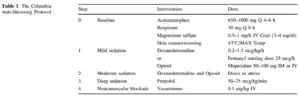
Consider meperidine q2hrs[ 7] [ 8] 50mg for normal renal function
25mg if CrCl < 30ml/min
Pancuronium IV infusion
Initiate before initiating cooling. Dosing recommendations: 0.1mg/kg loading dose followed by a continuous infusion of 0.33-2 mcg/kg/minute
Do not use in patients with renal and/or hepatic insufficiency Cisatracurium for renal/hepatic impairment
0.2mg/kg IV bolus
Followed by infusion at 1 mcg/kg/min, max of 3 mcg/kg/min
Columbia University anti-shivering protocol Rewarming If severe dysrhythmia/BP instability/bleeding develops, rewarm
Discontinue K infusions (extracellular K increases)
Keep paralytic and sedative until rewarmed
Slow rewarm at 0.5°C to target of 36°C General Management Other Concerns Head of bed at 30 degrees
Goal MAP 80 - 100 mmhg
Check skin q2-6 hrs for cold injury
Maintain normoglycemia
Do not treat hyperglycemia aggressively, as enzymatic functions are decreased at low temperatures, and rebound hypoglycaemia possible with rewarming
Replete K, Mg, Phos, Ca (hypothermia induced diuresis is expected)
Common unconcerning ECG findings during cooling - Osborne wave, HR < 40 bpm
Consider continuous EEG within 6 hrs, no later than 12 hrs after onset of cooling
Stress dose steroids for adrenal insufficiency
?Seizure prophylaxis Labs ABG q6 hrs for duration of hypothermia
CBC, Coags, BMP, Mg, Phos q6 hrs for duration of hypothermia
Expect decreased K, Ca, Mg, Phos during, and rebound at rewarming
Hyperglycemia as metabolism slows at low temperature and body develops insulin resistance
Troponins , CK-MB q6 hrs x2 daysLipase, LFTs (if abnormal, no need to intervene unless persistent after rewarming)
Other - Cortisol, UA, Pan-cultures, tox screen ABG InterpretationRewarm ABG to 37C for analysis (controversial)
A warmed ABG from a hypothermic patient will show a higher PaO2, higher PaCO2, and a lower pH than that actually present in the patient’s blood in vivo
PaO2 is decreased by 5 mmHg for each degree below 37C
PaCO2 is decreased by 2 mmHg for each degree below 37C
Change in pH = 0.015 pH units per degree C change in temperature
If measured pH is 7.360 at 37C, then the pH at 34C is calculated as follows:
pH = [7.360 + (37-34)(0.015)] = 7.405 Monitoring ECG q8 rule out ACSArterial line
Foley with temperature probe
CVP, ScvO2 Imaging Consider head CT
Consider CTPE study Other Considerations GI prophylaxis
Modify prophylactic heparin or LMWH dosing as there is hypothermic coagulopathy[ 9] No clear best way for monitoring of anticoagulation until further studies
Consider modified dosing:
Heparin 40 units IV bolus
Followed by 7 u/kg/hr during TH with scheduled repeated coags, plus or minus heparin levels Disposition External Links See Also Hypothermia Cardiac Arrest Links References
↑ Nolan, et al. Therapeutic Hypothermia After Cardiac Arrest. Circulation. 2003; 108: 118-121.
↑ Nielsen N, et al. Targeted Temperature Management at 33°C versus 36°C after Cardiac Arrest. N Engl J Med. 2013; 369:2197-2206. DOI: 10.1056/NEJMoa1310519
↑ Moler FW et al. Therapeutic Hypothermia after In-Hospital Cardiac Arrest in Children. N Engl J Med 2017; 376:318-329January 26, 2017.
↑ Moler FW et al. Therapeutic Hypothermia after Out-of-Hospital Cardiac Arrest in Children. N Engl J Med 2015; 372:1898-1908May 14, 2015.
↑ Mosler FW, et al. Therapeutic hypothermia after out-of-hospital cardiac arrest in children. N Eng J Med. 2015; 372:1898-1908.
↑ Song et al. Safely completed therapeutic hypothermia in postpartum cardiac arrest survivors. Am Jour Emer Med. June 2015. Volume 33, Issue 6, Pages 861.e5–861.e6.
↑ Choi HA, Ko SB, Presciutti M, et al. Prevention of Shivering During Therapeutic Temperature Modulation: The Columbia Anti-Shivering Protocol. Neurocrit Care. 2011; 14(3):389-394.
↑ Fox Chase Cancer Center. Therapeutic Hypothermia Protocol. University of Pennsylvania. https://www.med.upenn.edu/resuscitation/docs/protocols/FoxChaseCancerCenterTherapeuticHypothermiaOrderSetafterCardiacArrest-latestrevision8-4-11.doc
↑ Wahby KA et al. Heparin dosing in critically ill patients undergoing therapeutic hypothermia following cardiac arrest. Resuscitation. 2014 Apr;85(4):533-7.