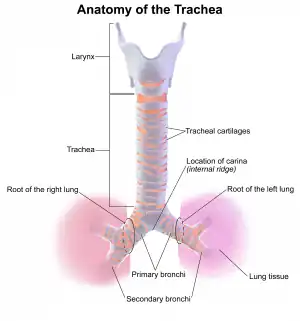
Cross section of a trachea and esophagus anatomy.Tracheal anatomy.
Congenital narrowing of the larygeal cartilage that causes upper airway obstruction and problems with swallowing.
A frequent complication of surgical repair of esophageal atresia (EA) and TEF
Most common cause of stridor in infancy
Typically infant to <2 years
Affects the epiglottis and/or arytenoid cartilages
When the epiglottis is usually folds in on itself because it is abnormally elongated, and the arytenoid cartilages are abnormally large. Because the misshapen epiglottis does not function properly, it can prolapse during inspiration, causing a high pitched "stridor".
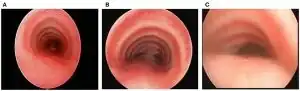
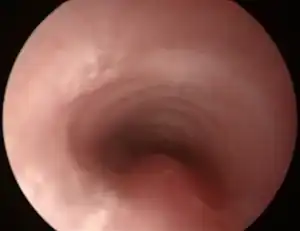
(A) Tracheal structure with normal C-shape rings. (B) U-shaped rings with a wider posterior membrane, demonstrating posterior intrusion. (C) Bow-shaped rings with a broad posterior membrane and severe posterior intrusion.Bronchoscopy in a neonate showing narrowing of tracheomalacia.